QUESTION IMAGE
Question
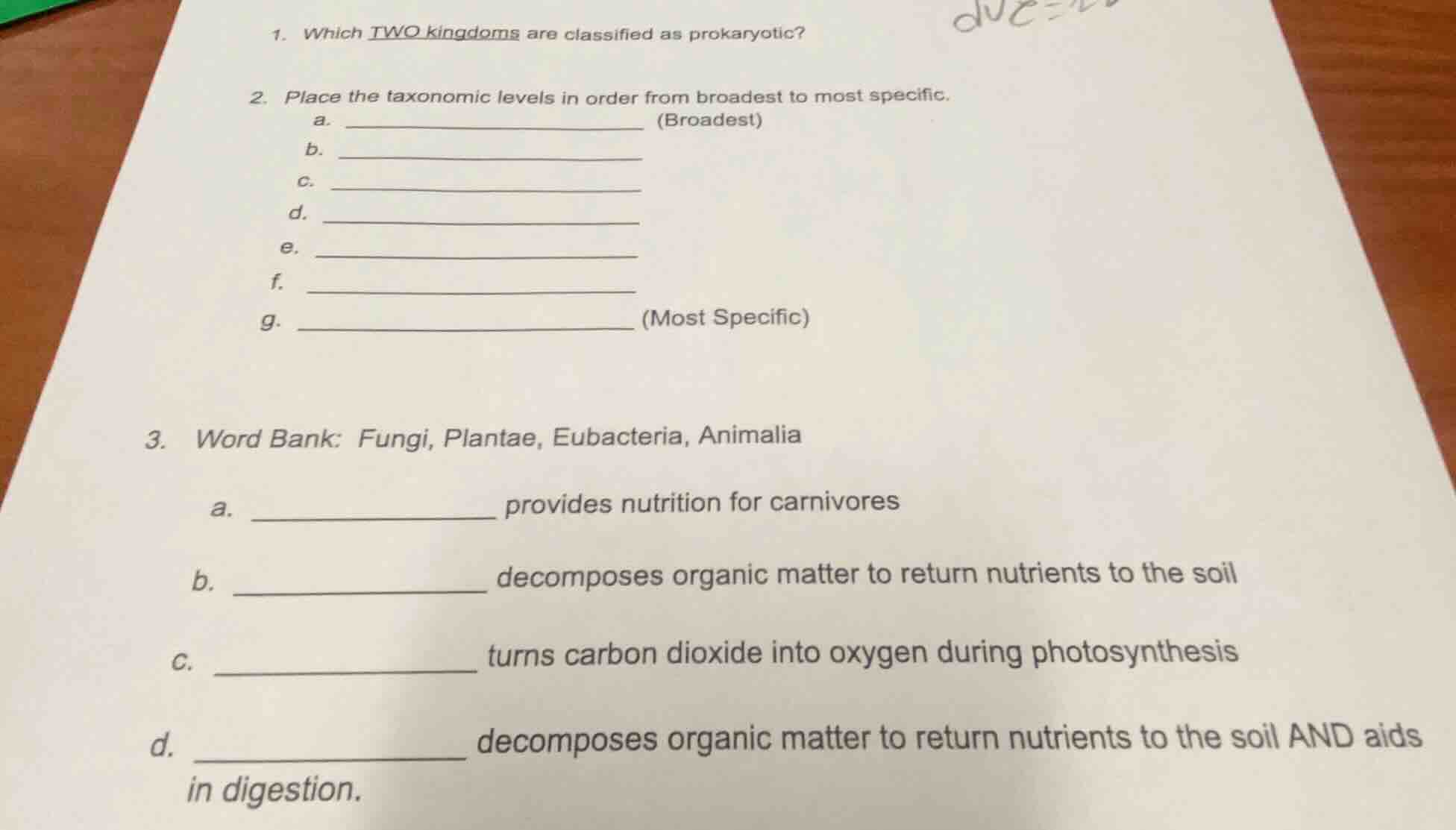
- which two kingdoms are classified as prokaryotic?
- place the taxonomic levels in order from broadest to most specific.
a. ____________________ (broadest)
b. ____________________
c. ____________________
d. ____________________
e. ____________________
f. ____________________
g. ____________________ (most specific)
- word bank: fungi, plantae, eubacteria, animalia
a. _______________ provides nutrition for carnivores
b. _______________ decomposes organic matter to return nutrients to the soil
c. _______________ turns carbon dioxide into oxygen during photosynthesis
d. _______________ decomposes organic matter to return nutrients to the soil and aids in digestion.
Question 1
Prokaryotic organisms lack a nucleus. The two prokaryotic kingdoms are Eubacteria (also called Bacteria) and Archaebacteria (though sometimes Archaea is considered a separate domain, but in some classification systems, Eubacteria and Archaebacteria are prokaryotic kingdoms; however, from the word bank later, Eubacteria is an option, and the other is usually Archaebacteria, but since the word bank here has Eubacteria, and the other prokaryotic kingdom is often Eubacteria and maybe another, but in standard classification, the two prokaryotic kingdoms (in the five - kingdom system) are Monera (divided into Eubacteria and Archaebacteria), but if we consider the options, Eubacteria is one, and the other is usually Archaebacteria, but since the word bank for question 3 has Eubacteria, maybe the answer is Eubacteria and Archaebacteria, but if we go by common questions, the two prokaryotic kingdoms are Eubacteria (Bacteria) and Archaebacteria (Archaea).
The taxonomic levels from broadest to most specific are Domain, Kingdom, Phylum, Class, Order, Family, Genus, Species. But if we are using the seven - level system (excluding Domain in some older systems), it's Kingdom, Phylum, Class, Order, Family, Genus, Species. Since the question has 7 blanks (a to g), we'll use the seven - level system starting from Kingdom (or Domain, but usually for this level of question, it's Kingdom as the broadest among the seven levels here). So the order is: a. Kingdom (Broadest), b. Phylum, c. Class, d. Order, e. Family, f. Genus, g. Species (Most Specific).
Carnivores eat other animals. Animals belong to the kingdom Animalia. So Animalia provides nutrition for carnivores as carnivores eat animals from the Animalia kingdom.

Snap & solve any problem in the app
Get step-by-step solutions on Sovi AI
Photo-based solutions with guided steps
Explore more problems and detailed explanations
The two prokaryotic kingdoms are Eubacteria and Archaebacteria (or in some systems, Eubacteria and the other prokaryotic group).