QUESTION IMAGE
Question
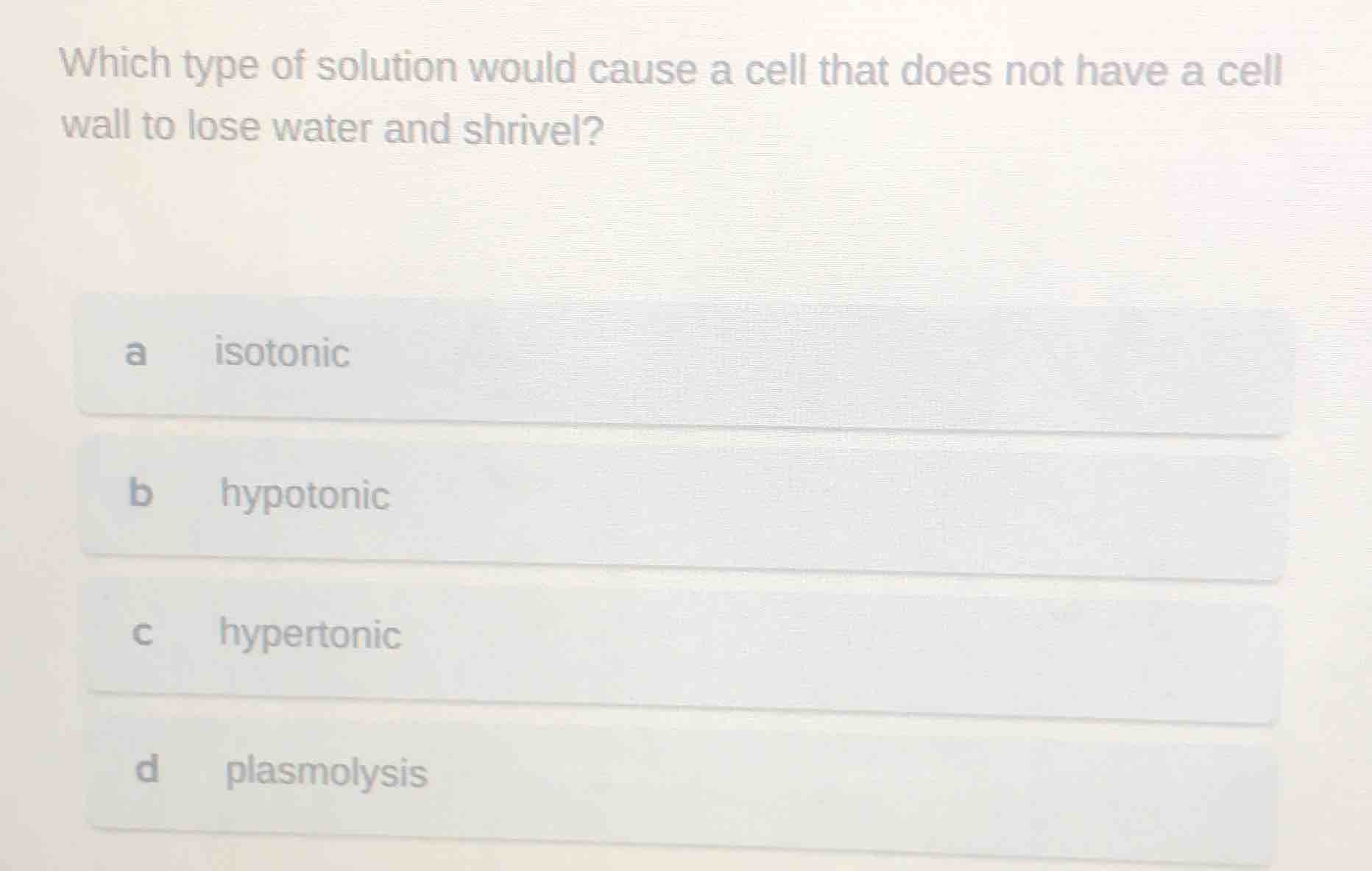
which type of solution would cause a cell that does not have a cell wall to lose water and shrivel?
a isotonic
b hypotonic
c hypertonic
d plasmolysis
Brief Explanations
To determine the solution type causing a cell without a cell wall (e.g., animal cell) to lose water and shrivel, we analyze each option:
- Option a (isotonic): In an isotonic solution, the solute concentration is equal inside and outside the cell, so there is no net water movement. Thus, the cell does not lose water or shrivel.
- Option b (hypotonic): A hypotonic solution has a lower solute concentration outside the cell than inside. This causes water to move into the cell, leading to cell swelling (and potential bursting in animal cells), not shriveling.
- Option c (hypertonic): A hypertonic solution has a higher solute concentration outside the cell than inside. Due to osmosis, water moves out of the cell to balance the solute concentration, causing the cell to lose water and shrivel (crenation in animal cells).
- Option d (plasmolysis): Plasmolysis is the process where a plant cell (with a cell wall) loses water in a hypertonic solution, causing the protoplast to shrink from the cell wall. It is not a solution type and does not apply to cells without a cell wall.

Snap & solve any problem in the app
Get step-by-step solutions on Sovi AI
Photo-based solutions with guided steps
Explore more problems and detailed explanations
c. hypertonic