QUESTION IMAGE
Question
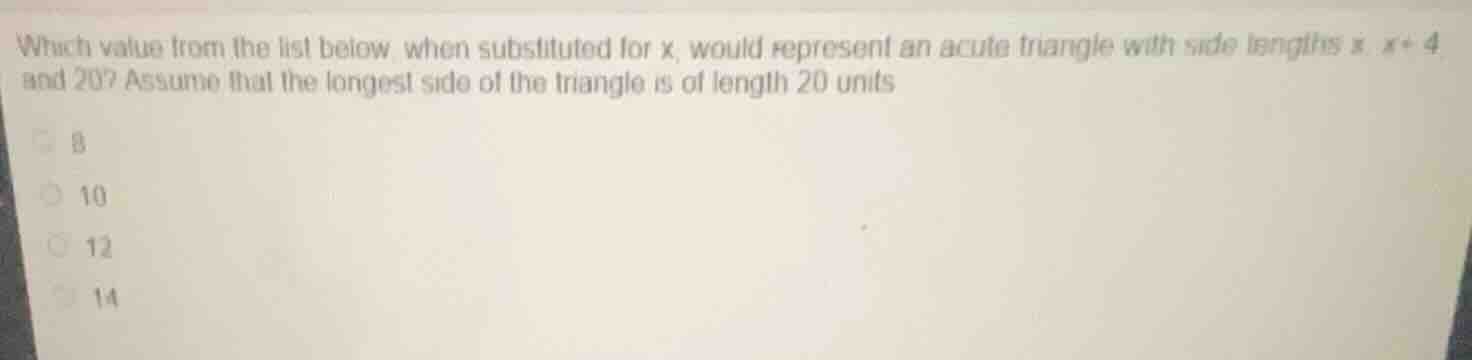
which value from the list below when substituted for x, would represent an acute triangle with side lengths x, x + 4, and 20? assume that the longest side of the triangle is of length 20 units
8
10
12
14
Step1: Recall triangle inequality and acute triangle condition
For a triangle with sides \(a\), \(b\), \(c\) (where \(c\) is the longest side), the triangle inequality is \(a + b>c\), and for an acute triangle, \(a^{2}+b^{2}>c^{2}\). Here, \(c = 20\), \(a=x\), \(b=x + 4\). First, apply the triangle inequality: \(x+(x + 4)>20\), which simplifies to \(2x+4>20\), then \(2x>16\), so \(x > 8\).
Step2: Apply the acute triangle condition
We have \(x^{2}+(x + 4)^{2}>20^{2}\). Expand the left - hand side: \(x^{2}+x^{2}+8x + 16>400\). Combine like terms: \(2x^{2}+8x+16 - 400>0\), so \(2x^{2}+8x - 384>0\). Divide both sides by 2: \(x^{2}+4x - 192>0\). Factor the quadratic: \(x^{2}+4x - 192=(x + 16)(x - 12)>0\). The solutions of the inequality \((x + 16)(x - 12)>0\) are \(x>12\) or \(x < - 16\) (we discard \(x < - 16\) since side length can't be negative). Also, from the triangle inequality, we know \(x>8\).
Step3: Check the given options
The options are 8, 10, 12, 14.
- For \(x = 8\): \(x+(x + 4)=8 + 12 = 20\), which does not satisfy the triangle inequality (\(a + b>c\), here \(a + b=c\), so it's a degenerate triangle, not a valid triangle).
- For \(x = 10\): Check the acute condition: \(10^{2}+14^{2}=100 + 196 = 296\), and \(20^{2}=400\). Since \(296<400\), it's an obtuse triangle.
- For \(x = 12\): \(12^{2}+16^{2}=144+256 = 400\), and \(20^{2}=400\), so it's a right triangle, not acute.
- For \(x = 14\): \(14^{2}+18^{2}=196 + 324 = 520\), and \(20^{2}=400\). Since \(520>400\), and \(14+(14 + 4)=14 + 18=32>20\) (satisfies triangle inequality), it is an acute triangle.

Snap & solve any problem in the app
Get step-by-step solutions on Sovi AI
Photo-based solutions with guided steps
Explore more problems and detailed explanations
14