QUESTION IMAGE
Question
which we eat
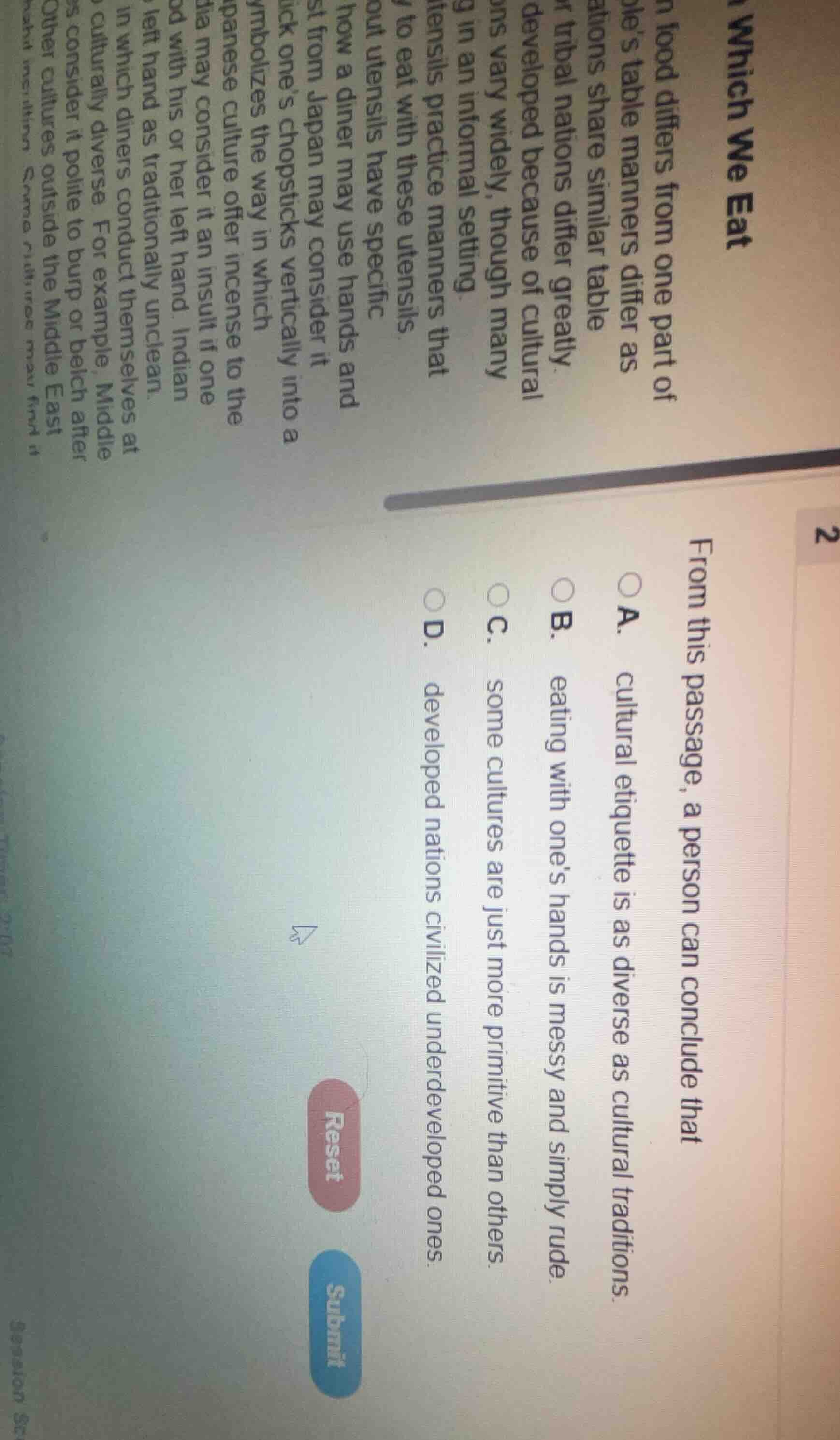
n food differs from one part of
e’s table manners differ as
ations share similar table
r tribal nations differ greatly.
developed because of cultural
s vary widely, though many
g in an informal setting.
tensils practice manners that
y to eat with these utensils.
out utensils have specific
how a diner may use hands and
st from japan may consider it
ick one’s chopsticks vertically into a
symbolizes the way in which
japanese culture offer incense to the
dia may consider it an insult if one
d with his or her left hand. indian
left hand as traditionally unclean.
in which diners conduct themselves atoculturally diverse. for example, middlees consider it polite to burp or belch after
other cultures outside the middle east
nashi institution. some cultures may find it
from this passage, a person can conclude that
a. cultural etiquette is as diverse as cultural traditions.
b. eating with one’s hands is messy and simply rude.
c. some cultures are just more primitive than others.
d. developed nations civilized underdeveloped ones.
reset
submit
The passage discusses how table manners (a part of cultural etiquette) differ across various cultures (like tribal nations, Japanese, Indian, Middle Eastern, etc.) due to cultural variations. Option A states that cultural etiquette is as diverse as cultural traditions, which aligns with the passage's focus on diverse cultural practices in eating. Option B is incorrect as the passage doesn't portray eating with hands as messy/rude (e.g., Indian culture's hand - eating is a tradition, not labeled as such). Option C is wrong because the passage emphasizes cultural diversity, not cultural superiority/inferiority (no claim of some cultures being more primitive). Option D is incorrect as the passage is about cultural differences in eating, not about developed/underdeveloped nations.

Snap & solve any problem in the app
Get step-by-step solutions on Sovi AI
Photo-based solutions with guided steps
Explore more problems and detailed explanations
A. cultural etiquette is as diverse as cultural traditions.