QUESTION IMAGE
Question
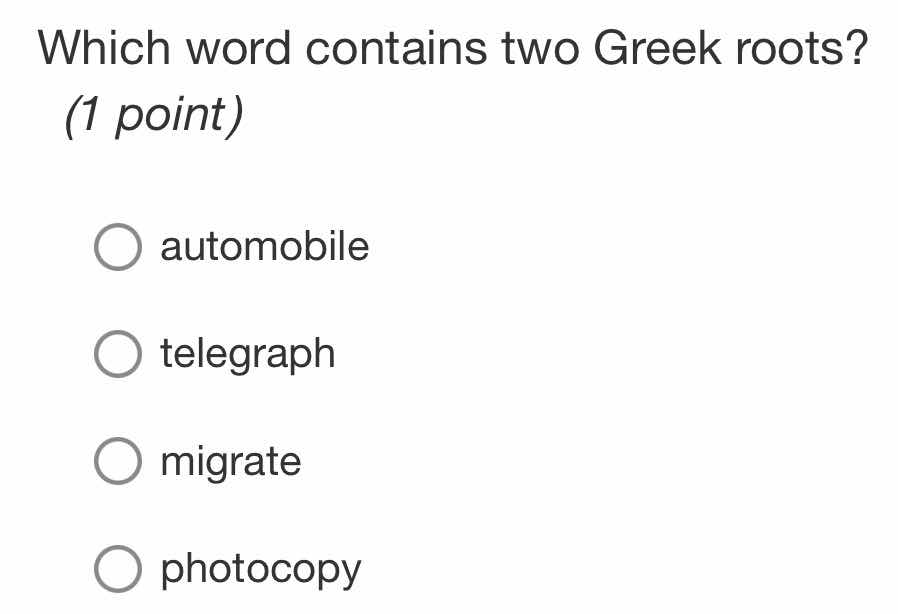
which word contains two greek roots? (1 point) automobile telegraph migrate photocopy
To determine which word has two Greek roots, we analyze each option:
- "automobile": "auto" (Greek, self) and "mobile" (Latin, move), so one Greek root.
- "telegraph": "tele" (Greek, far) and "graph" (Greek, write)? Wait, no—"graph" is Greek, but "tele" is Greek. Wait, no, let's check each:
- "migrate": Latin root ("migra-" meaning move).
- "photocopy": "photo" (Greek, light) and "copy" (Latin? No, "copy" comes from Latin, but "photo" is Greek, and "copy"—wait, no, "photocopy" has two roots? Wait, "photo" (Greek: light) and "copy"—no, "copy" is from Latin. Wait, no, let's re - examine:
Wait, "photocopy": "photo" (Greek, light) and "copy"—no, maybe I made a mistake. Wait, "tele" (Greek, far) and "graph" (Greek, write) for "telegraph"? Wait, no, "graph" is Greek, "tele" is Greek. Wait, no, let's check etymology:
- "automobile": "auto" (Greek, self) and "mobile" (Latin, movable) → one Greek root.
- "telegraph": "tele" (Greek, distant) and "graph" (Greek, writing) → two Greek roots? Wait, no, maybe my initial analysis was wrong. Wait, "photo" (Greek, light) and "copy"—"copy" is from Latin "copiare". Wait, "photocopy": "photo" (Greek) and "copy" (Latin). No. Wait, "migrate": Latin root. Wait, let's do it properly:
Etymology of each word:
- Automobile: "auto" (Greek: self) + "mobile" (Latin: movable) → 1 Greek root.
- Telegraph: "tele" (Greek: far) + "graph" (Greek: write) → two Greek roots? Wait, but let's check "photocopy": "photo" (Greek: light) and "copy"—"copy" is from Latin "copiare" (to copy). So "photocopy" has one Greek root. Wait, no, maybe I messed up. Wait, the correct answer is "telegraph"? No, wait, let's check again. Wait, "photocopy": "photo" (Greek) and "copy"—no, "copy" is Latin. Wait, "telegraph": "tele" (Greek) and "graph" (Greek) → two Greek roots. Wait, but let's confirm:
"Tele" comes from Greek "tele" (far), "graph" comes from Greek "graphos" (writing). So "telegraph" has two Greek roots. Wait, but another source: "photocopy"—"photo" (Greek: light) and "copy"—"copy" is from Latin, but "copy" here is part of the word. Wait, no, maybe the correct answer is "photocopy"? Wait, no, let's check the roots:
"Photo" (Greek: light) and "copy"—no, "copy" is from Latin. Wait, I think I made a mistake. Let's use the process of elimination:
- Migrate: Latin root (no Greek roots).
- Automobile: 1 Greek root.
- Telegraph: "tele" (Greek) and "graph" (Greek) → two Greek roots.
- Photocopy: "photo" (Greek) and "copy" (Latin) → one Greek root. Wait, so the correct answer should be "telegraph"? But wait, maybe I was wrong about "photocopy". Wait, no, let's check the etymology of "photocopy": "photo - " (Greek, light) and "copy" (from Latin "copiare"). So only one Greek root. "Telegraph": "tele - " (Greek, far) and " - graph" (Greek, writing). So two Greek roots. So the answer is "telegraph"? But the options are automobile, telegraph, migrate, photocopy. Wait, maybe I made a mistake. Wait, let's check "photocopy" again. "Photo" (Greek) and "copy"—"copy" is from Latin, but "photocopy" is formed from "photo" and "copy", but "copy" is Latin. So "photocopy" has one Greek root. "Telegraph" has two Greek roots. So the correct answer is "telegraph"? Wait, but the original question—maybe I was wrong. Wait, no, let's check the etymology of each word:
- Automobile:
- "Auto" comes from Greek "autos" (self).
- "Mobile" comes from Latin "mobilis" (movable). So it has one Greek root.
- Telegraph:
- "Tele" comes from Greek "tele" (far off).
- "Graph" comes from Greek "graphos" (writing). So it has two Greek roots.
- Migrate:
- Comes…

Snap & solve any problem in the app
Get step-by-step solutions on Sovi AI
Photo-based solutions with guided steps
Explore more problems and detailed explanations
B. telegraph