QUESTION IMAGE
Question
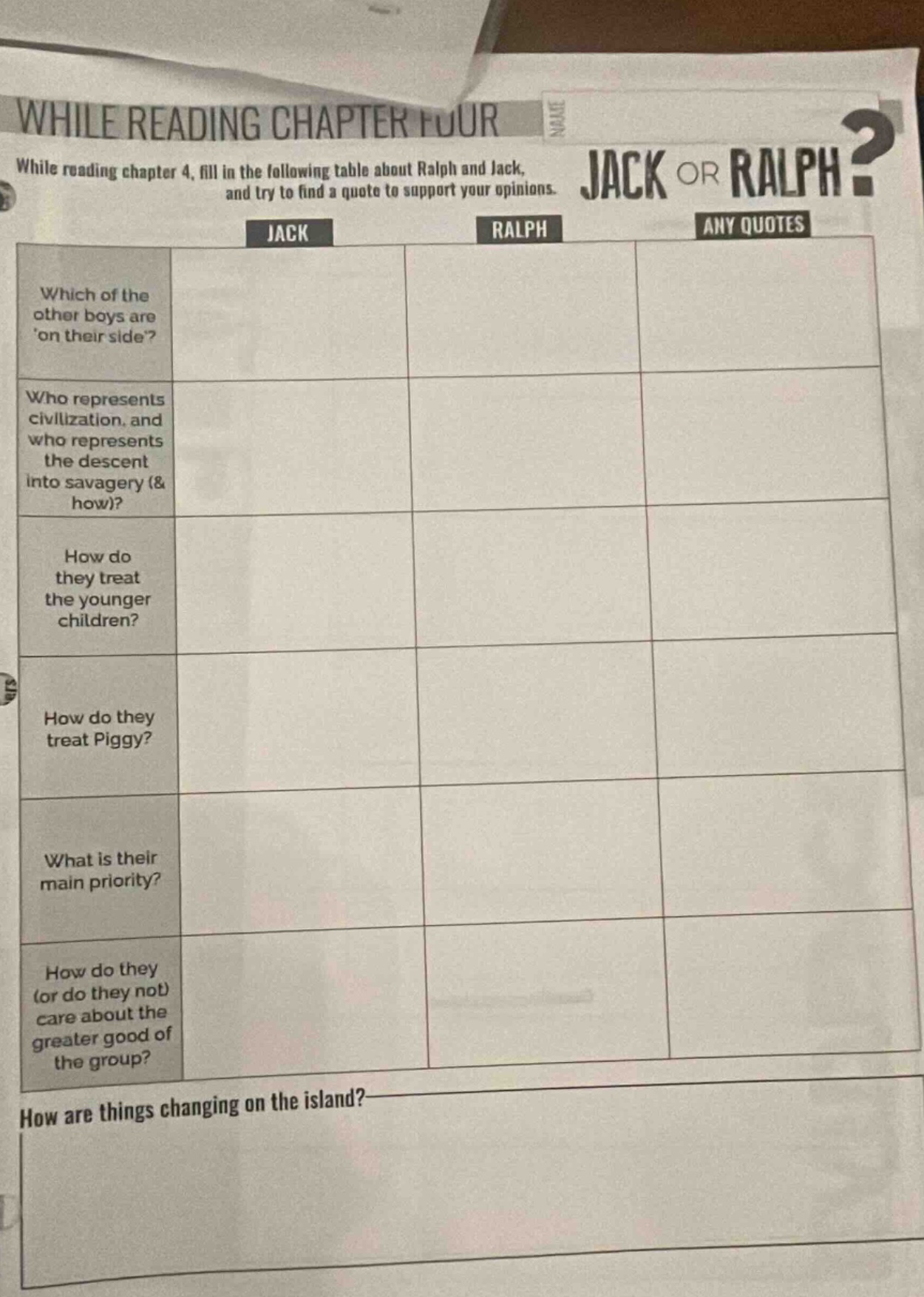
while reading chapter four
while reading chapter 4, fill in the following table about ralph and jack, and try to find a quote to support your opinions.
jack or ralph?
| jack | ralph | any quotes | |
|---|---|---|---|
| who represents civilization, and who represents the descent into savagery (& how)? | |||
| how do they treat the younger children? | |||
| how do they treat piggy? | |||
| what is their main priority? | |||
| how do they (or do they not) care about the greater good of the group? |
how are things changing on the island? |
Brief Explanations
To fill the table, we analyze Jack and Ralph from Lord of the Flies:
1. Which of the other boys are 'on their side?'
- Jack: The hunters (e.g., Roger, Maurice) and most of the choirboys side with Jack, drawn to his focus on hunting and savagery.
- Ralph: Piggy, Simon, and the littluns who value order (though some littluns drift to Jack’s excitement).
2. Who represents civilization, and who represents the descent into savagery?
- Jack: Represents savagery. He abandons rules, prioritizes hunting/killing (e.g., painting his face, leading the group to violence), rejecting civilization.
- Ralph: Represents civilization. He focuses on building shelters, maintaining the signal fire (for rescue), and using the conch for order.
3. How do they treat the younger children (littluns)?
- Jack: Often ignores or scares them (e.g., his hunting group’s chaos frightens littluns; he prioritizes his own goals over their safety).
- Ralph: Tries to protect them (e.g., emphasizes shelter-building for their safety, listens to their fears about the “beast”).
4. How do they treat Piggy?
- Jack: Mocking, hostile (e.g., calls him “Fatty,” dismisses his ideas, physically threatens him).
- Ralph: Respectful (values Piggy’s intelligence, includes him in decisions, defends him from Jack’s taunts).
5. What is their main priority?
- Jack: Hunting, gaining power, and indulging savagery (e.g., obsessed with killing pigs, controlling the group through fear).
- Ralph: Rescue (maintaining the signal fire) and order (shelters, conch-based rules) to survive civilizationally.
6. How do they care about the greater good?
- Jack: Selfish—prioritizes his own dominance and pleasure (hunting, violence) over the group’s needs (rescue, safety).
- Ralph: Selfless—prioritizes the group’s survival (shelter, fire, order) even when it’s hard (e.g., working on shelters while others play).
Quotes (examples):
- Jack (savagery): “He began to dance and his laughter became a bloodthirsty snarling.” (shows his descent into animalistic behavior).
- Ralph (civilization): “We’ve got to have rules and obey them. After all, we’re not savages. We’re English, and the English are best at everything.” (emphasizes order).
Filled Table (Example):
| Category | Jack | Ralph | Any Quotes |
|---|---|---|---|
| Civilization vs. savagery | Savagery: Abandons rules, hunts/kills, uses fear. | Civilization: Builds shelters, maintains signal fire, uses conch for order. | Jack: “Bollocks to the rules!” <br> Ralph: “The fire is the most important thing on the island.” |
| Treatment of littluns | Ignores/frightens; prioritizes hunting over their safety. | Protects (shelters, listens to fears). | Jack: (No direct quote here, but his actions show neglect). <br> Ralph: “We need shelters for the littluns.” |
| Treatment of Piggy | Mocking, hostile (calls him “Fatty,” threatens). | Respectful (values his ideas, defends him). | Jack: “Shut up, Fatty!” <br> Ralph: “Piggy’s got a right to speak.” |
| Main priority | Hunting, power, savagery. | Rescue (fire) and order (shelters). | Jack: “I’m going hunting. Do you want to come?” <br> Ralph: “If the fire’s out, we’ll never be rescued.” |
| Care for greater good | Selfish (prioritizes dominance). | Selfless (prioritizes group survival). | Jack: (No quote, but his actions show selfishness). <br> Ralph: “We’ve got to work together.” |

Snap & solve any problem in the app
Get step-by-step solutions on Sovi AI
Photo-based solutions with guided steps
Explore more problems and detailed explanations
The table is filled with the above analysis, distinguishing Jack’s savagery and Ralph’s civilization, their alliances, treatment of others, priorities, and quotes to support these traits.