QUESTION IMAGE
Question
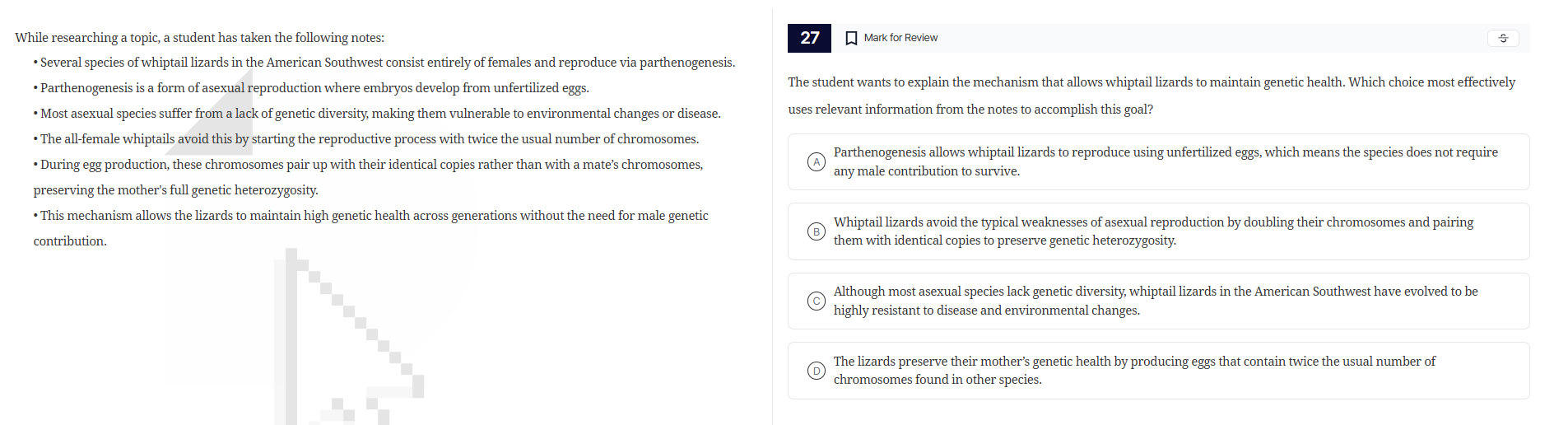
while researching a topic, a student has taken the following notes:
- several species of whiptail lizards in the american southwest consist entirely of females and reproduce via parthenogenesis.
- parthenogenesis is a form of asexual reproduction where embryos develop from unfertilized eggs.
- most asexual species suffer from a lack of genetic diversity, making them vulnerable to environmental changes or disease.
- the all - female whiptails avoid this by starting the reproductive process with twice the usual number of chromosomes.
- during egg production, these chromosomes pair up with their identical copies rather than with a mate’s chromosomes, preserving the mother’s full genetic heterozygosity.
- this mechanism allows the lizards to maintain high genetic health across generations without the need for male genetic contribution.
27 mark for review
the student wants to explain the mechanism that allows whiptail lizards to maintain genetic health. which choice most effectively uses relevant information from the notes to accomplish this goal?
a parthenogenesis allows whiptail lizards to reproduce using unfertilized eggs, which means the species does not require any male contribution to survive.
b whiptail lizards avoid the typical weaknesses of asexual reproduction by doubling their chromosomes and pairing them with identical copies to preserve genetic heterozygosity.
c although most asexual species lack genetic diversity, whiptail lizards in the american southwest have evolved to be highly resistant to disease and environmental changes.
d the lizards preserve their mother’s genetic health by producing eggs that contain twice the usual number of chromosomes found in other species.
- Option A focuses on reproduction without male contribution, not genetic health mechanism.
- Option B correctly links the lizards' chromosome - doubling and pairing with identical copies to preserving genetic heterozygosity, which avoids asexual reproduction's typical weakness (lack of genetic diversity) and explains genetic health maintenance.
- Option C states they are resistant to disease and environmental changes but doesn't explain the mechanism.
- Option D misinterprets the chromosome number (it's twice the usual for them, not compared to other species) and focuses on preserving the mother's genetic health (not the species' genetic health across generations).

Snap & solve any problem in the app
Get step-by-step solutions on Sovi AI
Photo-based solutions with guided steps
Explore more problems and detailed explanations
B. Whiptail lizards avoid the typical weaknesses of asexual reproduction by doubling their chromosomes and pairing them with identical copies to preserve genetic heterozygosity.