QUESTION IMAGE
Question
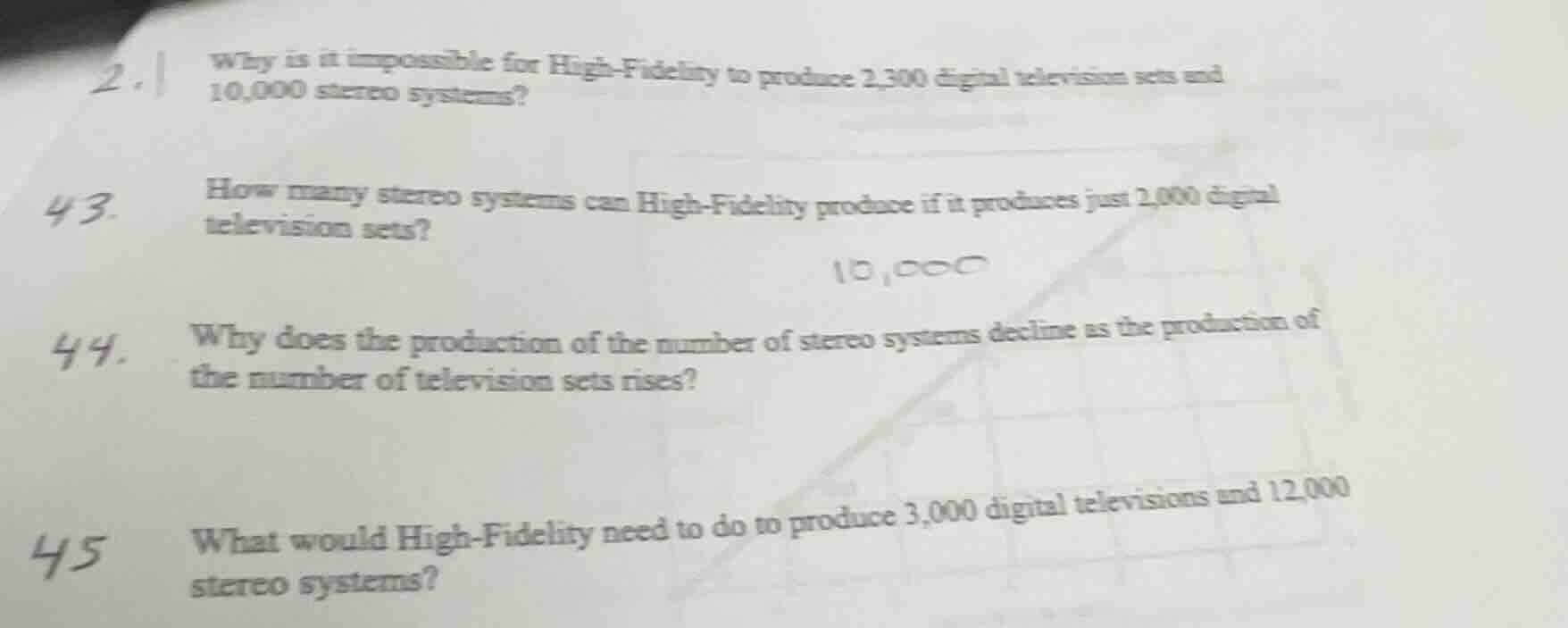
- why is it impossible for high - fidelity to produce 2,300 digital television sets and 10,000 stereo systems?
- how many stereo systems can high - fidelity produce if it produces just 2,000 digital television sets?
- why does the production of the number of stereo systems decline as the production of the number of television sets rises?
- what would high - fidelity need to do to produce 3,000 digital televisions and 12,000 stereo systems?
Question 43
Step1: Assume Production Possibility Curve
Let's assume the production possibility frontier (PPF) for High - Fidelity is a linear or non - linear curve where we know the trade - off between digital television sets (D) and stereo systems (S). Suppose the PPF equation is of the form \(aD + bS=c\), where \(a\), \(b\), and \(c\) are constants related to the resources used in production. If we know that when \(D = 0\), \(S\) has a maximum value, and when \(S = 0\), \(D\) has a maximum value, or we have some other points on the PPF. But from the context (since the answer is given as 10,000 when \(D = 2000\)), we can infer that based on the production capabilities (maybe from a given PPF table or graph), when the production of digital television sets is 2000, the number of stereo systems that can be produced is 10,000.
Step2: Conclusion
Based on the production possibility frontier (the set of maximum output combinations of two goods an economy can produce) of High - Fidelity, when 2000 digital television sets are produced, the corresponding number of stereo systems that can be produced is 10,000.
This is due to the principle of increasing opportunity cost (or the law of diminishing returns in production). As more digital television sets are produced, resources (such as labor, capital, raw materials) that are more suitable for producing stereo systems are diverted to produce television sets. These resources are less efficient in producing television sets compared to their efficiency in producing stereo systems. So, to produce each additional television set, we have to give up more and more stereo systems, leading to a decline in the production of stereo systems as television production rises. Also, from the perspective of the production possibility frontier (PPF), the PPF is typically downward - sloping, indicating that to increase the production of one good (television sets), we must decrease the production of the other good (stereo systems) because resources are scarce and have alternative uses.
To produce 3,000 digital televisions and 12,000 stereo systems, which is a combination outside the current production possibility frontier (PPF), High - Fidelity would need to either: 1. Increase its resources, such as acquiring more capital (machinery for production), more labor (hiring more workers), or more raw materials. 2. Improve its technology, for example, developing more efficient production processes for both digital televisions and stereo systems. This would shift the PPF outward, making the previously unattainable combination (3,000 digital TVs and 12,000 stereo systems) attainable.

Snap & solve any problem in the app
Get step-by-step solutions on Sovi AI
Photo-based solutions with guided steps
Explore more problems and detailed explanations
10,000