QUESTION IMAGE
Question
why lightning is good for agriculture
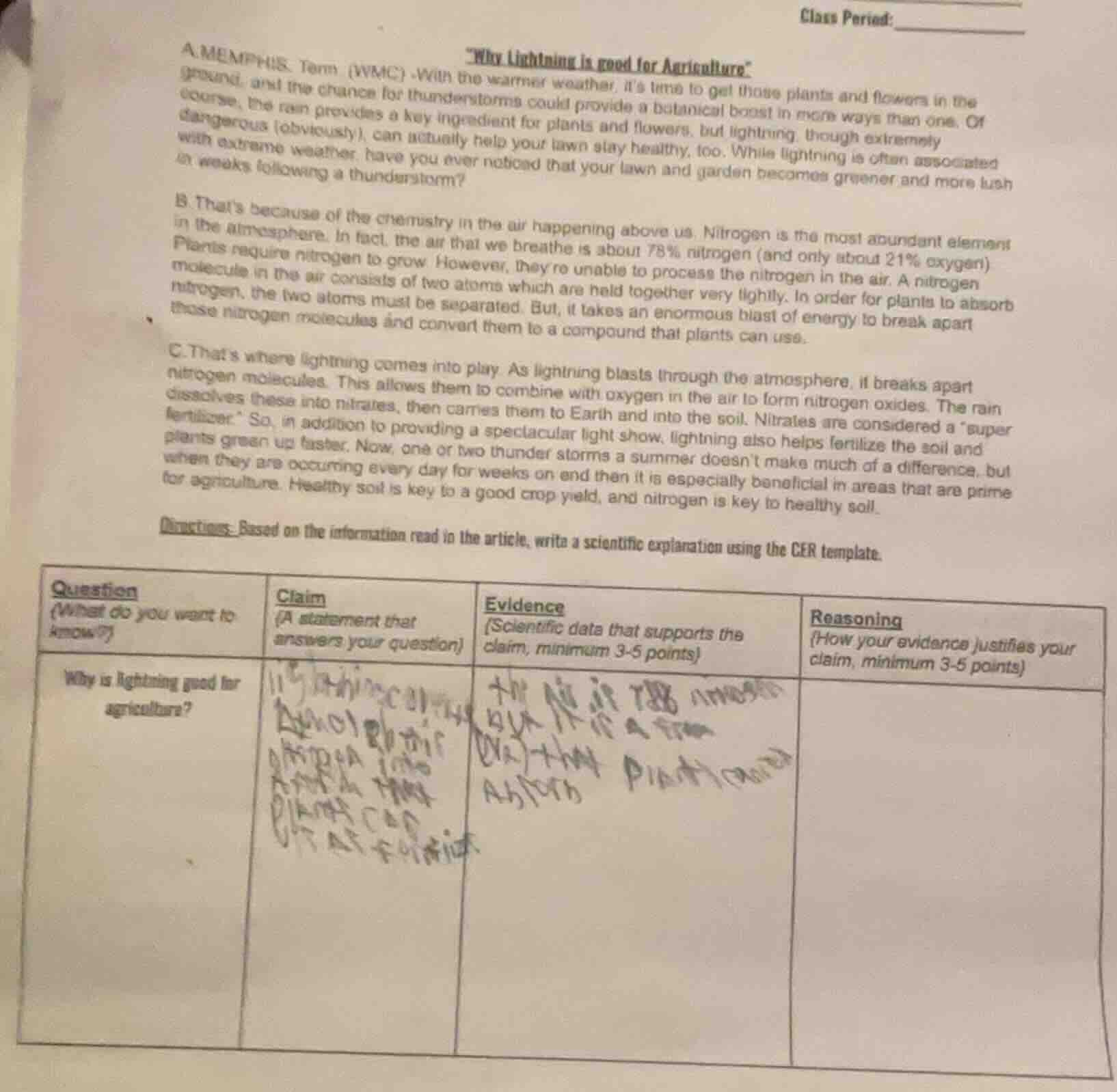
a. memphis, tenn. (wmc) -with the warmer weather, it’s time to get those plants and flowers in the ground, and the chance for thunderstorms could provide a botanical boost in more ways than one. of course, the rain provides a key ingredient for plants and flowers, but lightning, though extremely dangerous (obviously), can actually help your lawn stay healthy, too. while lightning is often associated with extreme weather, have you ever noticed that your lawn and garden becomes greener and more lush in weeks following a thunderstorm?
b. that’s because of the chemistry in the air happening above us. nitrogen is the most abundant element in the atmosphere. in fact, the air that we breathe is about 78% nitrogen (and only about 21% oxygen). plants require nitrogen to grow. however, they’re unable to process the nitrogen in the air. a nitrogen molecule in the air consists of two atoms which are held together very tightly. in order for plants to absorb nitrogen, the two atoms must be separated. but, it takes an enormous blast of energy to break apart those nitrogen molecules and convert them to a compound that plants can use.
c. that’s where lightning comes into play. as lightning blasts through the atmosphere, it breaks apart nitrogen molecules. this allows them to combine with oxygen in the air to form nitrogen oxides. the rain dissolves these into nitrates, then carries them to earth and into the soil. nitrates are considered a “super fertilizer.” so, in addition to providing a spectacular light show, lightning also helps fertilize the soil and plants green up faster. now, one or two thunder storms a summer doesn’t make much of a difference, but when they are occurring every day for weeks on end then it is especially beneficial in areas that are prime for agriculture. healthy soil is key to a good crop yield, and nitrogen is key to healthy soil.
directions: based on the information read in the article, write a scientific explanation using the cer template.
| question (what do you want to know?) | claim (a statement that answers your question) | evidence (scientific data that supports the claim, minimum 3-5 points) | reasoning (how your evidence justifies your claim, minimum 3-5 points) |
|---|
To answer using the CER template:
Claim:
Lightning is good for agriculture because it helps fertilize the soil by converting atmospheric nitrogen into a form plants can use, promoting plant growth.
Evidence:
- Air is about 78% nitrogen, but plants can’t use atmospheric nitrogen (N₂) directly.
- Lightning provides the energy to break apart N₂ molecules.
- Broken nitrogen combines with oxygen to form nitrogen oxides.
- Rain dissolves these nitrogen oxides into nitrates and carries them to the soil.
- Nitrates are a "super fertilizer" that helps plants grow greener and lusher.
Reasoning:
- Plants need nitrogen to grow, but N₂ in the air has strong bonds that plants can’t break.
- Lightning’s energy overcomes the bond strength of N₂, splitting it.
- The split nitrogen reacts with oxygen to form usable nitrogen compounds (nitrates).
- Rain transports these nitrates to the soil, where they act as fertilizer.
- Fertilized soil supports healthier plants, which is crucial for agriculture (especially in prime agricultural areas) as healthy soil leads to good crop yields.
- Even one or two thunderstorms in summer help, and frequent storms (weeks of daily storms) are especially beneficial for soil health and crop production.

Snap & solve any problem in the app
Get step-by-step solutions on Sovi AI
Photo-based solutions with guided steps
Explore more problems and detailed explanations
Claim:
Lightning is good for agriculture because it converts atmospheric nitrogen into plant - usable nitrates, acting as a natural fertilizer to enhance soil health and plant growth.
Evidence:
- The air we breathe is about 78% nitrogen, but plants cannot directly use atmospheric nitrogen (N₂).
- Lightning supplies the enormous energy needed to break apart nitrogen molecules (N₂).
- After being broken by lightning, nitrogen combines with oxygen to form nitrogen oxides.
- Rain dissolves these nitrogen oxides into nitrates and carries them to the Earth’s soil.
- Nitrates are considered a “super fertilizer” that makes lawns and gardens greener and lusher.
Reasoning:
- Plants require nitrogen for growth, yet the strong triple bond in N₂ molecules makes atmospheric nitrogen inaccessible to them. Lightning’s energy overcomes this bond strength, splitting N₂.
- The split nitrogen reacts with oxygen to form nitrogen oxides, which are then converted into nitrates by rain. These nitrates are a form of nitrogen that plants can absorb.
- As a “super fertilizer,” nitrates improve soil health. Healthy soil is essential for good crop yields, so lightning - derived nitrates benefit agriculture, especially in prime agricultural areas. Even a few summer thunderstorms help, and prolonged storm activity (daily for weeks) significantly boosts soil fertility and plant growth.