QUESTION IMAGE
Question
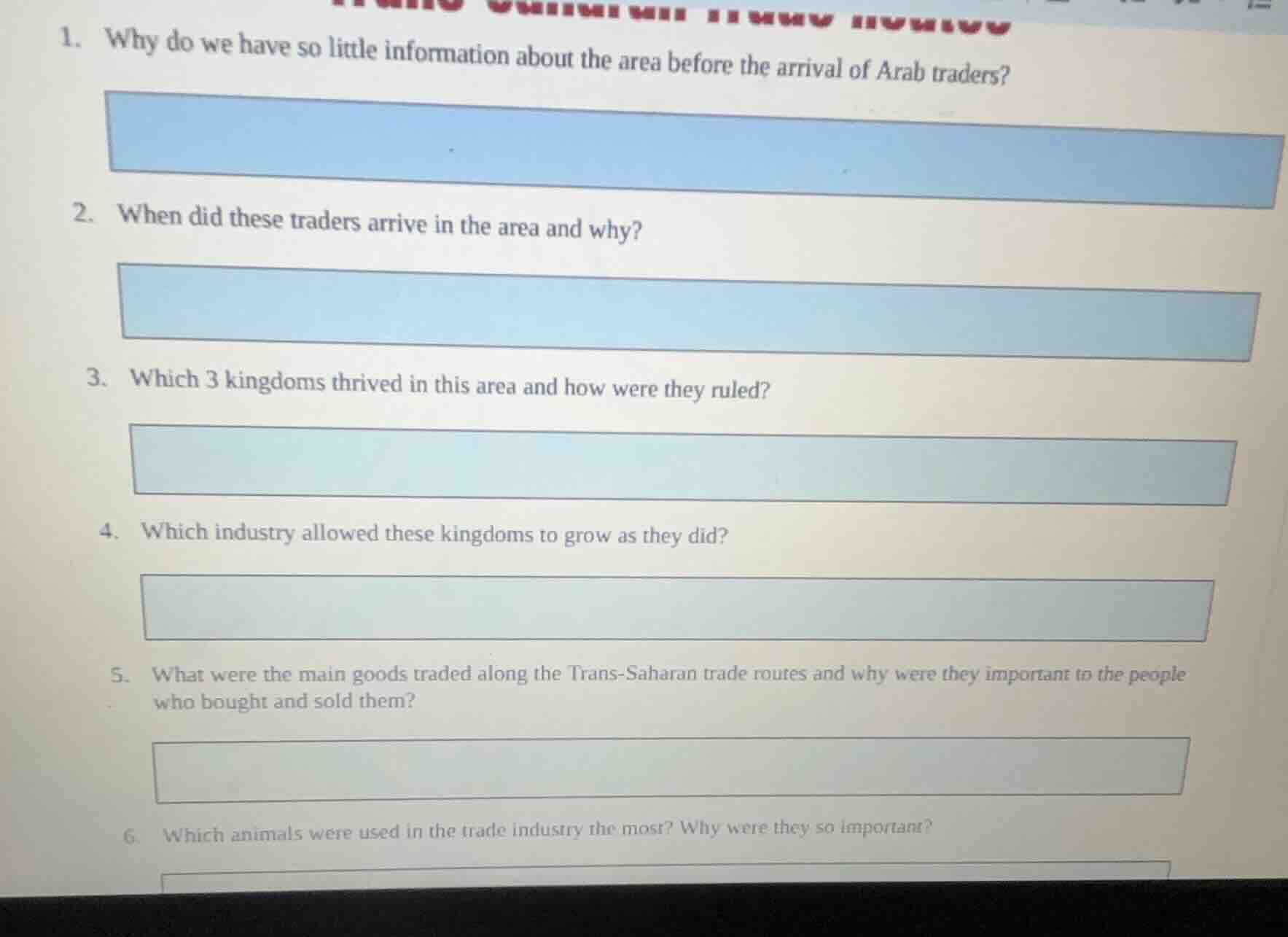
- why do we have so little information about the area before the arrival of arab traders?
- when did these traders arrive in the area and why?
- which 3 kingdoms thrived in this area and how were they ruled?
- which industry allowed these kingdoms to grow as they did?
- what were the main goods traded along the trans - saharan trade routes and why were they important to the people who bought and sold them?
- which animals were used in the trade industry the most? why were they so important?
Question 1
Before Arab traders arrived (likely in West Africa, e.g., Trans - Saharan region), many societies in the area had oral - based cultures with no written records. Also, the harsh environment (like the Sahara) limited external exploration and documentation. So, lack of written records and limited outside contact led to little info.
Arab traders arrived in the Trans - Saharan region around the 7th - 8th century CE. They came for trade, especially to access gold from West Africa and to trade it for goods like salt, textiles, and luxury items from North Africa and the Middle East. The growth of Islamic empires also spurred trade expansion.
The three kingdoms that thrived in the Trans - Saharan region were Ghana, Mali, and Songhai. Ghana was ruled by a king (Ghana) who controlled trade, had a bureaucracy, and relied on military power. Mali was ruled by kings like Sundiata and Mansa Musa; it had a centralized government, with the king controlling trade and territory, and a system of provinces. Songhai was ruled by kings like Sunni Ali and Askia Muhammad; it had a large empire with a centralized government, a professional army, and administrative divisions.

Snap & solve any problem in the app
Get step-by-step solutions on Sovi AI
Photo-based solutions with guided steps
Explore more problems and detailed explanations
Before Arab traders arrived (e.g., in West Africa), many local societies had oral traditions (no written records), and the harsh Sahara environment limited external exploration/documentation, resulting in little information.