QUESTION IMAGE
Question
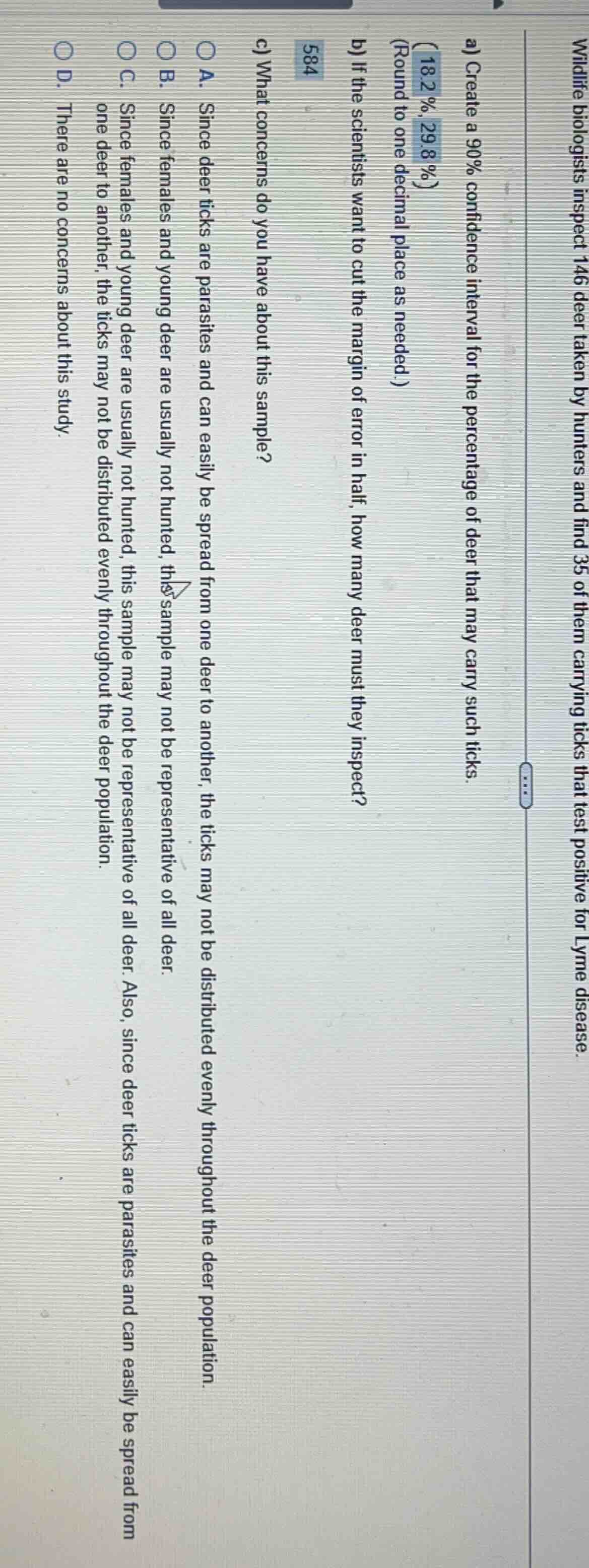
wildlife biologists inspect 146 deer taken by hunters and find 35 of them carrying ticks that test positive for lyme disease.
a) create a 90% confidence interval for the percentage of deer that may carry such ticks. (18.2 %, 29.8 %) (round to one decimal place as needed.)
b) if the scientists want to cut the margin of error in half, how many deer must they inspect?
584
c) what concerns do you have about this sample?
a. since deer ticks are parasites and can easily be spread from one deer to another, the ticks may not be distributed evenly throughout the deer population.
b. since females and young deer are usually not hunted, this sample may not be representative of all deer.
c. since females and young deer are usually not hunted, this sample may not be representative of all deer. also, since deer ticks are parasites and can easily be spread from one deer to another, the ticks may not be distributed evenly throughout the deer population.
d. there are no concerns about this study.
Step1: Calculate sample proportion
$\hat{p} = \frac{35}{146} \approx 0.2397$
Step2: Find z-score for 90% CI
For 90% confidence, $z_{\alpha/2} = 1.645$
Step3: Compute margin of error (a)
$E = z_{\alpha/2}\sqrt{\frac{\hat{p}(1-\hat{p})}{n}} = 1.645\sqrt{\frac{0.2397(1-0.2397)}{146}} \approx 0.0583$
Step4: Calculate 90% confidence interval (a)
$\hat{p} - E = 0.2397 - 0.0583 = 0.1814 \approx 18.2\%$
$\hat{p} + E = 0.2397 + 0.0583 = 0.2980 = 29.8\%$
Step5: Adjust sample size for half E (b)
New $E' = \frac{0.0583}{2} = 0.02915$
$n = \frac{z_{\alpha/2}^2 \hat{p}(1-\hat{p})}{(E')^2} = \frac{(1.645)^2(0.2397)(0.7603)}{(0.02915)^2} \approx 584$
Step6: Evaluate sample concerns (c)
Hunted deer exclude non-hunted groups (females/young), and ticks spread unevenly, so sample may not represent all deer.

Snap & solve any problem in the app
Get step-by-step solutions on Sovi AI
Photo-based solutions with guided steps
Explore more problems and detailed explanations
a) $18.2\% < p < 29.8\%$
b) 584
c) C. Since females and young deer are usually not hunted, this sample may not be representative of all deer. Also, since deer ticks are parasites and can easily be spread from one deer to another, the ticks may not be distributed evenly throughout the deer population.