QUESTION IMAGE
Question
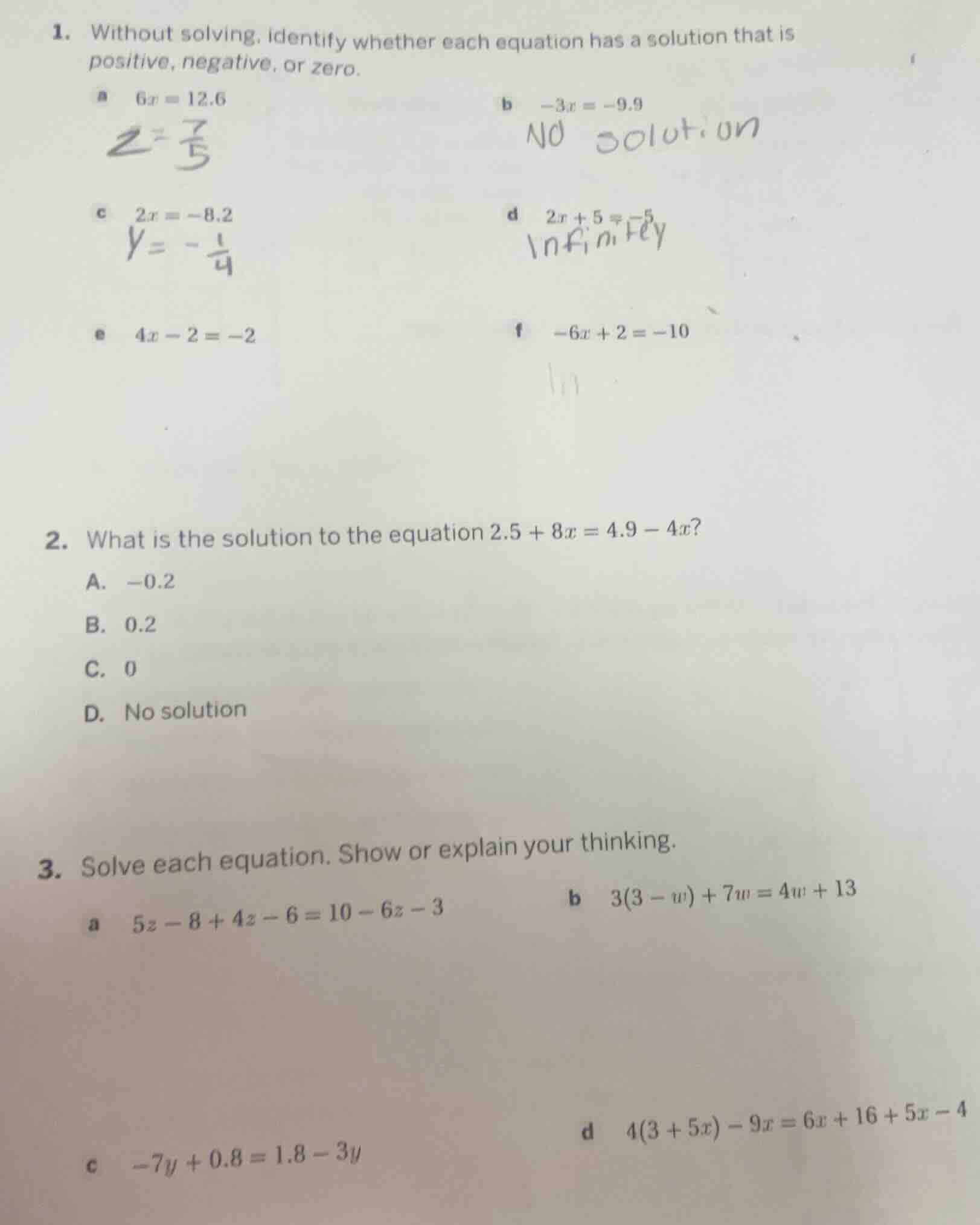
- without solving, identify whether each equation has a solution that is positive, negative, or zero.
a ( 6x = 12.6 )
b ( -3x = -9.9 )
c ( 2x = -8.2 )
d ( 2x + 5 = -5 )
e ( 4x - 2 = -2 )
f ( -6x + 2 = -10 )
- what is the solution to the equation ( 2.5 + 8x = 4.9 - 4x )?
a. ( -0.2 )
b. ( 0.2 )
c. ( 0 )
d. no solution
- solve each equation. show or explain your thinking.
a ( 5z - 8 + 4z - 6 = 10 - 6z - 3 )
b ( 3(3 - w) + 7w = 4w + 13 )
c ( -7y + 0.8 = 1.8 - 3y )
d ( 4(3 + 5x) - 9x = 6x + 16 + 5x - 4 )
Problem 1
Step1: Analyze sign of solution
For $6x=12.6$: positive/positive = positive
Step2: Analyze sign of solution
For $-3x=-9.9$: negative/negative = positive
Step3: Analyze sign of solution
For $2x=-8.2$: negative/positive = negative
Step4: Analyze sign of solution
For $2x+5=-5$: $2x=-10$, negative/positive = negative
Step5: Analyze sign of solution
For $4x-2=-2$: $4x=0$, solution is zero
Step6: Analyze sign of solution
For $-6x+2=-10$: $-6x=-12$, negative/negative = positive
Step1: Isolate x terms
Add $4x$ to both sides: $2.5 + 12x = 4.9$
Step2: Isolate constant terms
Subtract 2.5 from both sides: $12x = 4.9 - 2.5$
$12x = 2.4$
Step3: Solve for x
Divide by 12: $x = \frac{2.4}{12}$
Step1: Combine like terms
Left: $5z+4z-8-6=9z-14$; Right: $10-3-6z=7-6z$
Equation: $9z-14=7-6z$
Step2: Isolate z terms
Add $6z$ to both sides: $15z-14=7$
Step3: Isolate constant terms
Add 14 to both sides: $15z=21$
Step4: Solve for z
Divide by 15: $z=\frac{21}{15}=\frac{7}{5}$

Snap & solve any problem in the app
Get step-by-step solutions on Sovi AI
Photo-based solutions with guided steps
Explore more problems and detailed explanations
a. Positive solution
b. Positive solution
c. Negative solution
d. Negative solution
e. Zero solution
f. Positive solution
---