QUESTION IMAGE
Question
worksheet
name
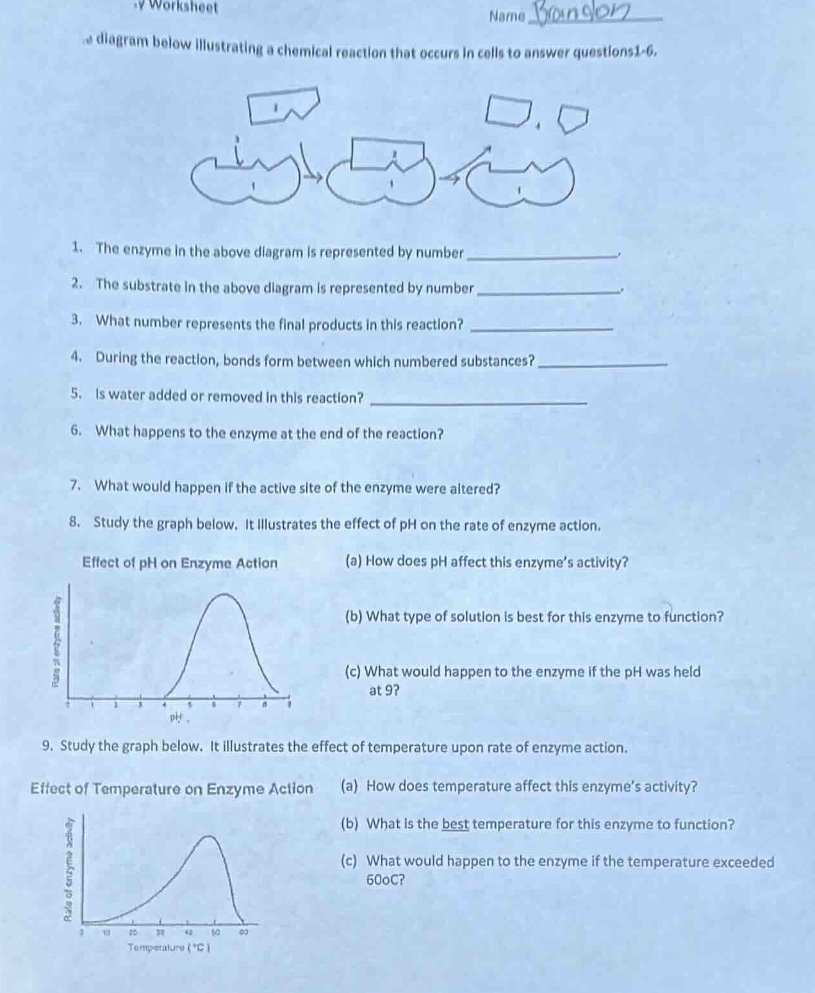
a diagram below illustrating a chemical reaction that occurs in cells to answer questions1-6.
- the enzyme in the above diagram is represented by number ______________.
- the substrate in the above diagram is represented by number ______________.
- what number represents the final products in this reaction? ______________
- during the reaction, bonds form between which numbered substances? ______________
- is water added or removed in this reaction? _____________________
- what happens to the enzyme at the end of the reaction?
- what would happen if the active site of the enzyme were altered?
- study the graph below. it illustrates the effect of ph on the rate of enzyme action.
effect of ph on enzyme action
(a) how does ph affect this enzyme’s activity?
(b) what type of solution is best for this enzyme to function?
(c) what would happen to the enzyme if the ph was held at 9?
- study the graph below. it illustrates the effect of temperature upon rate of enzyme action.
effect of temperature on enzyme action
(a) how does temperature affect this enzyme’s activity?
(b) what is the best temperature for this enzyme to function?
(c) what would happen to the enzyme if the temperature exceeded 60oc?
Question 1
Enzymes are biological catalysts that remain unchanged during the reaction and have a specific active site. In the diagram, the enzyme (number 1) has a specific shape and remains throughout the reaction, binding to the substrate.
The substrate is the molecule that binds to the enzyme's active site. In the diagram, number 2 is the molecule that fits into the enzyme (number 1), so it's the substrate.
After the enzyme - substrate reaction, the products are formed. In the diagram, number 4 represents the final products as they are the result of the reaction between the enzyme and substrate.

Snap & solve any problem in the app
Get step-by-step solutions on Sovi AI
Photo-based solutions with guided steps
Explore more problems and detailed explanations
1