QUESTION IMAGE
Question
write 0.92 as a fraction.
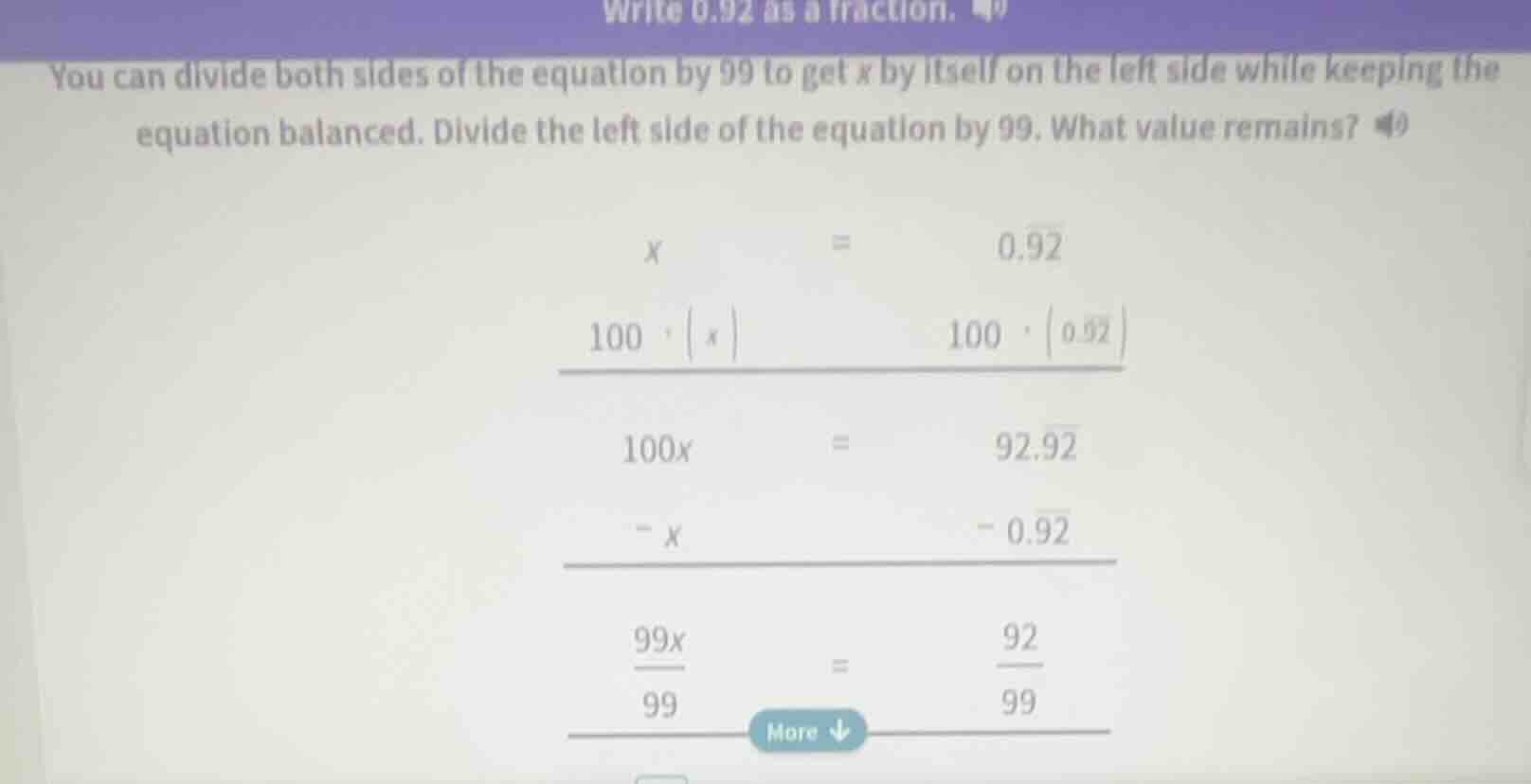
you can divide both sides of the equation by 99 to get x by itself on the left side while keeping the equation balanced. divide the left side of the equation by 99. what value remains?
x = 0.\overline{92}
100 \cdot (x) \quad \quad 100 \cdot (0.\overline{92})
\overline{100x = \quad \quad 92.\overline{92}}
- x \quad \quad \quad \quad - 0.\overline{92}
\overline{\frac{99x}{99} \quad = \quad \frac{92}{99}}
more
Step1: Identify the left - hand side expression
The left - hand side of the equation before dividing by 99 is \(99x\). We are asked to divide the left - hand side by 99.
Step2: Perform the division
When we divide \(99x\) by 99, we use the rule of dividing a term with a coefficient by a number. The formula for dividing \(ax\) by \(a\) (where \(a = 99\) here) is \(\frac{ax}{a}=x\) (as long as \(a
eq0\)). So, \(\frac{99x}{99}=x\).

Snap & solve any problem in the app
Get step-by-step solutions on Sovi AI
Photo-based solutions with guided steps
Explore more problems and detailed explanations
\(x\) (or we can also see from the equation \(\frac{99x}{99}=\frac{92}{99}\) and since \(\frac{99x}{99}=x\), the value that remains is \(x\) (and also from the right - hand side \(\frac{92}{99}\) but the question is about the left - hand side division result, so the left - hand side result is \(x\))