QUESTION IMAGE
Question
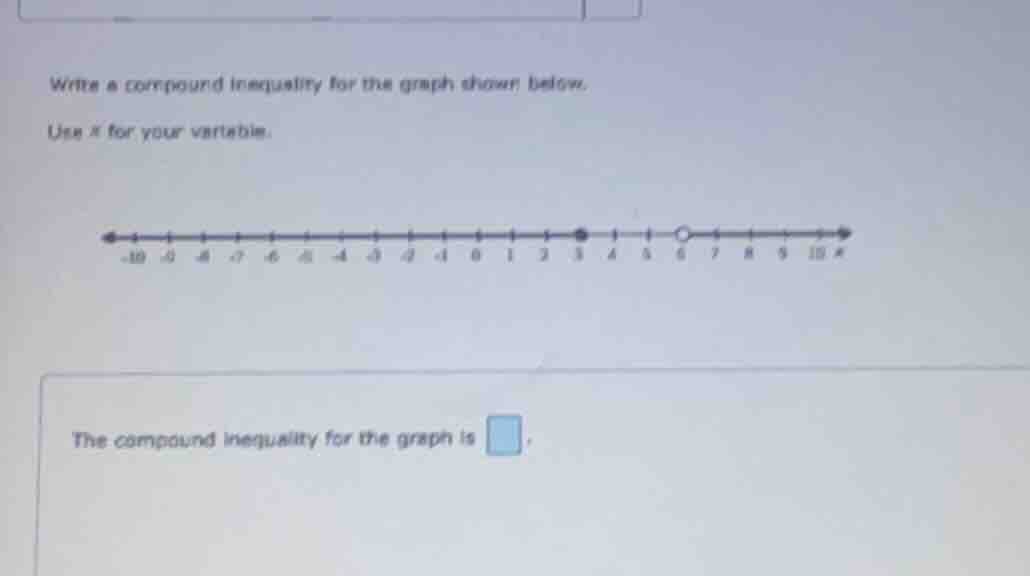
write a compound inequality for the graph shown below. use x for your variable. the compound inequality for the graph is \boxed{}
Step1: Analyze the closed circle
The closed circle is at \( x = 3 \), which means \( x \) is less than or equal to 3, so \( x \leq 3 \).
Step2: Analyze the open circle
The open circle is at \( x = 6 \), which means \( x \) is less than 6, so \( x < 6 \). Wait, no, wait. Wait, the graph: let's re-examine. Wait, the number line: the left part (from left) has a closed dot at 3 and open at 6? Wait, no, the direction: the arrows? Wait, the graph: the line is from left (maybe all the way left) up to 3 (closed dot) and then from 3 to 6 (open dot)? Wait, no, the number line: the closed circle is at 3 (filled), open at 6 (unfilled). So the solution is all numbers less than or equal to 3 and less than 6? Wait, no, that can't be. Wait, maybe the graph is \( x \leq 3 \) or \( x < 6 \)? No, no, the compound inequality is a conjunction or disjunction? Wait, no, the number line: let's see the positions. The closed circle is at 3 (so inclusive), open at 6 (exclusive). The line is drawn from the left (negative infinity) up to 3 (closed), and then from 3 to 6 (open)? Wait, no, maybe the graph is \( x \leq 3 \) and \( x < 6 \)? But that would be \( x \leq 3 \) because \( x \leq 3 \) is a subset of \( x < 6 \). Wait, no, maybe I misread. Wait, the number line: the closed dot is at 3, open at 6, and the shaded region is between? No, wait, the arrows: the left arrow (from -10 to 3, closed at 3) and then from 3 to 6, open at 6? Wait, no, the standard compound inequality for a number line with a closed dot at \( a \) and open dot at \( b \) (where \( a < b \)) and shaded between them would be \( a \leq x < b \). Wait, yes! Because closed dot at 3 (so \( x \) can be 3) and open dot at 6 (so \( x \) can't be 6), and the shaded region is between 3 (inclusive) and 6 (exclusive). So the compound inequality is \( 3 \leq x < 6 \)? Wait, no, wait, the closed dot is at 3, open at 6. So the solution is all \( x \) such that \( x \) is greater than or equal to 3 and less than 6. So \( 3 \leq x < 6 \).
Wait, let's confirm: closed circle at 3 means \( x \geq 3 \)? No, wait, the direction of the line. Wait, the number line: the closed dot is at 3, and the line is going to the left from 3? No, no, the number line: the points are -10, -9, ..., 0, 1, 2, 3 (closed), 4, 5, 6 (open), 7, ... So the shaded region is from left (all numbers less than or equal to 3) and then from 3 to 6 (less than 6)? No, that doesn't make sense. Wait, maybe the graph is \( x \leq 3 \) or \( x < 6 \), but that's not right. Wait, no, the correct way: when a number line has a closed dot at \( a \) and open dot at \( b \) (with \( a < b \)) and the shaded area is between \( a \) and \( b \), then it's \( a \leq x < b \). So here, \( a = 3 \), \( b = 6 \), so \( 3 \leq x < 6 \).

Snap & solve any problem in the app
Get step-by-step solutions on Sovi AI
Photo-based solutions with guided steps
Explore more problems and detailed explanations
\( 3 \leq x < 6 \)