QUESTION IMAGE
Question
4.
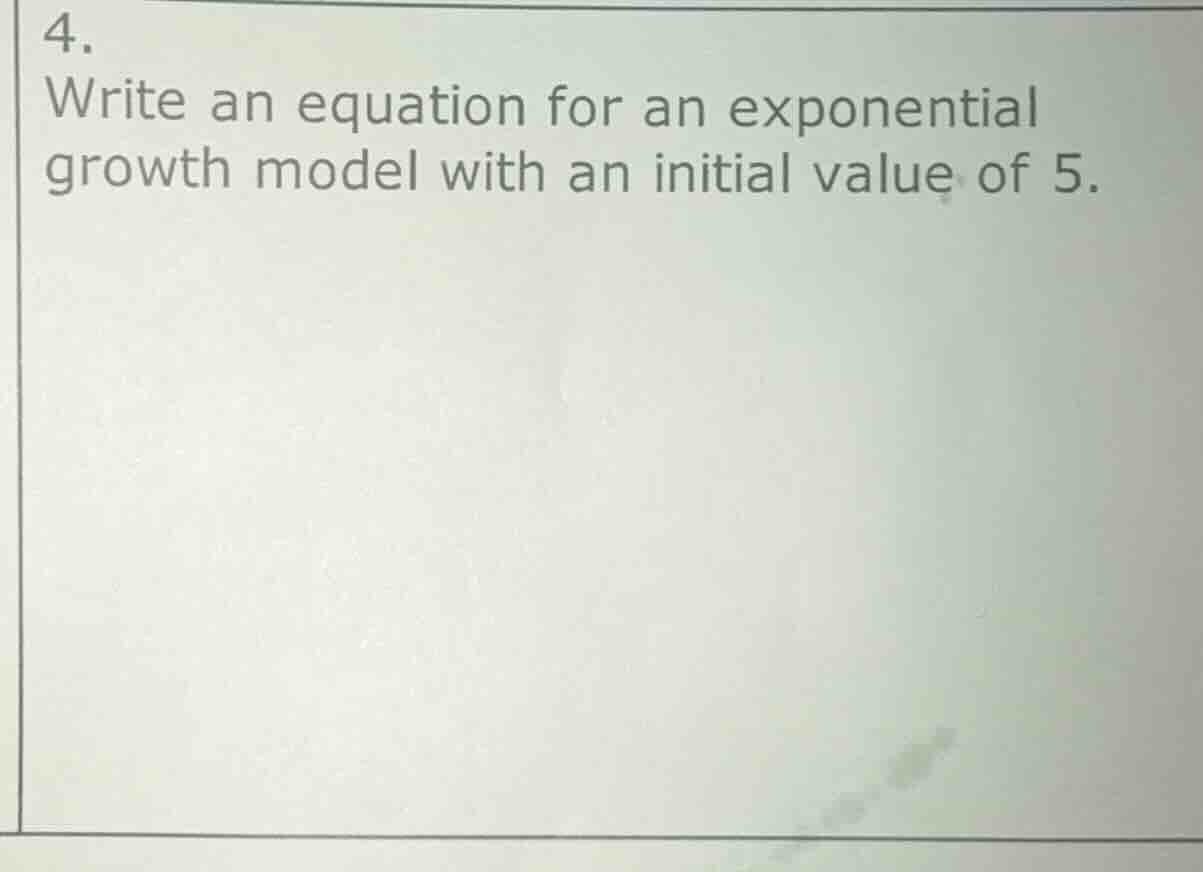
write an equation for an exponential
growth model with an initial value of 5.
Step1: Recall exponential growth formula
The general form of an exponential growth model is \( y = a(1 + r)^t \) or \( y = ae^{kt} \), where \( a \) is the initial value, \( r \) is the growth rate (for the first form), \( k \) is the continuous growth rate (for the second form), and \( t \) is time. Here, we can also use the form \( y = ab^t \) where \( a \) is the initial value and \( b>1 \) for growth.
Step2: Substitute initial value \( a = 5 \)
Using the form \( y = ab^t \) (or \( y = a(1 + r)^t \), or \( y=ae^{kt} \)), substitute \( a = 5 \). A common simple exponential growth model can be written as \( y = 5b^t \) where \( b>1 \), or using the base \( e \) as \( y = 5e^{kt} \) with \( k>0 \), or using the growth rate form \( y = 5(1 + r)^t \) with \( r>0 \). A specific example (taking \( b = 2 \) for simplicity, though any \( b>1 \) works) would be \( y = 5(2)^t \), but the general form with initial value 5 is \( y = 5(1 + r)^t \) (or \( y = 5b^t, b>1 \), or \( y = 5e^{kt}, k>0 \)). The most basic general form for exponential growth with initial value \( a = 5 \) is \( y = 5(1 + r)^t \) where \( r>0 \) is the growth rate, or using the base - multiplier form \( y = 5b^t \) where \( b>1 \). If we take the continuous growth model, it is \( y = 5e^{kt} \) with \( k>0 \). A simple non - specific (since growth rate is not given) exponential growth model with initial value 5 is \( y = 5(1 + r)^t \) (or \( y = 5b^t, b > 1\)) or \( y=5e^{kt},k > 0\). A very common answer (using the base - multiplier form with \( b = e^k\) or just a general base) is \( y = 5(1 + r)^t \) (or \( y = 5b^t\)) with \( a = 5 \). The simplest form when the growth rate is not specified is \( y = 5(1 + r)^t \) (or \( y = 5b^t, b>1\)) or \( y = 5e^{kt},k > 0\). If we assume a general exponential growth model without specifying the growth rate (since it's not given in the problem), we can write \( y = 5(1 + r)^t \) where \( r>0 \) is the growth rate, or \( y = 5b^t \) where \( b>1 \), or \( y = 5e^{kt} \) where \( k>0 \). A standard answer (using the form \( y = ab^t \)) is \( y = 5b^t \) with \( b>1 \), or more commonly, using the growth rate form \( y = 5(1 + r)^t \).

Snap & solve any problem in the app
Get step-by-step solutions on Sovi AI
Photo-based solutions with guided steps
Explore more problems and detailed explanations
A possible exponential growth model equation is \( y = 5(1 + r)^t \) (or \( y = 5b^t, b>1 \), or \( y = 5e^{kt}, k>0 \)). A specific example (taking \( r = 0.1\) for illustration, though any positive \( r \) works) could be \( y = 5(1 + 0.1)^t=5(1.1)^t \), but the general form with initial value 5 is \( y = 5(1 + r)^t \) (where \( r>0 \) is the growth rate) or \( y = 5b^t \) (where \( b > 1\)) or \( y=5e^{kt} \) (where \( k>0\)). The most basic answer (since growth rate is not given) is \( y = 5(1 + r)^t \) (or \( y = 5b^t, b>1 \)) with \( a = 5 \). A common answer is \( y = 5(1 + r)^t \) (or \( y = 5e^{kt} \) or \( y = 5b^t, b>1\)). If we use the base - 2 for simplicity (any \( b>1 \) is fine), \( y = 5(2)^t \) is also a valid exponential growth model with initial value 5.