QUESTION IMAGE
Question
write an equation of the line below.
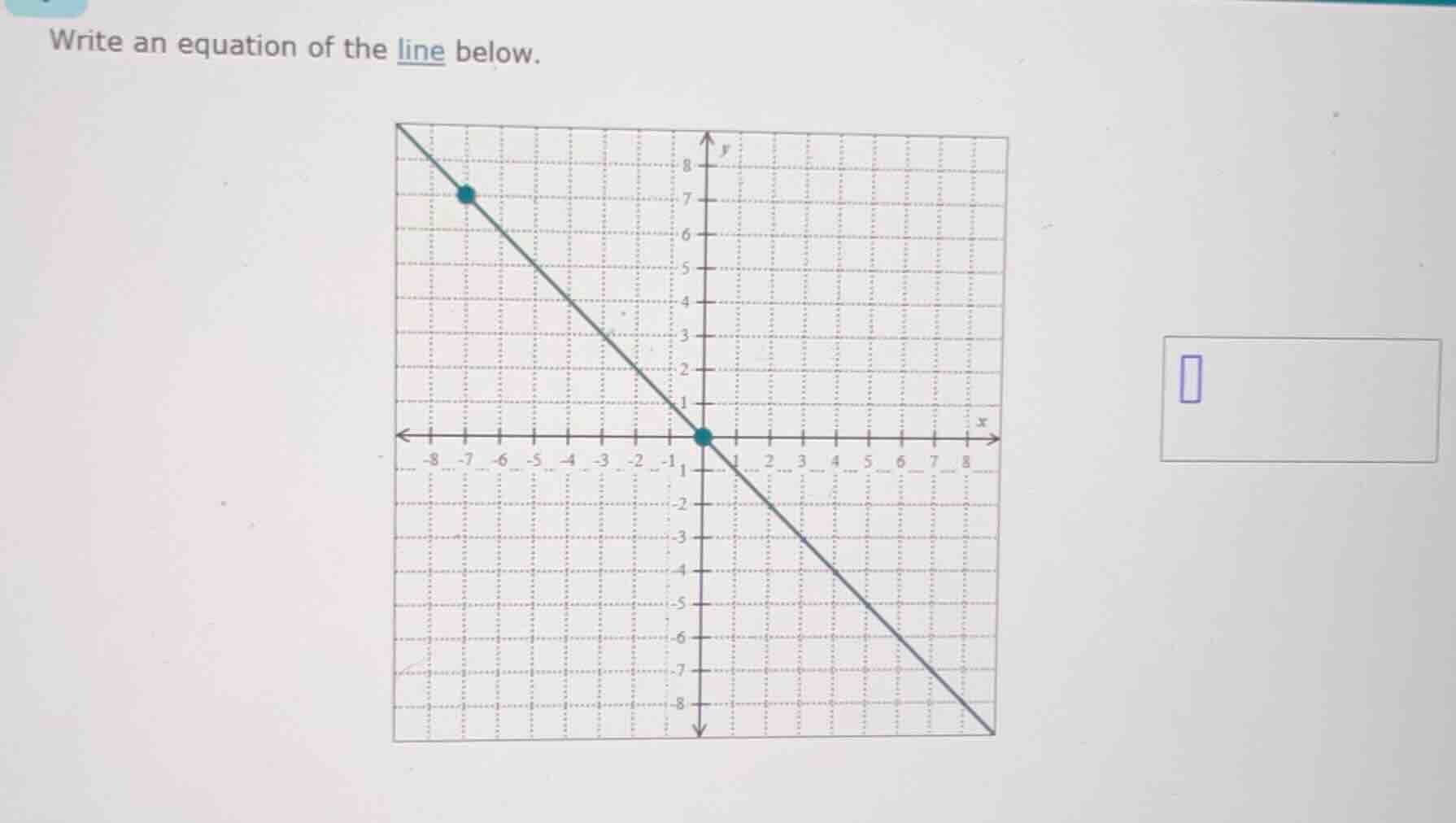
Step1: Identify two points on the line
From the graph, we can see two points: \((-7, 7)\) and \((0, 0)\) (wait, no, the blue dots: one is \((-7, 7)\) and the other is \((0, 0)\)? Wait, no, looking at the grid, the x-intercept is at \((0, 0)\)? Wait, no, the blue dot at x=-7, y=7 and the blue dot at x=0, y=0? Wait, no, let's check again. Wait, the line passes through \((-7, 7)\) and \((0, 0)\)? Wait, no, when x=0, y=0? Wait, the blue dot at (0,0)? Wait, the graph: the x-axis and y-axis intersect at (0,0), and there's a blue dot there, and another at (-7,7). Wait, let's calculate the slope.
Slope \(m = \frac{y_2 - y_1}{x_2 - x_1}\). Let's take the two points: \((-7, 7)\) and \((0, 0)\). So \(m = \frac{0 - 7}{0 - (-7)} = \frac{-7}{7} = -1\).
Step2: Use slope-intercept form \(y = mx + b\)
We know the slope \(m = -1\). Now, find the y-intercept \(b\). Since the line passes through \((0, 0)\), when \(x = 0\), \(y = 0\), so \(b = 0\). Wait, but let's check with the other point. If \(x = -7\), \(y = -1*(-7) + 0 = 7\), which matches the point \((-7, 7)\). So the equation is \(y = -x\). Wait, but let's check another point. For example, when x=1, y=-1, which is on the line. When x=2, y=-2, etc. So the equation is \(y = -x\). Wait, but let's confirm the slope again. From \((-7,7)\) to \((0,0)\), the change in y is \(0 - 7 = -7\), change in x is \(0 - (-7) = 7\), so slope is \(-7/7 = -1\). So the slope is -1, and the y-intercept is 0. So the equation is \(y = -x\).
Wait, but maybe I made a mistake. Wait, the blue dot at (0,0) is on the line, and the other blue dot at (-7,7). So yes, slope is -1, y-intercept 0. So the equation is \(y = -x\).
Wait, but let's check the line. When x increases by 1, y decreases by 1. So from (0,0), moving to (1,-1), (2,-2), etc., which is a slope of -1. So the equation is \(y = -x\).

Snap & solve any problem in the app
Get step-by-step solutions on Sovi AI
Photo-based solutions with guided steps
Explore more problems and detailed explanations
\(y = -x\)