QUESTION IMAGE
Question
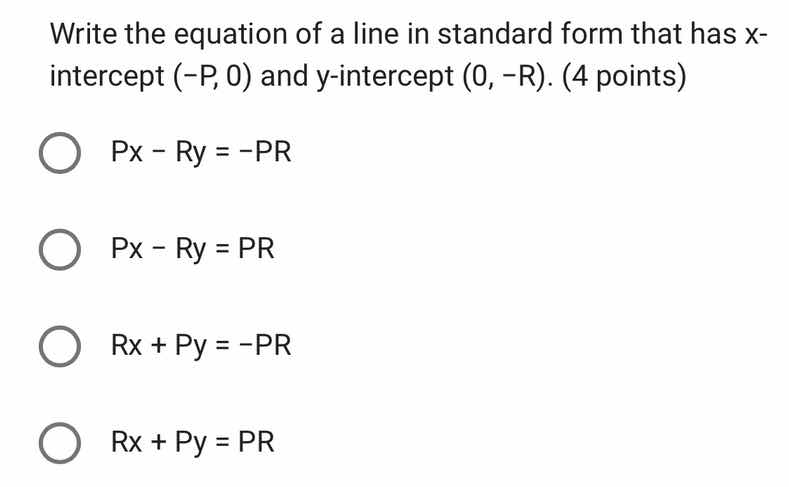
write the equation of a line in standard form that has x-intercept (-p, 0) and y-intercept (0, -r). (4 points)
px - ry = -pr
px - ry = pr
rx + py = -pr
rx + py = pr
Step1: Recall Intercept Form
The intercept form of a line is $\frac{x}{a} + \frac{y}{b} = 1$, where \(a\) is the \(x\)-intercept and \(b\) is the \(y\)-intercept. Here, \(a=-P\) and \(b = -R\). So substitute into the intercept form:
\[
\frac{x}{-P}+\frac{y}{-R}=1
\]
Step2: Eliminate Denominators
Multiply each term by \(-PR\) (the least common multiple of \(-P\) and \(-R\)) to clear the fractions:
\[
(-PR)\cdot\frac{x}{-P}+(-PR)\cdot\frac{y}{-R}=(-PR)\cdot1
\]
Simplify each term:
- For the first term: \((-PR)\cdot\frac{x}{-P}=Rx\) (the \(-P\) in the numerator and denominator cancels, leaving \(R x\))
- For the second term: \((-PR)\cdot\frac{y}{-R}=Py\) (the \(-R\) in the numerator and denominator cancels, leaving \(P y\))
- For the right - hand side: \((-PR)\cdot1=-PR\)
So the equation becomes \(Rx + Py=-PR\)

Snap & solve any problem in the app
Get step-by-step solutions on Sovi AI
Photo-based solutions with guided steps
Explore more problems and detailed explanations
C. \(Rx + Py=-PR\) (assuming the options are labeled A, B, C, D with the third option being C)