QUESTION IMAGE
Question
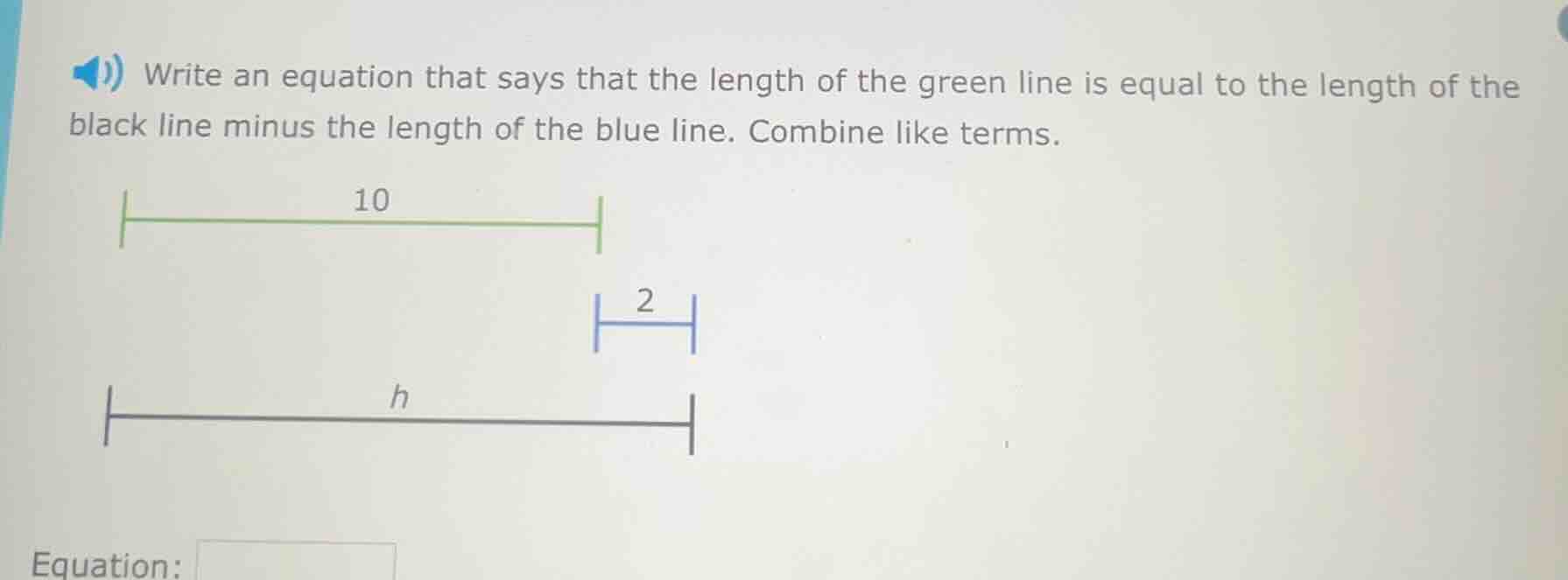
write an equation that says that the length of the green line is equal to the length of the black line minus the length of the blue line. combine like terms.
10
2
h
equation:
Step1: Identify line lengths
Green line length: \( 10 \)
Black line length: \( h \)
Blue line length: \( 2 \)
Step2: Translate the statement
The green line length equals black minus blue: \( 10 = h - 2 \)
Step3: Combine like terms (optional, but here we can re-arrange for clarity)
To show the equation as per the problem (or solve for \( h \) if needed, but the problem asks for the equation stating the relationship): The equation is \( 10 = h - 2 \), and if we want to write it with combined terms (solving for \( h \) would be \( h = 10 + 2 = 12 \), but the problem's main equation is \( 10 = h - 2 \), and combining like terms (if we consider moving terms) gives \( h = 10 + 2 \) or \( 10 + 2 = h \), but the initial equation from the relationship is \( 10 = h - 2 \).
Wait, the problem says "Write an equation that says that the length of the green line is equal to the length of the black line minus the length of the blue line." So green (10) = black (h) - blue (2). So the equation is \( 10 = h - 2 \). Then, combining like terms (solving for h) would be \( h = 10 + 2 = 12 \), but the equation as per the relationship is \( 10 = h - 2 \), and if we rearrange to combine like terms (constants), we get \( h = 10 + 2 \), which simplifies to \( h = 12 \), but the equation first is \( 10 = h - 2 \), and then combining like terms (adding 2 to both sides) gives \( 10 + 2 = h \), so \( h = 12 \), but the problem says "Write an equation that says... Combine like terms." So the equation starts as \( 10 = h - 2 \), and combining like terms (moving -2 to the left) gives \( 10 + 2 = h \), so \( h = 12 \), but the equation expressing the relationship is \( 10 = h - 2 \), and after combining like terms (simplifying), it's \( h = 12 \). But the problem's "Equation" box is for the equation that states the relationship, then combined. Wait, the problem says "Write an equation that says that the length of the green line is equal to the length of the black line minus the length of the blue line. Combine like terms." So first, write the equation as per the statement: \( 10 = h - 2 \). Then, combine like terms (solve for h) by adding 2 to both sides: \( 10 + 2 = h \), so \( h = 12 \). But the equation is \( 10 = h - 2 \), and after combining like terms, it's \( h = 12 \). But the problem might want the equation in the form after combining, so let's check:
Original relationship: Green = Black - Blue → \( 10 = h - 2 \). Then, combining like terms (constants) by adding 2 to both sides: \( 10 + 2 = h \) → \( h = 12 \). So the equation after combining like terms is \( h = 12 \), but the initial equation is \( 10 = h - 2 \). Wait, the problem says "Write an equation that says... Combine like terms." So first, write the equation based on the statement, then combine like terms. So:
Step 1: Write the equation from the statement: \( 10 = h - 2 \)
Step 2: Combine like terms (add 2 to both sides to isolate h): \( 10 + 2 = h - 2 + 2 \) → \( 12 = h \) (or \( h = 12 \))
So the equation after combining like terms is \( h = 12 \), but the equation expressing the relationship is \( 10 = h - 2 \). Wait, maybe the problem wants the equation in the form that shows the relationship and then simplified. Let's re-express:
The green line length is 10, black is h, blue is 2. So "green = black - blue" → \( 10 = h - 2 \). Then, combining like terms (constants) gives \( h = 10 + 2 \) → \( h = 12 \). So the equation is \( 10 = h - 2 \), and after combining like terms, it's \( h = 12 \). But the problem's "Equation" box is for the equation, so probably \( 10 = h - 2 \) (and the…

Snap & solve any problem in the app
Get step-by-step solutions on Sovi AI
Photo-based solutions with guided steps
Explore more problems and detailed explanations
The equation is \( 10 = h - 2 \), and after combining like terms (solving for \( h \)) we get \( h = 12 \). But the equation expressing the relationship is \( \boldsymbol{10 = h - 2} \) (or \( \boldsymbol{h = 12} \) after combining like terms).