QUESTION IMAGE
Question
write a function in any form that would match the graph shown below.
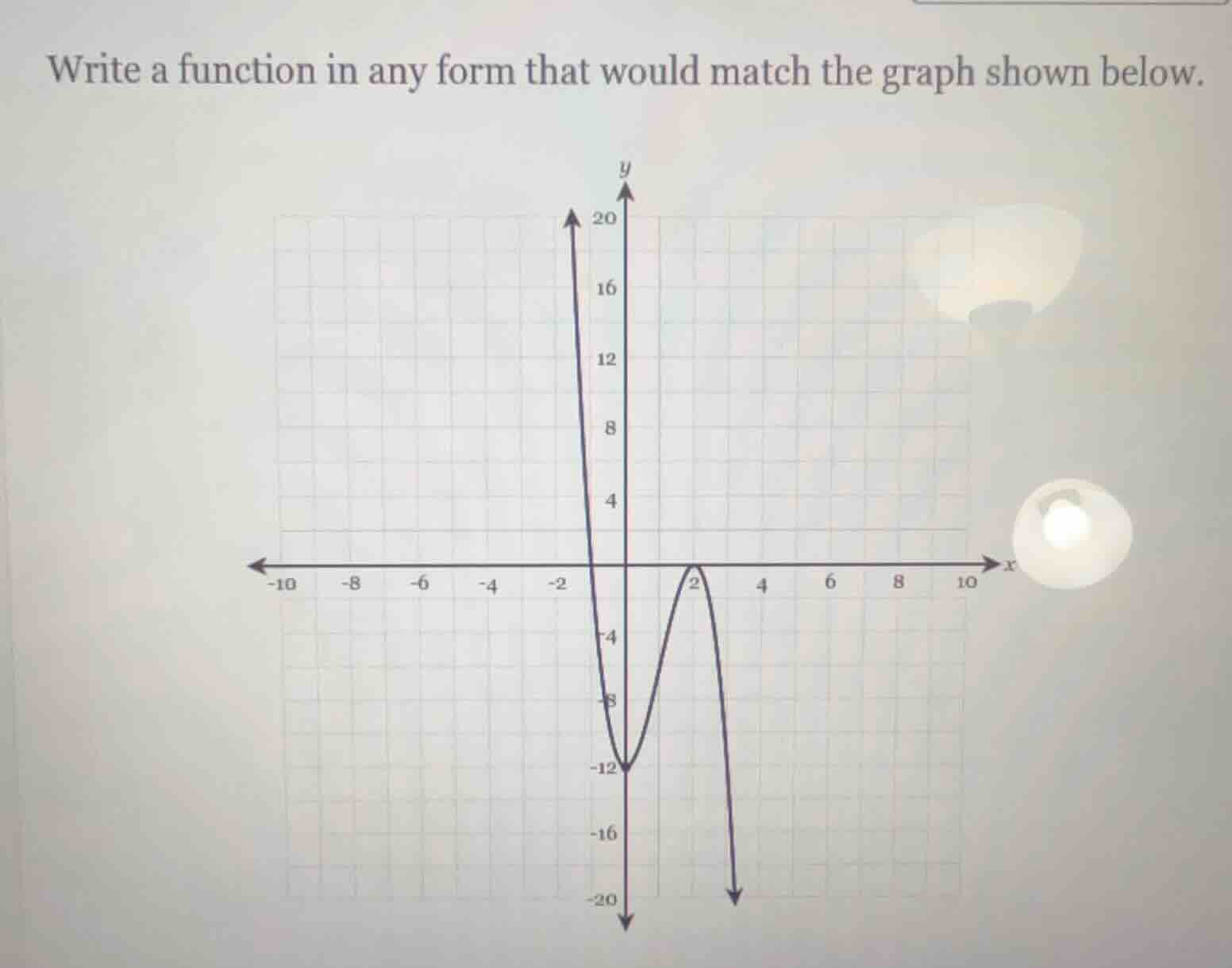
Step1: Identify root locations
The graph crosses/touches the x-axis at $x=0$ (crosses) and $x=2$ (touches, so this is a double root). So the factored form starts as $y = ax(x-2)^2$, where $a$ is the leading coefficient.
Step2: Use y-intercept to find $a$
The y-intercept is $(0, -12)$. Substitute $x=0, y=-12$:
$-12 = a(0)(0-2)^2$
This does not work, so we adjust: the y-intercept is when $x=0$, $y=-12$, so use another point. The vertex at $x=2$ has $y=0$, and the minimum at $x=0$ is $y=-12$. Wait, substitute $x=0, y=-12$ into $y = a(x)(x-2)^2$:
$-12 = a(0)(-2)^2$ is invalid, so correct: the function has a root at $x=0$ (crossing) and $x=2$ (double root), and when $x=0$, $y=-12$. So rewrite as $y = a(x)(x-2)^2$. Wait, no—when $x=0$, $y=-12$, so:
$-12 = a(0 - 0)(0-2)^2$ is wrong, so actually, the y-intercept is $(0,-12)$, so the constant term is $-12$. Expand $y = ax(x-2)^2$:
$y = ax(x^2 -4x +4) = ax^3 -4ax^2 +4ax$
The constant term is 0, which does not match. So the correct form is $y = a(x)(x-2)^2 + k$, no—wait, the graph has a y-intercept at $(0,-12)$, and touches $x=2$ (root, $y=0$), crosses $x=0$? No, wait the graph crosses x-axis left of 0, at $x=0$ it's $y=-12$, then goes up to $(2,0)$. Oh! I misread: the graph crosses x-axis at $x=0$? No, at $x=0$, $y=-12$, so the x-intercepts are $x=0$? No, no: the graph crosses x-axis between $x=-1$ and $x=0$, and touches at $x=2$. So roots are $x=r$ (crossing, left of 0) and $x=2$ (double root). Wait, no—when $x=0$, $y=-12$, so substitute $x=0$ into $y = a(x - r)(x-2)^2$:
$-12 = a(-r)(-2)^2 = a(-r)(4) \implies -12 = -4ar \implies ar=3$.
Also, when $x=2$, $y=0$, which holds. Now, the vertex (the local maximum at $x=2$? No, $x=2$ is the x-intercept (touching), so the local minimum is at $x=0$, $y=-12$. The derivative (for cubic) is $y' = a[(x-2)^2 + 2(x-r)(x-2)]$. At $x=0$, derivative is 0 (local min):
$0 = a[(-2)^2 + 2(-r)(-2)] = a[4 +4r] \implies 4 +4r=0 \implies r= -1$.
Now from $ar=3$, $a(-1)=3 \implies a= -3$.
Step3: Build the function
Substitute $a=-3$, $r=-1$ into $y = a(x - r)(x-2)^2$:
$y = -3(x +1)(x-2)^2$
Verify: when $x=0$, $y=-3(1)(4)= -12$, which matches. When $x=2$, $y=0$, which matches. The leading term is $-3x^3$, so as $x\to\infty$, $y\to-\infty$, $x\to-\infty$, $y\to\infty$, which matches the graph.

Snap & solve any problem in the app
Get step-by-step solutions on Sovi AI
Photo-based solutions with guided steps
Explore more problems and detailed explanations
$y = -3(x+1)(x-2)^2$ (or expanded form $y = -3x^3 + 9x^2 - 12$)