QUESTION IMAGE
Question
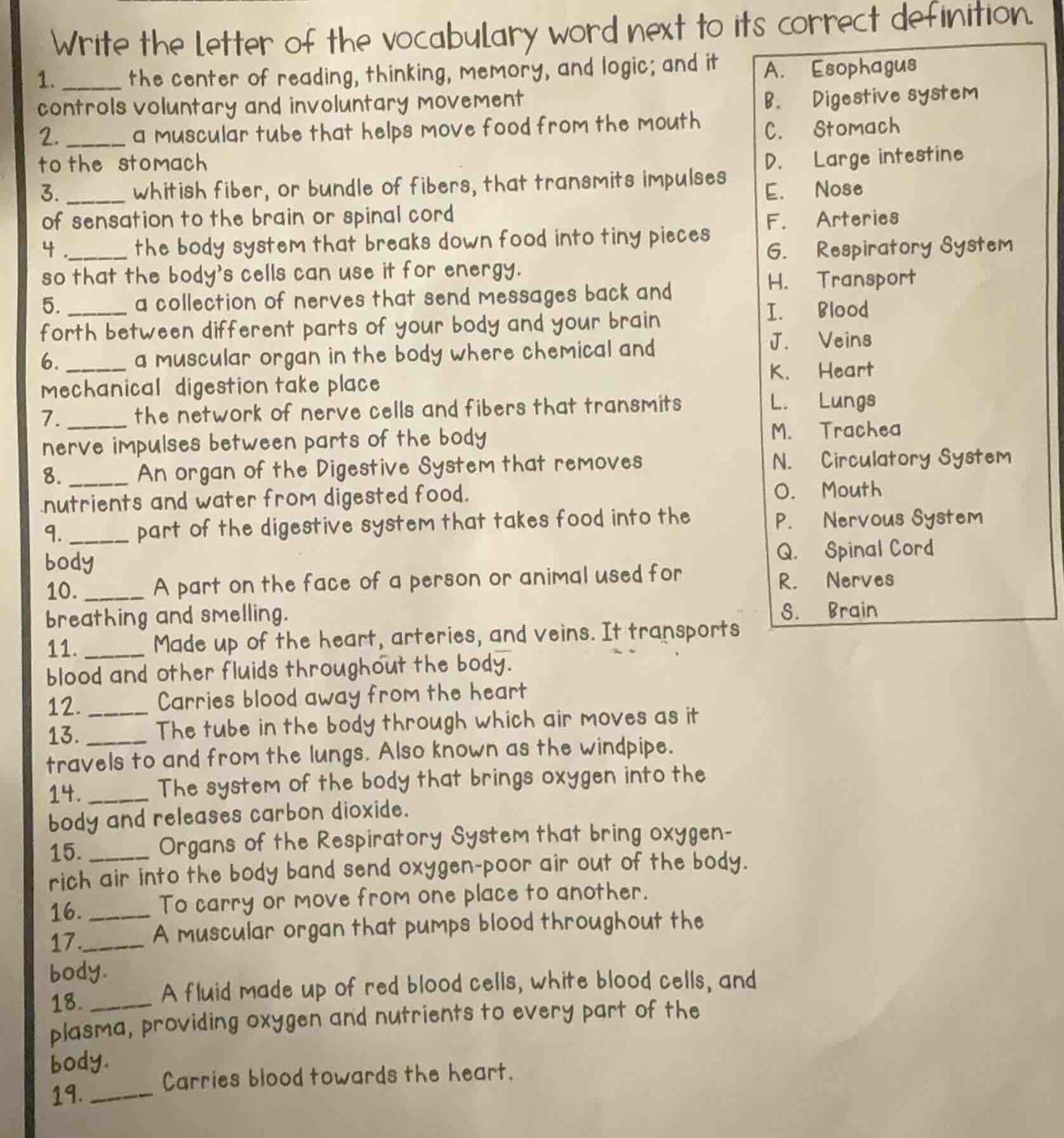
write the letter of the vocabulary word next to its correct definition.
- ______ the center of reading, thinking, memory, and logic; and it controls voluntary and involuntary movement
- ______ a muscular tube that helps move food from the mouth to the stomach
- ______ whitish fiber, or bundle of fibers, that transmits impulses of sensation to the brain or spinal cord
- ______ the body system that breaks down food into tiny pieces so that the bodys cells can use it for energy.
- ______ a collection of nerves that send messages back and forth between different parts of your body and your brain
- ______ a muscular organ in the body where chemical and mechanical digestion take place
- ______ the network of nerve cells and fibers that transmits nerve impulses between parts of the body
- ______ an organ of the digestive system that removes nutrients and water from digested food.
- ______ part of the digestive system that takes food into the body
- ______ a part on the face of a person or animal used for breathing and smelling.
- ______ made up of the heart, arteries, and veins. it transports blood and other fluids throughout the body.
- ______ carries blood away from the heart
- ______ the tube in the body through which air moves as it travels to and from the lungs. also known as the windpipe.
- ______ the system of the body that brings oxygen into the body and releases carbon dioxide.
- ______ organs of the respiratory system that bring oxygen - rich air into the body and send oxygen - poor air out of the body.
- ______ to carry or move from one place to another.
- ______ a muscular organ that pumps blood throughout the body.
- ______ a fluid made up of red blood cells, white blood cells, and plasma, providing oxygen and nutrients to every part of the body.
- ______ carries blood towards the heart.
a. esophagus
b. digestive system
c. stomach
d. large intestine
e. nose
f. arteries
g. respiratory system
h. transport
i. blood
j. veins
k. heart
l. lungs
m. trachea
n. circulatory system
o. mouth
p. nervous system
q. spinal cord
r. nerves
s. brain
Brief Explanations
Each definition is matched to the corresponding human body system or organ based on core biological functions:
- The brain controls cognition and movement.
- The esophagus moves food from mouth to stomach.
- Nerves transmit sensory impulses to the CNS.
- The digestive system breaks down food for energy.
- The spinal cord relays signals between body and brain.
- The stomach performs mechanical/chemical digestion.
- The nervous system coordinates body nerve impulses.
- The large intestine absorbs nutrients/water from digested food.
- The mouth is the entry point for food.
- The nose is used for breathing and smelling.
- The circulatory system transports blood via heart, arteries, veins.
- Arteries carry blood away from the heart.
- The trachea (windpipe) moves air to/from lungs.
- The respiratory system exchanges oxygen and carbon dioxide.
- The lungs facilitate gas exchange for the respiratory system.
- "Transport" means moving substances between locations.
- The heart pumps blood throughout the body.
- Blood is the fluid that delivers oxygen and nutrients.
- Veins carry blood back to the heart.

Snap & solve any problem in the app
Get step-by-step solutions on Sovi AI
Photo-based solutions with guided steps
Explore more problems and detailed explanations
- S. Brain
- A. Esophagus
- R. Nerves
- B. Digestive system
- Q. Spinal Cord
- C. Stomach
- P. Nervous System
- D. Large intestine
- O. Mouth
- E. Nose
- N. Circulatory System
- F. Arteries
- M. Trachea
- G. Respiratory System
- L. Lungs
- H. Transport
- K. Heart
- I. Blood
- J. Veins