QUESTION IMAGE
Question
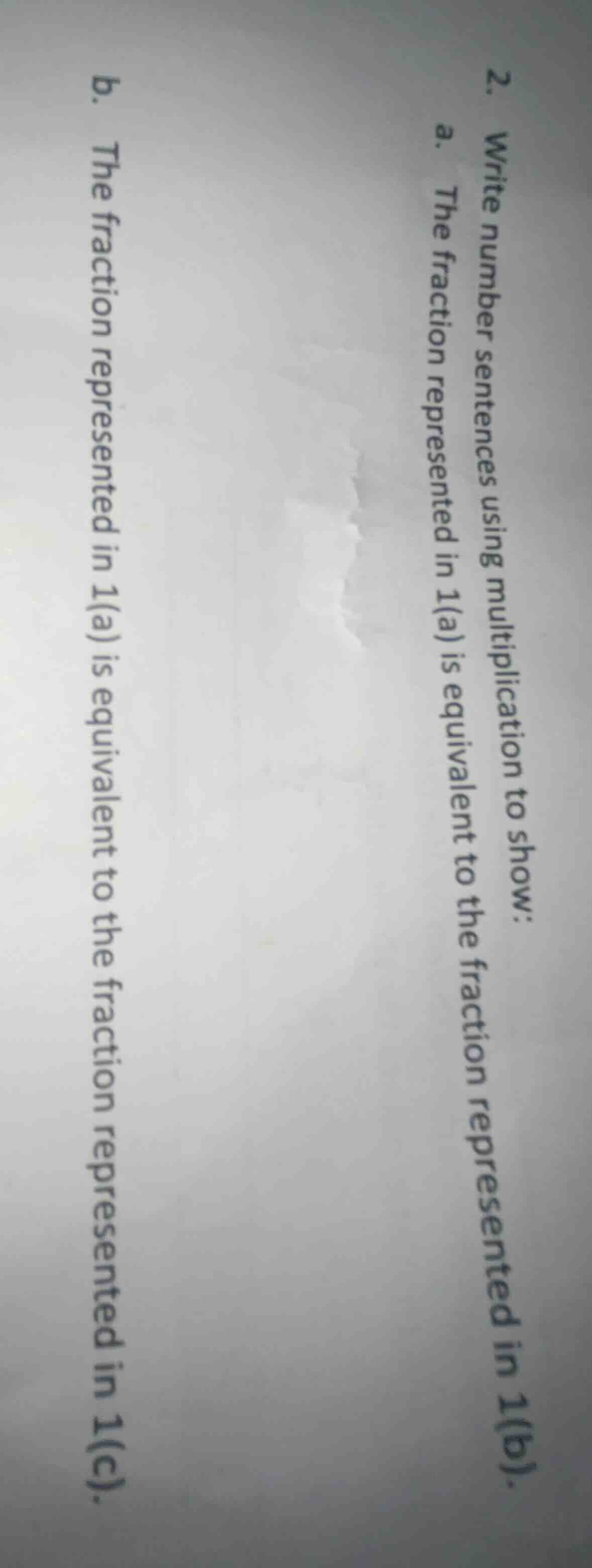
- write number sentences using multiplication to show:
a. the fraction represented in 1(a) is equivalent to the fraction represented in 1(b).
b. the fraction represented in 1(a) is equivalent to the fraction represented in 1(c).
To solve this, we need the fractions from 1(a), 1(b), and 1(c) which are not provided here. However, the general method to show equivalent fractions using multiplication is as follows:
Step 1: Recall the concept of equivalent fractions
Equivalent fractions are fractions that have the same value even though they look different. We can find equivalent fractions by multiplying (or dividing) both the numerator and the denominator by the same non - zero number. For example, if we have a fraction \(\frac{a}{b}\), and we multiply both the numerator and the denominator by a number \(n\) (where \(n
eq0\)), we get \(\frac{a\times n}{b\times n}\), and \(\frac{a}{b}=\frac{a\times n}{b\times n}\)
Step 2: Use the fractions from 1(a), 1(b), 1(c)
Let's assume that the fraction from 1(a) is \(\frac{x}{y}\), the fraction from 1(b) is \(\frac{m}{n}\) and the fraction from 1(c) is \(\frac{p}{q}\)
- For part 2(a):
Let the fraction in 1(a) be \(\frac{a}{b}\) and the fraction in 1(b) be \(\frac{c}{d}\). To show they are equivalent, we need to find a number \(k\) such that \(a\times k = c\) and \(b\times k=d\) (or vice - versa, we can also divide). Then we can write \(\frac{a}{b}=\frac{a\times k}{b\times k}=\frac{c}{d}\)
- For part 2(b):
Let the fraction in 1(a) be \(\frac{a}{b}\) and the fraction in 1(c) be \(\frac{e}{f}\). We find a number \(l\) such that \(a\times l=e\) and \(b\times l = f\) (or vice - versa). Then we can write \(\frac{a}{b}=\frac{a\times l}{b\times l}=\frac{e}{f}\)
Since the fractions from 1(a), 1(b) and 1(c) are not given, we can't provide a numerical answer. But the above steps explain the general method to solve such problems related to equivalent fractions using multiplication.

Snap & solve any problem in the app
Get step-by-step solutions on Sovi AI
Photo-based solutions with guided steps
Explore more problems and detailed explanations
To solve this, we need the fractions from 1(a), 1(b), and 1(c) which are not provided here. However, the general method to show equivalent fractions using multiplication is as follows:
Step 1: Recall the concept of equivalent fractions
Equivalent fractions are fractions that have the same value even though they look different. We can find equivalent fractions by multiplying (or dividing) both the numerator and the denominator by the same non - zero number. For example, if we have a fraction \(\frac{a}{b}\), and we multiply both the numerator and the denominator by a number \(n\) (where \(n
eq0\)), we get \(\frac{a\times n}{b\times n}\), and \(\frac{a}{b}=\frac{a\times n}{b\times n}\)
Step 2: Use the fractions from 1(a), 1(b), 1(c)
Let's assume that the fraction from 1(a) is \(\frac{x}{y}\), the fraction from 1(b) is \(\frac{m}{n}\) and the fraction from 1(c) is \(\frac{p}{q}\)
- For part 2(a):
Let the fraction in 1(a) be \(\frac{a}{b}\) and the fraction in 1(b) be \(\frac{c}{d}\). To show they are equivalent, we need to find a number \(k\) such that \(a\times k = c\) and \(b\times k=d\) (or vice - versa, we can also divide). Then we can write \(\frac{a}{b}=\frac{a\times k}{b\times k}=\frac{c}{d}\)
- For part 2(b):
Let the fraction in 1(a) be \(\frac{a}{b}\) and the fraction in 1(c) be \(\frac{e}{f}\). We find a number \(l\) such that \(a\times l=e\) and \(b\times l = f\) (or vice - versa). Then we can write \(\frac{a}{b}=\frac{a\times l}{b\times l}=\frac{e}{f}\)
Since the fractions from 1(a), 1(b) and 1(c) are not given, we can't provide a numerical answer. But the above steps explain the general method to solve such problems related to equivalent fractions using multiplication.