QUESTION IMAGE
Question
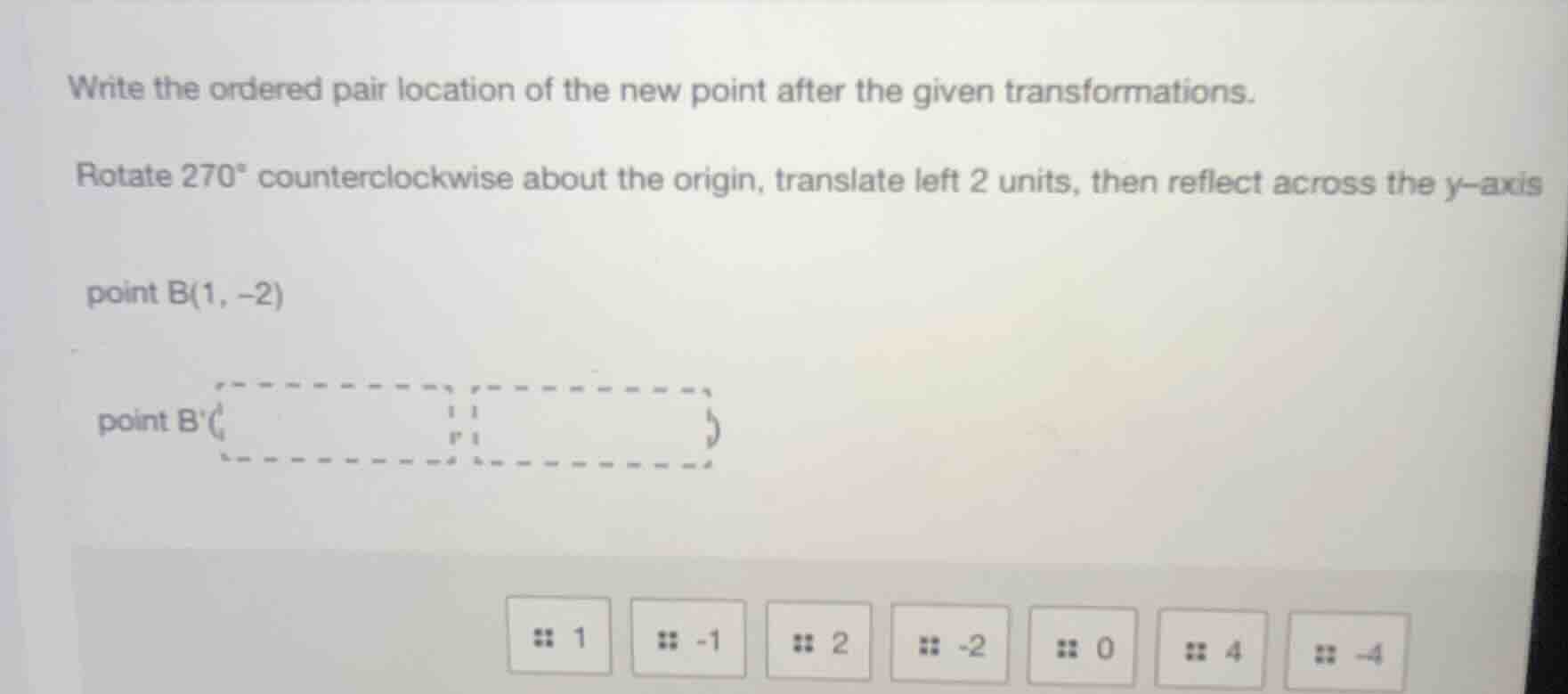
write the ordered pair location of the new point after the given transformations. rotate 270° counterclockwise about the origin, translate left 2 units, then reflect across the y - axis point b(1, -2) point b(, )
Step1: Rotate \(270^\circ\) counterclockwise about the origin
The rule for rotating a point \((x, y)\) \(270^\circ\) counterclockwise about the origin is \((x, y)\to(y, -x)\). For point \(B(1, -2)\), applying this rule: \(x = 1\), \(y=-2\), so the new point is \((-2, -1)\).
Step2: Translate left 2 units
To translate a point \((x, y)\) left 2 units, we subtract 2 from the \(x\)-coordinate. So for the point \((-2, -1)\), the new \(x\)-coordinate is \(-2 - 2=-4\), and the \(y\)-coordinate remains \(-1\). The point becomes \((-4, -1)\).
Step3: Reflect across the \(y\)-axis
The rule for reflecting a point \((x, y)\) across the \(y\)-axis is \((x, y)\to(-x, y)\). For the point \((-4, -1)\), applying this rule: the new \(x\)-coordinate is \(-(-4) = 4\), and the \(y\)-coordinate remains \(-1\). The point becomes \((4, -1)\). Wait, there is a mistake in the previous step. Wait, let's re - check step 2.
Wait, step 1: rotation \(270^\circ\) counterclockwise: \((x,y)\to(y, -x)\). For \(B(1,-2)\), \(x = 1\), \(y=-2\), so \((-2,-1)\) is correct.
Step 2: Translate left 2 units: \((x,y)\to(x - 2,y)\). So \((-2-2,-1)=(-4,-1)\) is correct.
Step 3: Reflect across \(y\)-axis: \((x,y)\to(-x,y)\). So \((-(-4),-1)=(4, - 1)\). But wait, the options do not have 4 and - 1? Wait, maybe I made a mistake in rotation. Wait, the rule for \(270^\circ\) counterclockwise is equivalent to \(90^\circ\) clockwise. The rule for \(90^\circ\) clockwise is \((x,y)\to(y,-x)\), which is the same as \(270^\circ\) counterclockwise. Wait, let's re - do step 1.
Wait, point \(B(1,-2)\). Rotate \(270^\circ\) counterclockwise: \((x,y)\to(y, -x)\). So \(x = 1\), \(y=-2\), so \((-2,-1)\). Then translate left 2 units: \(x=-2-2 = - 4\), \(y=-1\), so \((-4,-1)\). Reflect across \(y\)-axis: \((-x,y)\), so \(x = 4\), \(y=-1\). But the options have 4 and - 1? Wait, the options given are 1, - 1, 2, - 2, 0, 4, - 4. So 4 and - 1 is possible? Wait, maybe I made a mistake in the rotation direction. Wait, maybe it's \(270^\circ\) clockwise? No, the problem says counterclockwise. Wait, let's check the rotation rule again.
The general rotation rules:
- \(90^\circ\) counterclockwise: \((x,y)\to(-y,x)\)
- \(180^\circ\) counterclockwise: \((x,y)\to(-x,-y)\)
- \(270^\circ\) counterclockwise: \((x,y)\to(y,-x)\)
Yes, that's correct. So \((1,-2)\) rotated \(270^\circ\) counterclockwise is \((-2,-1)\). Then translate left 2 units: \((-2 - 2,-1)=(-4,-1)\). Then reflect across \(y\)-axis: \((4,-1)\). But the options have 4 and - 1? Wait, the options given are 1, - 1, 2, - 2, 0, 4, - 4. So 4 and - 1 is an option? Wait, maybe I made a mistake in the translation. Wait, no, left translation is subtracting from \(x\). Wait, let's re - check the problem again.
Wait, the original point is \(B(1,-2)\). Let's re - do the steps:
- Rotate \(270^\circ\) counterclockwise: \((x,y)\to(y, -x)\). So \((1,-2)\to(-2,-1)\). Correct.
- Translate left 2 units: \(x=-2-2=-4\), \(y = - 1\). So \((-4,-1)\). Correct.
- Reflect across \(y\)-axis: \((-x,y)\to(4,-1)\). So the ordered pair is \((4, - 1)\). But in the options, 4 and - 1 are available. Wait, maybe the problem has a typo, or I made a mistake. Wait, let's check the reflection rule again. Reflect across \(y\)-axis: \((x,y)\to(-x,y)\). So \((-4,-1)\to(4,-1)\). Yes. So the new point is \((4, - 1)\). But the options have 4 and - 1. So the ordered pair is \((4, - 1)\). But wait, the options for \(y\)-coordinate: - 1 is there, and 4 is there. So the answer is \((4, - 1)\). But maybe I made a mistake in the rotation. Wait, let's check \(270^\circ\) clockwi…

Snap & solve any problem in the app
Get step-by-step solutions on Sovi AI
Photo-based solutions with guided steps
Explore more problems and detailed explanations
\((4, -1)\)