QUESTION IMAGE
Question
write the set using set-builder notation.
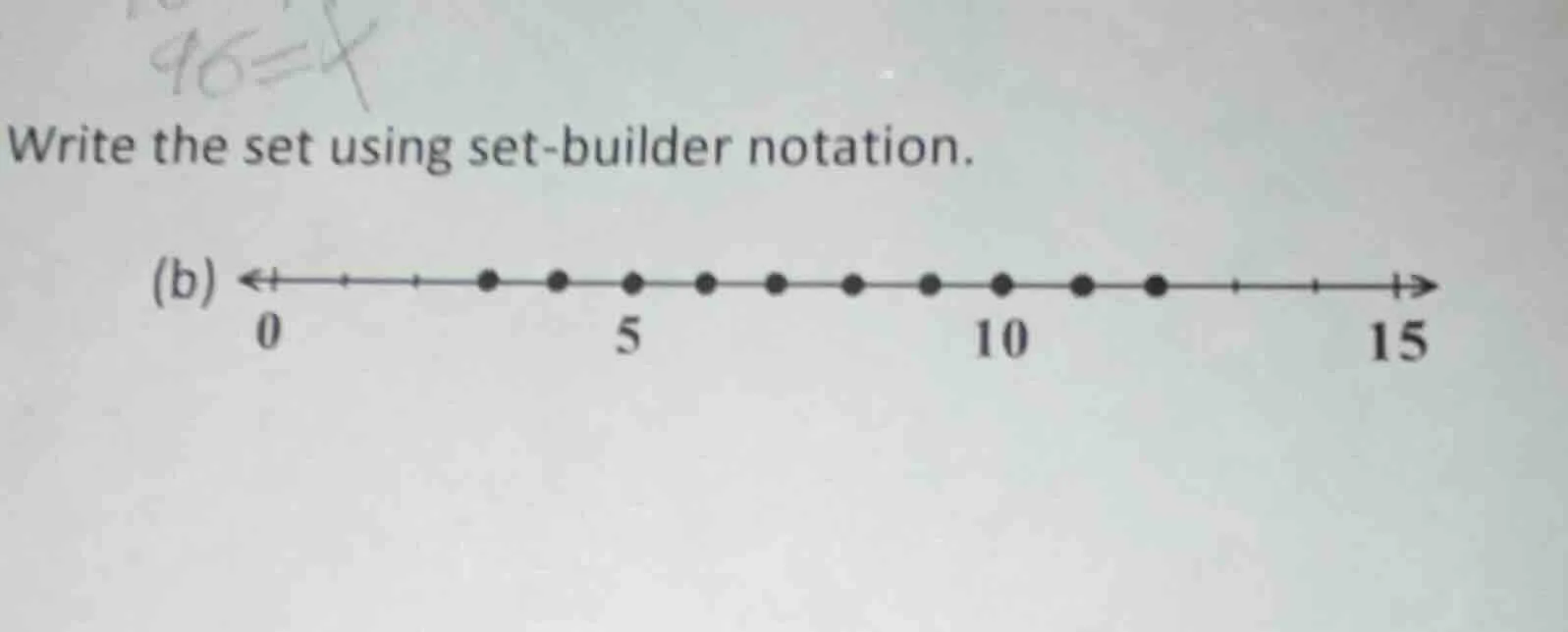
(b) 0 5 10 15
Step1: Identify the pattern on the number line
Looking at the number line, the marked points seem to be integers starting from 3 (let's check the spacing: from 0, the first mark is at 3? Wait, no, let's count the intervals. Wait, the first marked point after 0: from 0, the first mark is at 3? Wait, no, maybe the step is 1? Wait, no, let's see the positions. Wait, the number line has marks at 3,4,5,6,7,8,9,10,11,12? Wait, no, the labels are 0,5,10,15. Wait, maybe the marked points are integers \( x \) such that \( 3 \leq x \leq 12 \) or wait, let's check the number of marked points. Wait, the first marked point is at 3 (since from 0, three small ticks? Wait, the number line has 0, then three small ticks, then a marked point, then another, then 5, etc. Wait, maybe the marked points are integers \( x \) where \( 3 \leq x \leq 12 \)? Wait, no, let's count the marked points: from the first marked point to the last, how many? Let's see: the first marked point, then 4,5,6,7,8,9,10,11,12? Wait, no, maybe the correct range is \( 3 \leq x \leq 12 \) where \( x \) is an integer. Wait, alternatively, maybe the marked points are integers from 3 to 12 inclusive. Let's confirm: the number line has 0, then three units (each small tick is 1), so first marked point at 3, then 4,5,6,7,8,9,10,11,12. So the set is all integers \( x \) such that \( 3 \leq x \leq 12 \).
Step2: Write the set-builder notation
Set-builder notation is \( \{ x \mid \text{condition on } x \} \). Here, \( x \) is an integer, and \( 3 \leq x \leq 12 \). So the set is \( \{ x \in \mathbb{Z} \mid 3 \leq x \leq 12 \} \).

Snap & solve any problem in the app
Get step-by-step solutions on Sovi AI
Photo-based solutions with guided steps
Explore more problems and detailed explanations
\(\{ x \in \mathbb{Z} \mid 3 \leq x \leq 12 \}\)