QUESTION IMAGE
Question
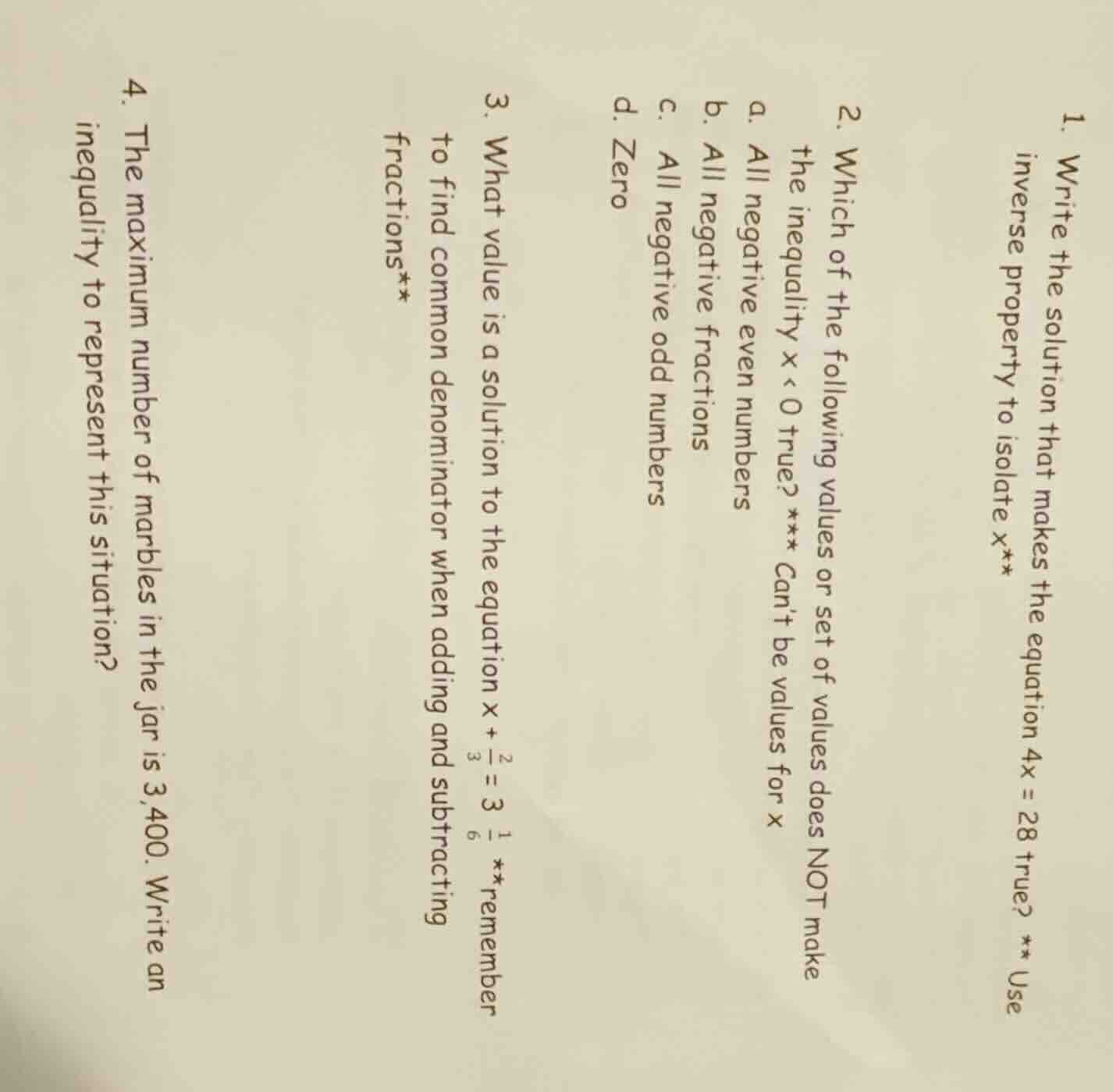
- write the solution that makes the equation ( 4x = 28 ) true? use inverse property to isolate ( x )
- which of the following values or set of values does not make the inequality ( x < 0 ) true? *** can’t be values for ( x )
a. all negative even numbers
b. all negative fractions
c. all negative odd numbers
d. zero
- what value is a solution to the equation ( x + \frac{2}{3} = 3\frac{1}{6} ) remember to find common denominator when adding and subtracting fractions
- the maximum number of marbles in the jar is 3,400. write an inequality to represent this situation?
Question 1
Step1: Recall inverse property of multiplication
The inverse property of multiplication states that for a non - zero number \(a\), \(a\times\frac{1}{a} = 1\). For the equation \(4x=28\), we use the inverse property of multiplication (multiplying both sides by the multiplicative inverse of 4) to isolate \(x\). The multiplicative inverse of 4 is \(\frac{1}{4}\).
Step2: Solve for \(x\)
Multiply both sides of the equation \(4x = 28\) by \(\frac{1}{4}\):
\(4x\times\frac{1}{4}=28\times\frac{1}{4}\)
Simplifying the left - hand side, \(4\times\frac{1}{4}x=x\), and the right - hand side, \(28\times\frac{1}{4}=\frac{28}{4} = 7\). So \(x = 7\) makes the equation \(4x = 28\) true.
Step1: Analyze option a
Let \(x\) be a negative even number, say \(x=-2\). Then \(x=-2<0\), so negative even numbers satisfy \(x < 0\).
Step2: Analyze option b
Let \(x =-\frac{1}{2}\), then \(x=-\frac{1}{2}<0\), so negative fractions satisfy \(x < 0\).
Step3: Analyze option c
Let \(x=-3\) (a negative odd number), then \(x = - 3<0\), so negative odd numbers satisfy \(x < 0\).
Step4: Analyze option d
If \(x = 0\), then the inequality \(x<0\) becomes \(0 < 0\), which is false. So zero does not make the inequality \(x < 0\) true.
Step1: Rewrite the equation
We have the equation \(x+\frac{2}{3}=3\frac{1}{6}\). First, convert the mixed number \(3\frac{1}{6}\) to an improper fraction. \(3\frac{1}{6}=\frac{3\times6 + 1}{6}=\frac{19}{6}\) and \(\frac{2}{3}=\frac{4}{6}\).
Step2: Solve for \(x\)
Subtract \(\frac{2}{3}\) (or \(\frac{4}{6}\)) from both sides of the equation:
\(x=\frac{19}{6}-\frac{4}{6}\)
\(x=\frac{19 - 4}{6}=\frac{15}{6}=\frac{5}{2}=2\frac{1}{2}\)
To find a common denominator when adding or subtracting fractions, we look for the least common multiple (LCM) of the denominators. For 3 and 6, the LCM of 3 and 6 is 6. So we convert \(\frac{2}{3}\) to \(\frac{4}{6}\) to have a common denominator of 6.

Snap & solve any problem in the app
Get step-by-step solutions on Sovi AI
Photo-based solutions with guided steps
Explore more problems and detailed explanations
The solution of the equation \(4x = 28\) is \(x = 7\). We use the multiplicative inverse property (multiplying both sides by \(\frac{1}{4}\), the multiplicative inverse of 4) to isolate \(x\).