QUESTION IMAGE
Question
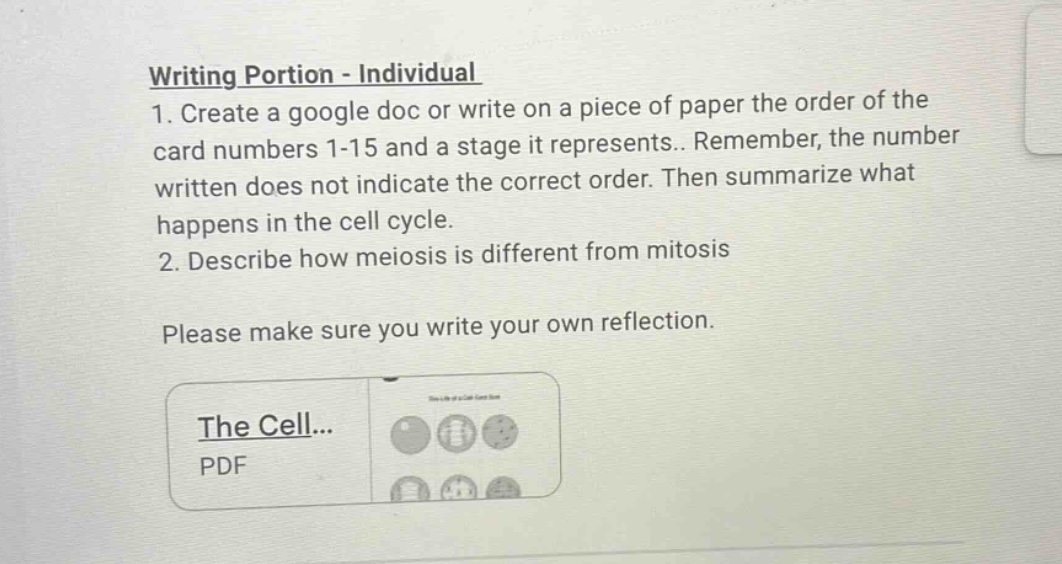
writing portion - individual
- create a google doc or write on a piece of paper the order of the
card numbers 1 - 15 and a stage it represents.. remember, the number
written does not indicate the correct order. then summarize what
happens in the cell cycle.
- describe how meiosis is different from mitosis
please make sure you write your own reflection.
the cell...
pdf
Part 1: Order of Card Numbers (Representing Cell Cycle Stages) and Cell Cycle Summary
Step 1: Identify Cell Cycle Stages
The cell cycle has two main phases: interphase (G₁, S, G₂) and mitotic phase (mitosis: prophase, metaphase, anaphase, telophase; and cytokinesis). For 15 cards, we can assign stages as follows (example order, assuming cards represent these stages):
- G₁ (Gap 1: cell grows, prepares for DNA replication)
- S (Synthesis: DNA replicates)
- G₂ (Gap 2: cell prepares for mitosis)
- Prophase (chromosomes condense, spindle forms)
- Prometaphase (nuclear envelope breaks down, chromosomes attach to spindle)
- Metaphase (chromosomes align at equator)
- Anaphase (sister chromatids separate)
- Telophase (nuclear envelopes reform, chromosomes decondense)
- Cytokinesis (cell divides into two daughter cells)
- (Optional: G₀, resting phase for non - dividing cells)
- (Repeat or additional sub - stages for clarity, e.g., early prophase, late prophase)
- (Early metaphase, late metaphase)
- (Early anaphase, late anaphase)
- (Early telophase, late telophase)
- (Final cytokinesis or G₁ of next cycle)
Step 2: Summarize the Cell Cycle
The cell cycle is a series of events that cells go through to grow, replicate DNA, and divide. Interphase (G₁, S, G₂) is the longest phase: G₁ (cell growth, normal functions), S (DNA replication, forming sister chromatids), G₂ (cell prepares for division). The mitotic phase includes mitosis (prophase, metaphase, anaphase, telophase) where the nucleus divides, and cytokinesis (cytoplasm divides), resulting in two genetically identical daughter cells.
Part 2: Differences Between Meiosis and Mitosis
Step 1: Define Mitosis and Meiosis
- Mitosis: A type of cell division for growth, repair, and asexual reproduction. Produces 2 diploid (2n) daughter cells, genetically identical to the parent. Has 1 round of division (prophase - metaphase - anaphase - telophase - cytokinesis).
- Meiosis: A type of cell division for sexual reproduction (gamete formation). Produces 4 haploid (n) daughter cells, genetically unique (due to crossing over and independent assortment). Has 2 rounds of division (meiosis I: prophase I, metaphase I, anaphase I, telophase I; meiosis II: prophase II, metaphase II, anaphase II, telophase II).
Step 2: Key Differences
| Feature | Mitosis | Meiosis |
|---|---|---|
| Number of Divisions | 1 | 2 |
| Daughter Cells | 2 diploid (2n), identical | 4 haploid (n), unique |
| Genetic Variation | No (except mutations) | Yes (crossing over, independent assortment) |
Part 3: Reflection
Reflecting on this task, I learned the detailed sequence of the cell cycle and the critical differences between mitosis and meiosis. Understanding the cell cycle helps explain how organisms grow and repair, while meiosis’ role in creating genetic diversity is vital for evolution and sexual reproduction. This knowledge deepens my appreciation for cellular processes and their impact on life.

Snap & solve any problem in the app
Get step-by-step solutions on Sovi AI
Photo-based solutions with guided steps
Explore more problems and detailed explanations
s (Key Summaries):
- Cell Cycle Order (Example): 1 - G₁, 2 - S, 3 - G₂, 4 - Prophase, 5 - Prometaphase, 6 - Metaphase, 7 - Anaphase, 8 - Telophase, 9 - Cytokinesis, 10 - G₀, 11 - Early Prophase, 12 - Late Metaphase, 13 - Early Anaphase, 14 - Late Telophase, 15 - Final Cytokinesis.
Cell Cycle Summary: Interphase (G₁, S, G₂) prepares the cell for division; mitotic phase (mitosis + cytokinesis) divides the nucleus and cytoplasm, producing two identical daughter cells.
- Meiosis vs. Mitosis: Mitosis produces 2 identical diploid cells for growth/repair; meiosis produces 4 unique haploid cells for sexual reproduction, with 2 divisions and genetic variation.
- Reflection: Gained clarity on cellular division processes and their biological significance.