QUESTION IMAGE
Question
writing a translation rule
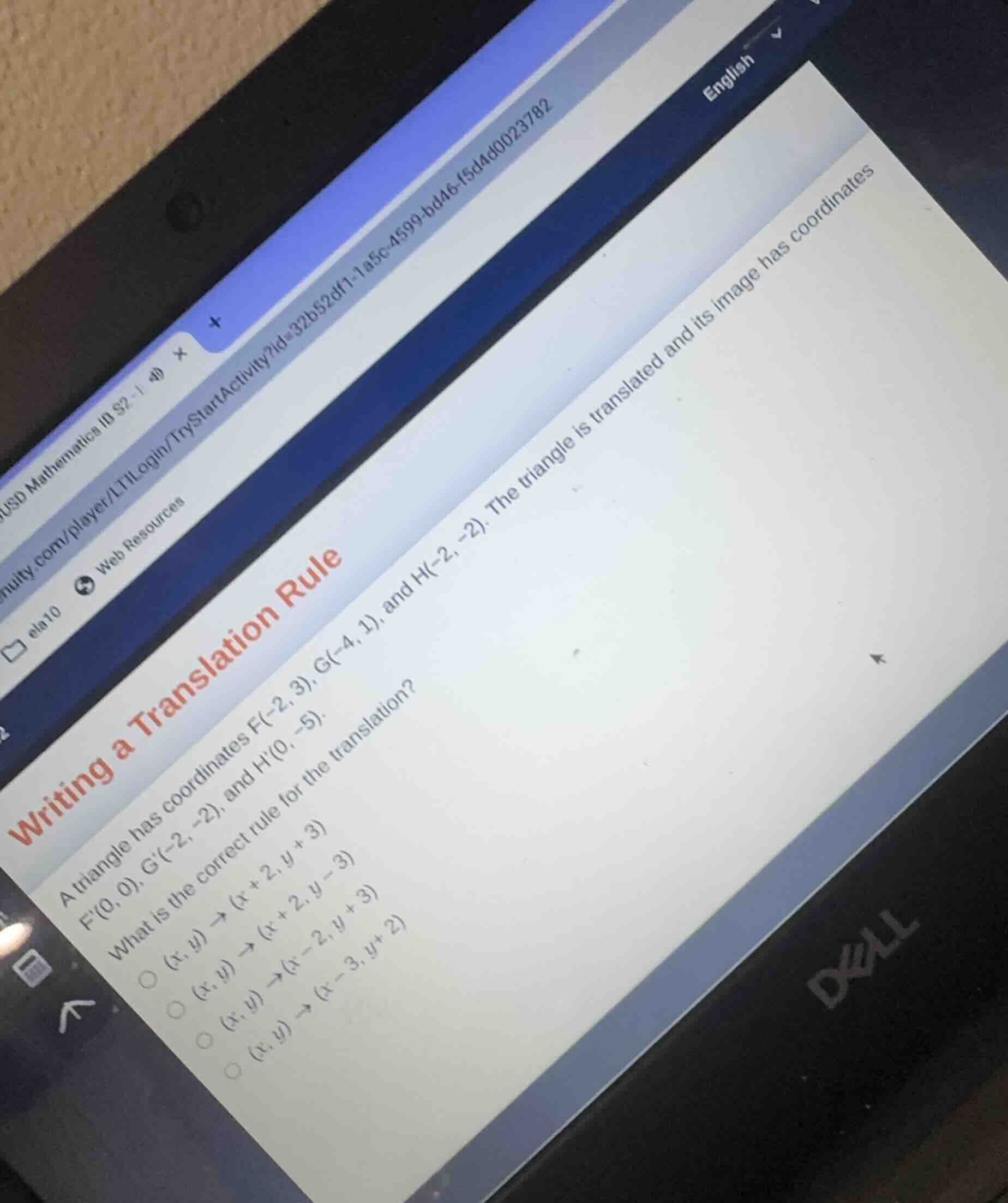
a triangle has coordinates f(-2, 3), g(-4, 1), and h(-2, -2). the triangle is translated and its image has coordinates
f(0, 0), g(-2, -2), and h(0, -5).
what is the correct rule for the translation?
(x, y) → (x + 2, y + 3)
(x, y) → (x + 2, y − 3)
(x, y) →(x − 2, y + 3)
(x, y) → (x − 3, y + 2)
Step1: Analyze point F
Original point \( F(-2, 3) \), image \( F'(0, 0) \). Calculate \( \Delta x = 0 - (-2) = 2 \), \( \Delta y = 0 - 3 = -3 \)? Wait, no, wait. Wait, \( F(-2,3) \) to \( F'(0,0) \). Wait, \( 0 - (-2) = 2 \) (x - change), \( 0 - 3 = -3 \)? But let's check another point. \( G(-4,1) \) to \( G'(-2,-2) \). \( \Delta x = -2 - (-4) = 2 \), \( \Delta y = -2 - 1 = -3 \). \( H(-2,-2) \) to \( H'(0,-5) \). \( \Delta x = 0 - (-2) = 2 \), \( \Delta y = -5 - (-2) = -3 \). Wait, no, the options: first option is \( (x + 2, y + 3) \). Wait, maybe I miscalculated. Wait, \( F(-2,3) \) to \( F'(0,0) \): \( x \) goes from -2 to 0, so \( x + 2 \). \( y \) goes from 3 to 0, so \( y - 3 \)? But option 2 is \( (x + 2, y - 3) \). Wait, but let's check \( G(-4,1) \) to \( G'(-2,-2) \): \( x \): -4 + 2 = -2 (correct). \( y \): 1 - 3 = -2 (correct). \( H(-2,-2) \) to \( H'(0,-5) \): \( x \): -2 + 2 = 0 (correct). \( y \): -2 - 3 = -5 (correct). Wait, but the first option is \( (x + 2, y + 3) \), which would make \( y \) increase, but here \( y \) decreases. Wait, maybe I made a mistake. Wait, the options:
Option 1: \( (x, y) \to (x + 2, y + 3) \)
Option 2: \( (x, y) \to (x + 2, y - 3) \)
Option 3: \( (x, y) \to (x - 2, y + 3) \)
Option 4: \( (x, y) \to (x - 3, y + 2) \)
Wait, let's recalculate \( F(-2,3) \) to \( F'(0,0) \):
\( x \): -2 + 2 = 0 (correct for \( F' \) x-coordinate). \( y \): 3 - 3 = 0 (correct for \( F' \) y-coordinate). \( G(-4,1) \): -4 + 2 = -2 (correct \( G' \) x), 1 - 3 = -2 (correct \( G' \) y). \( H(-2,-2) \): -2 + 2 = 0 (correct \( H' \) x), -2 - 3 = -5 (correct \( H' \) y). So the translation is \( x + 2 \), \( y - 3 \), which is option 2. Wait, but the first option is \( y + 3 \), which would be wrong. Wait, maybe I messed up the direction. Wait, translation rule: \( (x, y) \to (x + a, y + b) \), where \( a \) is horizontal change, \( b \) vertical. So for \( F(-2,3) \) to \( F'(0,0) \), \( 0 = -2 + a \implies a = 2 \). \( 0 = 3 + b \implies b = -3 \). So the rule is \( (x + 2, y - 3) \), which is option 2. Wait, but let's check the options again. The first option is \( (x + 2, y + 3) \), second is \( (x + 2, y - 3) \), third \( (x - 2, y + 3) \), fourth \( (x - 3, y + 2) \). So the correct rule is \( (x, y) \to (x + 2, y - 3) \), which is the second option. Wait, but let's confirm with each point:
- \( F(-2, 3) \): \( x + 2 = -2 + 2 = 0 \), \( y - 3 = 3 - 3 = 0 \) → \( F'(0, 0) \) (correct)
- \( G(-4, 1) \): \( x + 2 = -4 + 2 = -2 \), \( y - 3 = 1 - 3 = -2 \) → \( G'(-2, -2) \) (correct)
- \( H(-2, -2) \): \( x + 2 = -2 + 2 = 0 \), \( y - 3 = -2 - 3 = -5 \) → \( H'(0, -5) \) (correct)
So the correct rule is \( (x, y) \to (x + 2, y - 3) \), which is the second option. Wait, but the options are:
- \( (x, y) \to (x + 2, y + 3) \)
- \( (x, y) \to (x + 2, y - 3) \)
- \( (x, y) \to (x - 2, y + 3) \)
- \( (x, y) \to (x - 3, y + 2) \)
So the answer is option 2: \( (x, y) \to (x + 2, y - 3) \)

Snap & solve any problem in the app
Get step-by-step solutions on Sovi AI
Photo-based solutions with guided steps
Explore more problems and detailed explanations
The correct option is the second one: \( \boldsymbol{(x, y) \to (x + 2, y - 3)} \) (corresponding to the option labeled as the second choice, e.g., if options are A to D, assuming the second option is, say, B: \( (x, y) \to (x + 2, y - 3) \))