QUESTION IMAGE
Question
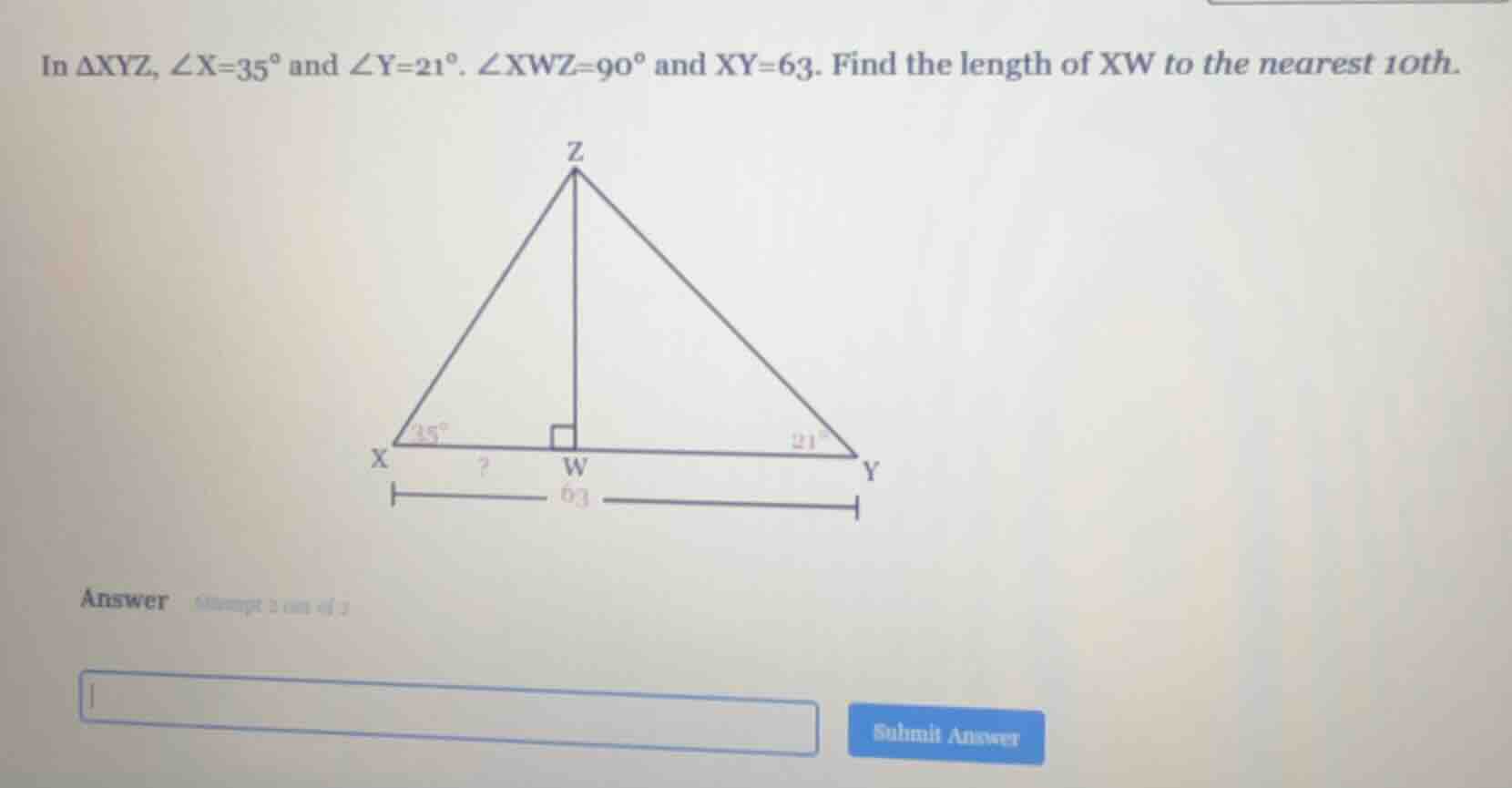
in δxyz, ∠x=35° and ∠y=21°. ∠xwz=90° and xy=63. find the length of xw to the nearest 10th.
Step1: Find ∠Z in △XYZ
In a triangle, the sum of angles is \(180^\circ\). So, \(\angle Z = 180^\circ - \angle X - \angle Y = 180^\circ - 35^\circ - 21^\circ = 124^\circ\). But maybe we can use trigonometry with the right triangle. Let's denote \(XW = x\), \(WY = 63 - x\), and \(ZW = h\) (height).
In \(Rt\triangle XWZ\), \(\tan(35^\circ) = \frac{h}{x}\) ⇒ \(h = x\tan(35^\circ)\).
In \(Rt\triangle YWZ\), \(\tan(21^\circ) = \frac{h}{63 - x}\) ⇒ \(h = (63 - x)\tan(21^\circ)\).
Step2: Equate the two expressions for h
Since both equal \(h\), we have:
\(x\tan(35^\circ) = (63 - x)\tan(21^\circ)\)
Expand the right side: \(x\tan(35^\circ) = 63\tan(21^\circ) - x\tan(21^\circ)\)
Bring terms with \(x\) to left: \(x\tan(35^\circ) + x\tan(21^\circ) = 63\tan(21^\circ)\)
Factor \(x\): \(x(\tan(35^\circ) + \tan(21^\circ)) = 63\tan(21^\circ)\)
Step3: Solve for x
\(x = \frac{63\tan(21^\circ)}{\tan(35^\circ) + \tan(21^\circ)}\)
Calculate \(\tan(35^\circ) \approx 0.7002\), \(\tan(21^\circ) \approx 0.3839\)
Substitute values: \(x = \frac{63 \times 0.3839}{0.7002 + 0.3839} = \frac{24.1857}{1.0841} \approx 22.3\) (Wait, no, maybe I mixed up. Wait, actually, let's re-examine. Wait, maybe using the Law of Sines in △XYZ first.
Law of Sines: \(\frac{XZ}{\sin(21^\circ)} = \frac{XY}{\sin(124^\circ)}\)
\(XZ = \frac{63 \times \sin(21^\circ)}{\sin(124^\circ)}\)
\(\sin(21^\circ) \approx 0.3584\), \(\sin(124^\circ) = \sin(56^\circ) \approx 0.8290\)
\(XZ \approx \frac{63 \times 0.3584}{0.8290} \approx \frac{22.5792}{0.8290} \approx 27.24\)
Then in \(Rt\triangle XWZ\), \(\cos(35^\circ) = \frac{XW}{XZ}\) ⇒ \(XW = XZ\cos(35^\circ)\)
\(XW \approx 27.24 \times \cos(35^\circ)\), \(\cos(35^\circ) \approx 0.8192\)
\(XW \approx 27.24 \times 0.8192 \approx 22.3\)? Wait, no, maybe better to use the first method.
Wait, first method:
\(x = \frac{63 \times 0.3839}{0.7002 + 0.3839} = \frac{24.1857}{1.0841} \approx 22.3\)? Wait, no, wait:
Wait, \(\tan(35) ≈ 0.7002\), \(\tan(21) ≈ 0.3839\)
So denominator: \(0.7002 + 0.3839 = 1.0841\)
Numerator: \(63 * 0.3839 = 24.1857\)
24.1857 / 1.0841 ≈ 22.3? Wait, but let's check with Law of Sines again.
Law of Sines in △XYZ: \(\frac{XZ}{\sin(21^\circ)} = \frac{XY}{\sin(124^\circ)}\)
\(XZ = \frac{63 \times \sin(21^\circ)}{\sin(124^\circ)} = \frac{63 \times 0.3584}{0.8290} ≈ \frac{22.5792}{0.8290} ≈ 27.24\)
Then in right triangle XWZ, \(XW = XZ \cos(35^\circ) ≈ 27.24 * 0.8192 ≈ 22.3\). Wait, but maybe I made a mistake in the first method. Wait, no, let's do the first method again.
From \(x\tan35 = (63 - x)\tan21\)
\(x0.7002 = (63 - x)0.3839\)
\(0.7002x = 63*0.3839 - 0.3839x\)
\(0.7002x + 0.3839x = 24.1857\)
\(1.0841x = 24.1857\)
\(x = 24.1857 / 1.0841 ≈ 22.3\). Wait, but let's check with another approach.
Alternatively, let's use the formula for the length of the segment in a triangle with an altitude. The length of XW can be found by \(XW = \frac{XY \times \cos(\angle X) \times \cos(\angle Y)}{\cos(\angle X) + \cos(\angle Y)}\)? No, better to use the two right triangles.
Wait, another way: Let’s let \(XW = x\), then \(WY = 63 - x\). In △XWZ, \(ZW = x \tan 35\). In △YWZ, \(ZW = (63 - x) \tan 21\). So:
\(x \tan 35 = (63 - x) \tan 21\)
\(x (\tan 35 + \tan 21) = 63 \tan 21\)
\(x = \frac{63 \tan 21}{\tan 35 + \tan 21}\)
Calculating:
\(\tan 21 ≈ 0.38386\), \(\tan 35 ≈ 0.70021\)
So numerator: \(63 * 0.38386 ≈ 24.1832\)
Denominator: \(0.70021 + 0.38386 ≈ 1.08407\)
\(x ≈ 24.1832 / 1.08407 ≈ 22.3\)
Wait, but let's check with more precise values.
\(\tan(21^\circ) = \tan(21) ≈ 0.383864035\)
\(\tan(35^\circ)…

Snap & solve any problem in the app
Get step-by-step solutions on Sovi AI
Photo-based solutions with guided steps
Explore more problems and detailed explanations
\(22.3\)