QUESTION IMAGE
Question
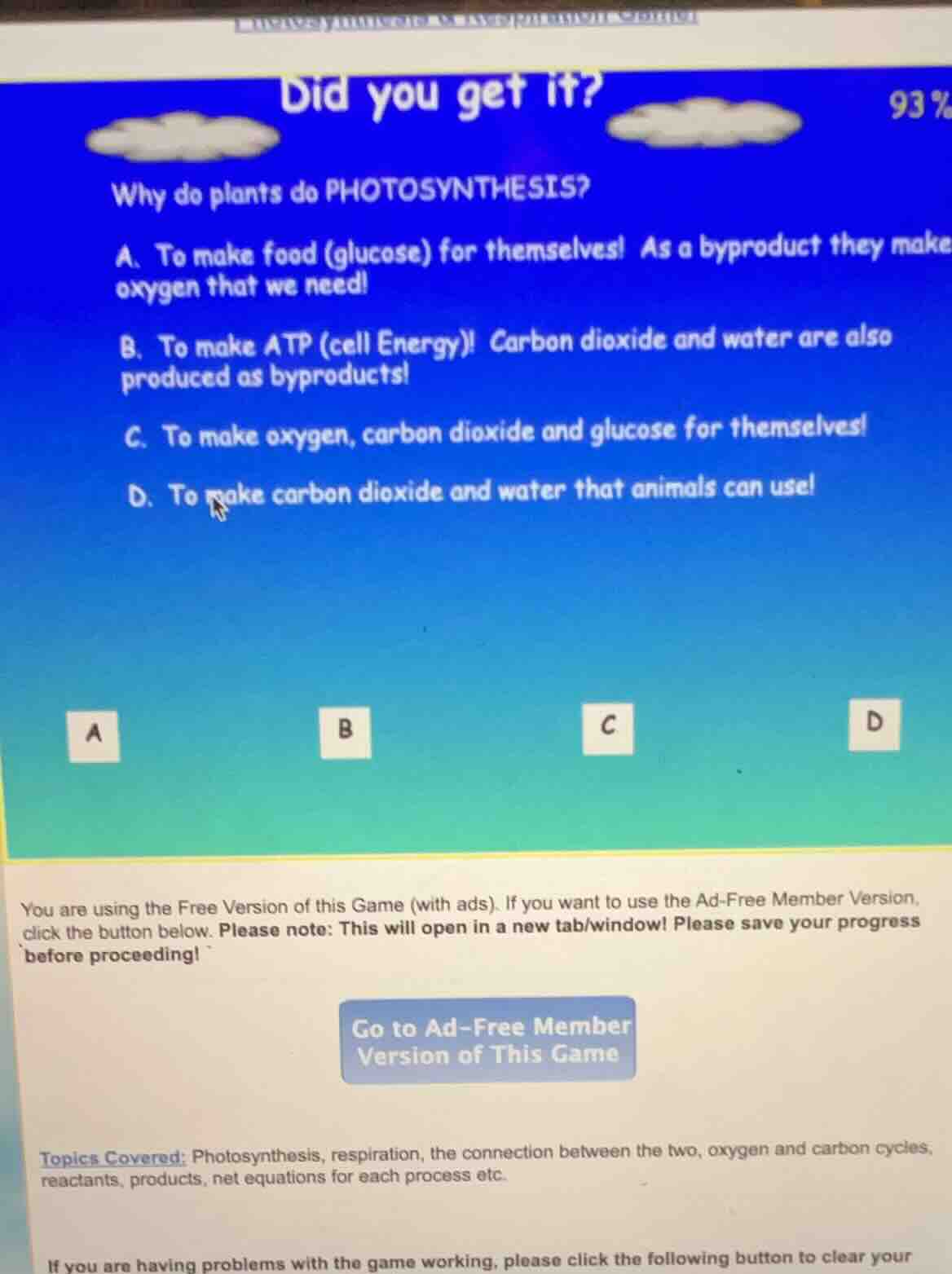
did you get it?
why do plants do photosynthesis?
a. to make food (glucose) for themselves! as a byproduct they make oxygen that we need!
b. to make atp (cell energy)! carbon dioxide and water are also produced as byproducts!
c. to make oxygen, carbon dioxide and glucose for themselves!
d. to make carbon dioxide and water that animals can use!
a b c d
you are using the free version of this game (with ads). if you want to use the ad - free member version, click the button below. please note: this will open in a new tab/window! please save your progress before proceeding!
go to ad - free member version of this game
topics covered: photosynthesis, respiration, the connection between the two, oxygen and carbon cycles, reactants, products, net equations for each process etc.
if you are having problems with the game working, please click the following button to clear your
- Option A: Photosynthesis in plants uses sunlight, carbon dioxide, and water to produce glucose (food for the plant) and oxygen as a byproduct. This matches the purpose of photosynthesis.
- Option B: ATP is mainly produced in cellular respiration, not photosynthesis. Photosynthesis produces glucose which is then used in respiration to make ATP. Also, the byproducts of photosynthesis are oxygen and glucose (not carbon dioxide and water).
- Option C: Plants do not make carbon dioxide for themselves; they take in carbon dioxide for photosynthesis.
- Option D: Plants take in carbon dioxide and water for photosynthesis, they do not produce them for animals. Animals produce carbon dioxide which plants use.

Snap & solve any problem in the app
Get step-by-step solutions on Sovi AI
Photo-based solutions with guided steps
Explore more problems and detailed explanations
A. To make food (glucose) for themselves! As a byproduct they make oxygen that we need!