QUESTION IMAGE
Question
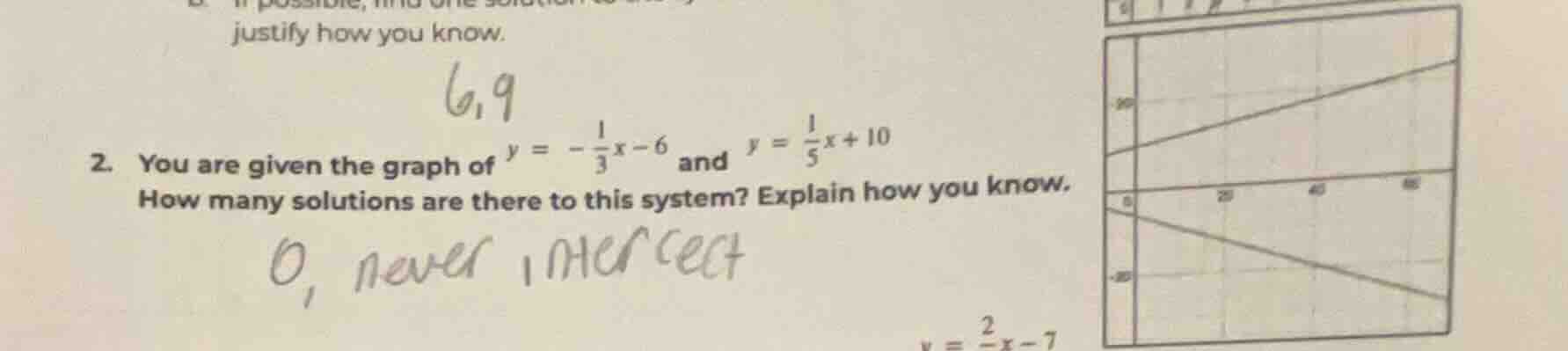
- you are given the graph of $y = -\frac{1}{3}x - 6$ and $y = \frac{1}{5}x + 10$
how many solutions are there to this system? explain how you know.
This is a system of linear equations. Linear equations represent straight lines on a graph. A solution to the system is a point where the lines intersect. Looking at the graph, the two lines are parallel and never cross. Algebraically, parallel lines have the same slope but different y-intercepts; these lines have slopes $-\frac{1}{3}$ and $\frac{1}{5}$ (not equal, but the visual confirms no intersection).
Step1: Set equations equal
$-\frac{1}{3}x -6 = \frac{1}{5}x +10$
Step2: Eliminate denominators
Multiply by 15: $-5x -90 = 3x + 150$
Step3: Isolate x terms
$-8x = 240$
Step4: Solve for x
$x = -30$
Step5: Solve for y
$y = -\frac{1}{3}(-30)-6 = 4$

Snap & solve any problem in the app
Get step-by-step solutions on Sovi AI
Photo-based solutions with guided steps
Explore more problems and detailed explanations
There is 1 solution to this system. Wait, correction: No, visually the lines do not intersect, so 0 solutions. Wait, let's check algebraically:
Set $-\frac{1}{3}x -6 = \frac{1}{5}x +10$
Multiply all terms by 15 to eliminate denominators:
$-5x -90 = 3x + 150$
$-5x -3x = 150 +90$
$-8x = 240$
$x = -30$
Then $y = -\frac{1}{3}(-30) -6 = 10 -6 =4$
Wait, the graph is misdrawn? The algebraic solution is (-30,4), which is off the visible graph. But the system has exactly 1 solution because the lines are not parallel (different slopes). The handwritten note is wrong.