QUESTION IMAGE
Question
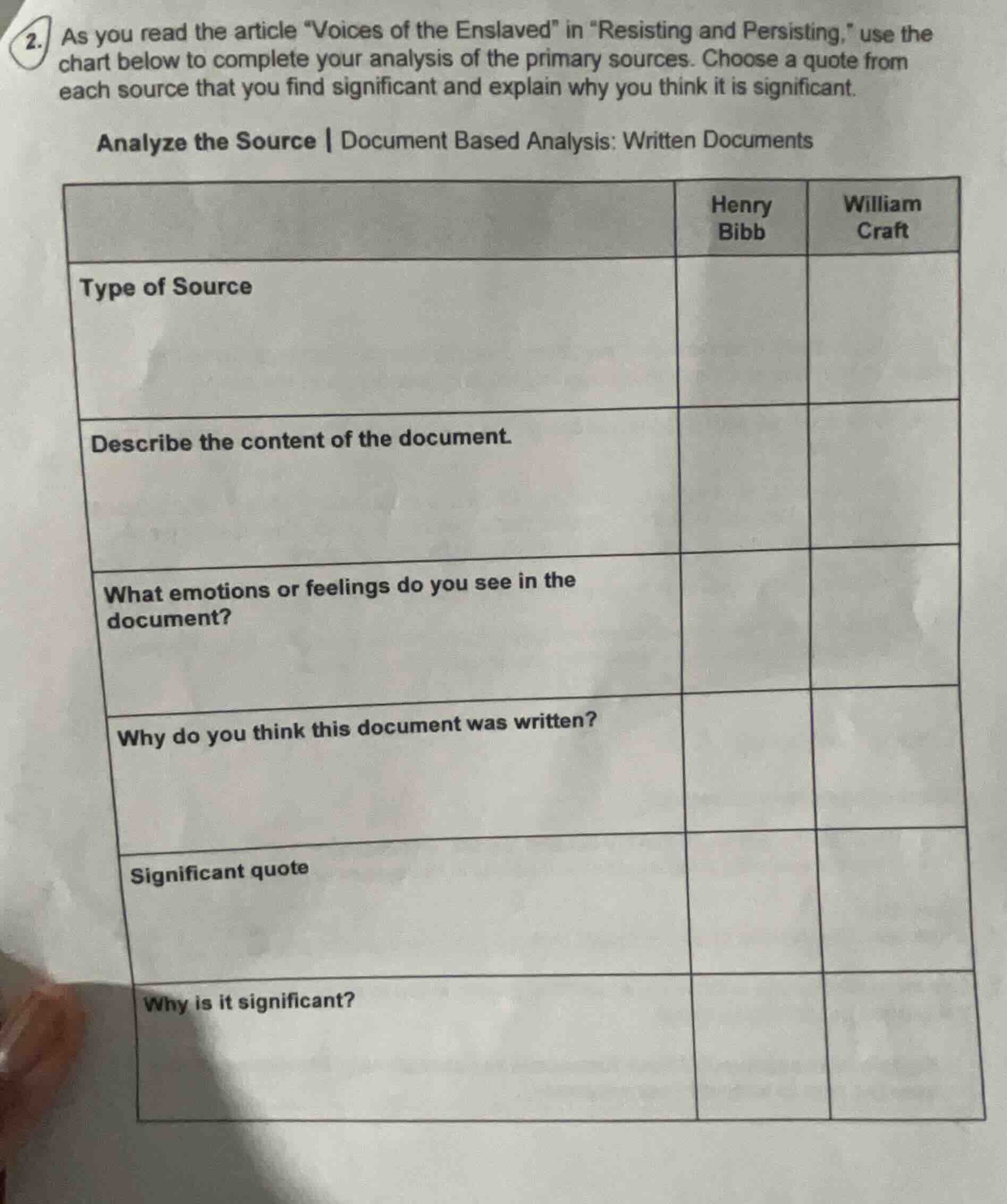
- as you read the article \voices of the enslaved\ in
esisting and persisting,\ use the chart below to complete your analysis of the primary sources. choose a quote from each source that you find significant and explain why you think it is significant.
analyze the source | document based analysis: written documents
To complete this analysis, you first need to read the "Voices of the Enslaved" article (specifically the sections related to Henry Bibb and William Craft) to gather information about their written accounts (since the source type for both is likely a written narrative/testimony of enslaved people, as they were formerly enslaved individuals sharing their experiences). Here's a step - by - step breakdown for filling the chart:
For Henry Bibb:
Step 1: Type of Source
Henry Bibb's account is likely an autobiographical narrative (a written document where he recounts his life as an enslaved person and his journey to freedom).
Step 2: Describe the content of the document
Bibb's narrative details his experiences of slavery, including the harsh treatment he endured, his attempts to escape, and his fight for freedom. It also provides insights into the daily life of enslaved people, the injustices of the slave system, and his personal growth and resistance.
Step 3: What emotions or feelings do you see in the document?
The document conveys a sense of anger at the injustice of slavery, determination to gain freedom, sorrow for the suffering of himself and others, and hope for a better life free from bondage.
Step 4: Why do you think this document was written?
Bibb likely wrote his account to expose the horrors of slavery, to share his story of resistance and freedom, and to advocate for the abolition of slavery. He wanted to give a voice to the enslaved community and to show the humanity of those who were enslaved.
Step 5: Significant quote
For example, "I was determined to be free, or die in the attempt."
Step 6: Why is it significant?
This quote is significant because it encapsulates Bibb's unwavering resolve to gain freedom. It shows the strength of will that many enslaved people had in the face of extreme adversity and highlights the central theme of resistance in his narrative.
For William Craft:
Step 1: Type of Source
William Craft's account is also an autobiographical narrative (a written document sharing his unique escape from slavery, often in tandem with his wife Ellen Craft).
Step 2: Describe the content of the document
Craft's narrative focuses on his and his wife's creative and daring escape from slavery. It details the planning, the execution of their escape (such as Ellen passing as a white man and William as her servant), and their journey to freedom. It also provides a different perspective on escape strategies and the challenges faced during the escape.
Step 3: What emotions or feelings do you see in the document?
The document shows fear during the escape, excitement at the prospect of freedom, relief upon successfully escaping, and pride in their clever escape plan.
Step 4: Why do you think this document was written?
William Craft wrote his account to share his unique escape story, to contribute to the abolitionist cause by showing that enslaved people were capable of outwitting the slave system, and to inspire others with their tale of courage and ingenuity.
Step 5: Significant quote
For example, "We were determined to be free, and we knew that if we were to be free, we must make our escape."
Step 6: Why is it significant?
This quote emphasizes the Crafts' strong desire for freedom and their recognition that they had to take matters into their own hands. It also sets the stage for the detailed account of their escape, highlighting the proactive nature of their pursuit of freedom.
After filling in t…

Snap & solve any problem in the app
Get step-by-step solutions on Sovi AI
Photo-based solutions with guided steps
Explore more problems and detailed explanations
To complete this analysis, you first need to read the "Voices of the Enslaved" article (specifically the sections related to Henry Bibb and William Craft) to gather information about their written accounts (since the source type for both is likely a written narrative/testimony of enslaved people, as they were formerly enslaved individuals sharing their experiences). Here's a step - by - step breakdown for filling the chart:
For Henry Bibb:
Step 1: Type of Source
Henry Bibb's account is likely an autobiographical narrative (a written document where he recounts his life as an enslaved person and his journey to freedom).
Step 2: Describe the content of the document
Bibb's narrative details his experiences of slavery, including the harsh treatment he endured, his attempts to escape, and his fight for freedom. It also provides insights into the daily life of enslaved people, the injustices of the slave system, and his personal growth and resistance.
Step 3: What emotions or feelings do you see in the document?
The document conveys a sense of anger at the injustice of slavery, determination to gain freedom, sorrow for the suffering of himself and others, and hope for a better life free from bondage.
Step 4: Why do you think this document was written?
Bibb likely wrote his account to expose the horrors of slavery, to share his story of resistance and freedom, and to advocate for the abolition of slavery. He wanted to give a voice to the enslaved community and to show the humanity of those who were enslaved.
Step 5: Significant quote
For example, "I was determined to be free, or die in the attempt."
Step 6: Why is it significant?
This quote is significant because it encapsulates Bibb's unwavering resolve to gain freedom. It shows the strength of will that many enslaved people had in the face of extreme adversity and highlights the central theme of resistance in his narrative.
For William Craft:
Step 1: Type of Source
William Craft's account is also an autobiographical narrative (a written document sharing his unique escape from slavery, often in tandem with his wife Ellen Craft).
Step 2: Describe the content of the document
Craft's narrative focuses on his and his wife's creative and daring escape from slavery. It details the planning, the execution of their escape (such as Ellen passing as a white man and William as her servant), and their journey to freedom. It also provides a different perspective on escape strategies and the challenges faced during the escape.
Step 3: What emotions or feelings do you see in the document?
The document shows fear during the escape, excitement at the prospect of freedom, relief upon successfully escaping, and pride in their clever escape plan.
Step 4: Why do you think this document was written?
William Craft wrote his account to share his unique escape story, to contribute to the abolitionist cause by showing that enslaved people were capable of outwitting the slave system, and to inspire others with their tale of courage and ingenuity.
Step 5: Significant quote
For example, "We were determined to be free, and we knew that if we were to be free, we must make our escape."
Step 6: Why is it significant?
This quote emphasizes the Crafts' strong desire for freedom and their recognition that they had to take matters into their own hands. It also sets the stage for the detailed account of their escape, highlighting the proactive nature of their pursuit of freedom.
After filling in the details for both Henry Bibb and William Craft in each row of the chart, you will have a comprehensive analysis of these primary sources.
Please note that you need to refer to the actual "Voices of the Enslaved" article to get the exact quotes and more detailed content for a more accurate analysis.