QUESTION IMAGE
Question
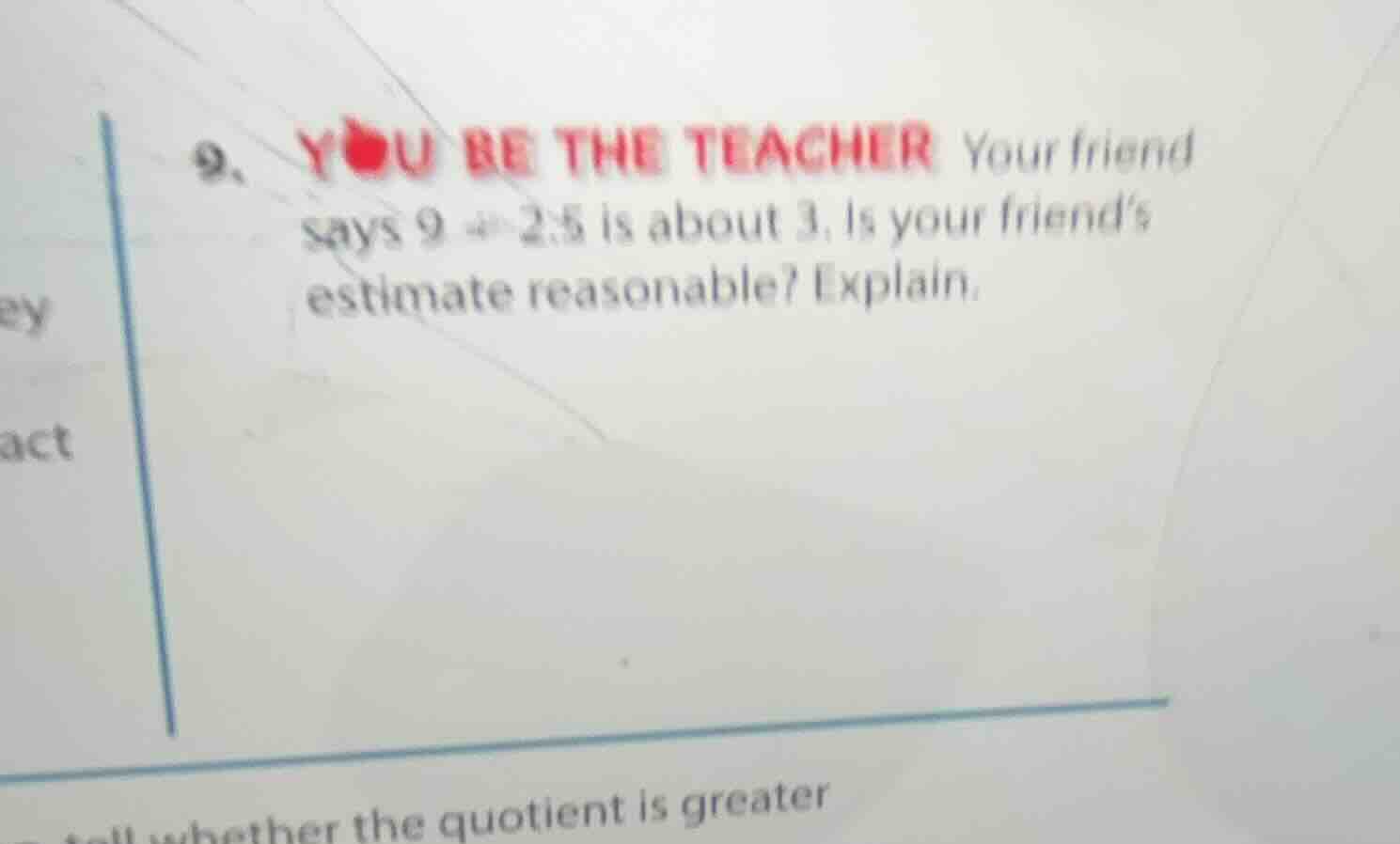
- you be the teacher your friend says $9\div2.5$ is about 3. is your friends estimate reasonable? explain.
Step1: Recall multiplication for estimation
To check the estimate, we can use the inverse operation of division, which is multiplication. If \( 9\div2.5\approx3 \), then \( 3\times2.5 \) should be close to 9.
Step2: Calculate \( 3\times2.5 \)
\( 3\times2.5 = 7.5 \)
Step3: Compare with 9
The product \( 7.5 \) is not very close to 9. A better estimate: Let's round 2.5 to 3 (since 2.5 is close to 3). Then \( 9\div3 = 3 \), but wait, actually, if we use the correct inverse: we know that \( 2.5\times3.6=9 \) (because \( 9\div2.5 = 3.6 \)). Wait, maybe another way: \( 2.5\times3 = 7.5 \), \( 2.5\times4 = 10 \). Since 9 is between \( 2.5\times3 = 7.5 \) and \( 2.5\times4 = 10 \), and 9 - 7.5 = 1.5, 10 - 9 = 1, so it's closer to 4? Wait, no, wait the original division is \( 9\div2.5 \). Let's do the exact division: \( 9\div2.5=\frac{9}{\frac{5}{2}}=9\times\frac{2}{5}=\frac{18}{5} = 3.6 \). So the actual value is 3.6, which is close to 3? Wait, 3.6 is 0.6 more than 3. But maybe the friend rounded 2.5 to 3, then 9÷3=3. But the difference between 3.6 and 3 is 0.6. Alternatively, if we consider that 2.5 is half of 5, so 9÷2.5 = (9×2)÷5 = 18÷5 = 3.6. So the actual value is 3.6, which is about 3 (since 3.6 is close to 3, maybe the friend considered rounding to the nearest whole number). Wait, maybe my initial step was wrong. Let's re - evaluate. The friend says 9÷2.5 is about 3. Let's calculate the actual value: 9 divided by 2.5. We can multiply numerator and denominator by 2 to eliminate the decimal: (9×2)÷(2.5×2)=18÷5 = 3.6. Now, 3.6 is approximately 3 (if we round to the nearest whole number). The difference between 3.6 and 3 is 0.6, which is a relatively small error for an estimate. Alternatively, using the multiplication check: if we think the estimate is 3, then 3×2.5 = 7.5, and 9 - 7.5 = 1.5. But if we use the actual quotient 3.6, then 3.6×2.5 = 9. So the friend's estimate of 3 is reasonable because 3.6 is close to 3 (when rounding to the nearest whole number), or because when doing a quick estimate, rounding 2.5 to 3 (since 2.5 is a decimal and rounding to a whole number for easier division) gives 9÷3 = 3, and the actual value is 3.6 which is close to 3.
Wait, maybe I made a mistake earlier. Let's correct: The key is that for estimation, we can round the divisor. 2.5 is close to 3, so 9÷3 = 3. The actual quotient is 3.6, which is close to 3 (the difference is 0.6, which is acceptable for a rough estimate). So the friend's estimate is reasonable because when we round 2.5 to 3 (a whole number for easier mental math), 9 divided by 3 is 3, and the actual quotient (3.6) is close to 3.

Snap & solve any problem in the app
Get step-by-step solutions on Sovi AI
Photo-based solutions with guided steps
Explore more problems and detailed explanations
The friend's estimate is reasonable. When estimating \( 9\div2.5 \), we can round the divisor \( 2.5 \) to \( 3 \) (a whole number for simpler mental calculation). Then \( 9\div3 = 3 \). The actual value of \( 9\div2.5 \) is \( 3.6 \), which is close to \( 3 \), so the estimate of \( 3 \) is reasonable (the difference between \( 3.6 \) and \( 3 \) is relatively small for a rough estimate).