QUESTION IMAGE
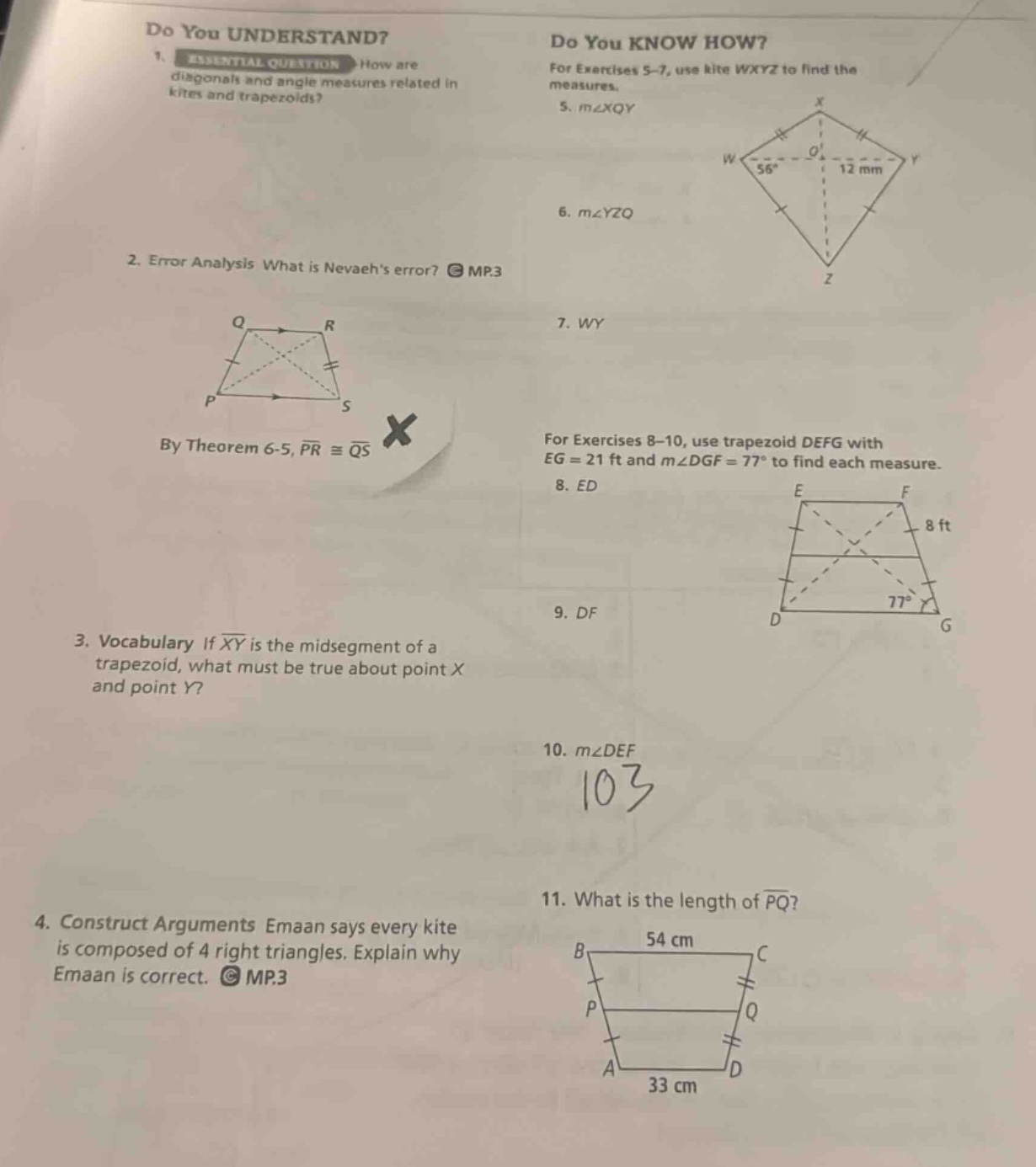
Question
do you understand?
- essential question how are diagonals and angle measures related in kites and trapezoids?
- error analysis what is nevaehs error? mp.3
by theorem 6 - 5, $overline{pr} cong overline{qs}$
- vocabulary if $overline{xy}$ is the midsegment of a trapezoid, what must be true about point x and point y?
- construct arguments emaan says every kite is composed of 4 right triangles. explain why emaan is correct. mp.3
do you know how?
for exercises 5 - 7, use kite wxyz to find the measures.
- $mangle xqy$
- $mangle yzo$
- $wy$
for exercises 8 - 10, use trapezoid defg with $eg = 21$ ft and $mangle dgf = 77^{circ}$ to find each measure.
- $ed$
- $df$
- $mangle def$
- what is the length of $overline{pq}$?
1. (Essential Question)
Diagonals of kites are perpendicular; one diagonal bisects the other and the non-vertex angles. In isosceles trapezoids, diagonals are congruent, base angles are congruent, and consecutive angles between the two bases are supplementary. For non-isosceles trapezoids, only consecutive angles between bases are supplementary.
2. (Error Analysis)
Step1: Identify figure type
PQRS is a trapezoid with $\overline{PQ} \parallel \overline{SR}$, $\overline{PS} \cong \overline{QR}$ (isosceles trapezoid).
Step2: Recall trapezoid diagonal theorem
In isosceles trapezoids, the congruent segments are the legs, and the diagonals are congruent to each other ($\overline{PR} \cong \overline{QS}$ is true for isosceles trapezoids, but if PQRS is not isosceles, this does not hold. The error is misapplying the theorem to a non-isosceles trapezoid, as the markings only show $\overline{PQ} \parallel \overline{SR}$ and one pair of non-parallel sides is not marked congruent, so Theorem 6-5 (for isosceles trapezoids) does not apply.
3. (Vocabulary)
Step1: Recall midsegment definition
A trapezoid midsegment connects the midpoints of the two non-parallel legs.
Step2: State requirement for X and Y
$X$ must be the midpoint of one leg, $Y$ must be the midpoint of the other leg.
4. (Construct Arguments)
Step1: Recall kite diagonal property
The diagonals of a kite are perpendicular to each other.
Step2: Explain triangle division
The perpendicular intersection of the diagonals creates 4 triangles, each with a right angle at the intersection point, so all 4 are right triangles.
5. (Find $m\angle XQY$)
Step1: Recall kite diagonal property
Diagonals of a kite are perpendicular.
Step2: State angle measure
$\angle XQY = 90^\circ$
6. (Find $m\angle YZQ$)
Step1: Use kite angle congruence
$\angle WXQ = \angle W = 56^\circ$ (adjacent angles to congruent sides in kite are equal).
Step2: Calculate $\angle XWQ$
In $\triangle WXO$, $\angle XWQ = \frac{180^\circ - 90^\circ - 56^\circ}{1} = 34^\circ$
Step3: Use kite triangle congruence
$\triangle WXO \cong \triangle YZO$, so $\angle YZQ = \angle XWQ = 34^\circ$
7. (Find $WY$)
Step1: Identify segment length
$OY = 12$ mm, and the diagonal $WY$ is bisected by $XZ$.
Step2: Calculate $WY$
$WY = 2 \times OY = 2 \times 12 = 24$ mm
8. (Find $ED$)
Step1: Identify trapezoid side property
In trapezoid $DEFG$, $\overline{EF} \parallel \overline{DG}$, and $\overline{ED} \cong \overline{FG}$ (marked congruent).
Step2: State length of $ED$
$ED = FG = 8$ ft
9. (Find $DF$)
Step1: Recall trapezoid diagonal property
In isosceles trapezoids, diagonals are congruent.
Step2: State length of $DF$
$DF = EG = 21$ ft
10. (Find $m\angle DEF$)
Step1: Use consecutive angle property
$\angle DEF$ and $\angle DGF$ are supplementary (consecutive angles between parallel bases of trapezoid).
Step2: Calculate angle measure
$m\angle DEF = 180^\circ - 77^\circ = 103^\circ$
11. (Find length of $\overline{PQ}$)
Step1: Recall trapezoid midsegment formula
The midsegment length is $\frac{1}{2} \times (\text{sum of the two bases})$.
Step2: Substitute values
$PQ = \frac{1}{2} \times (AB + CD) = \frac{1}{2} \times (33 + 54) = \frac{1}{2} \times 87 = 43.5$ cm

Snap & solve any problem in the app
Get step-by-step solutions on Sovi AI
Photo-based solutions with guided steps
Explore more problems and detailed explanations
- Diagonals of kites are perpendicular; one bisects the other and the angles. In isosceles trapezoids, diagonals are congruent, base angles are congruent, and consecutive angles between bases are supplementary.
- Nevaeh misapplied Theorem 6-5; $\overline{PR}
ot\cong \overline{QS}$
- $X$ is the midpoint of one leg, $Y$ is the midpoint of the other leg.
- The diagonals of a kite are perpendicular, dividing it into 4 right triangles.
- $90^\circ$
- $34^\circ$
- $24$ mm
- $8$ ft
- $21$ ft
- $103^\circ$
- $43.5$ cm