QUESTION IMAGE
Question
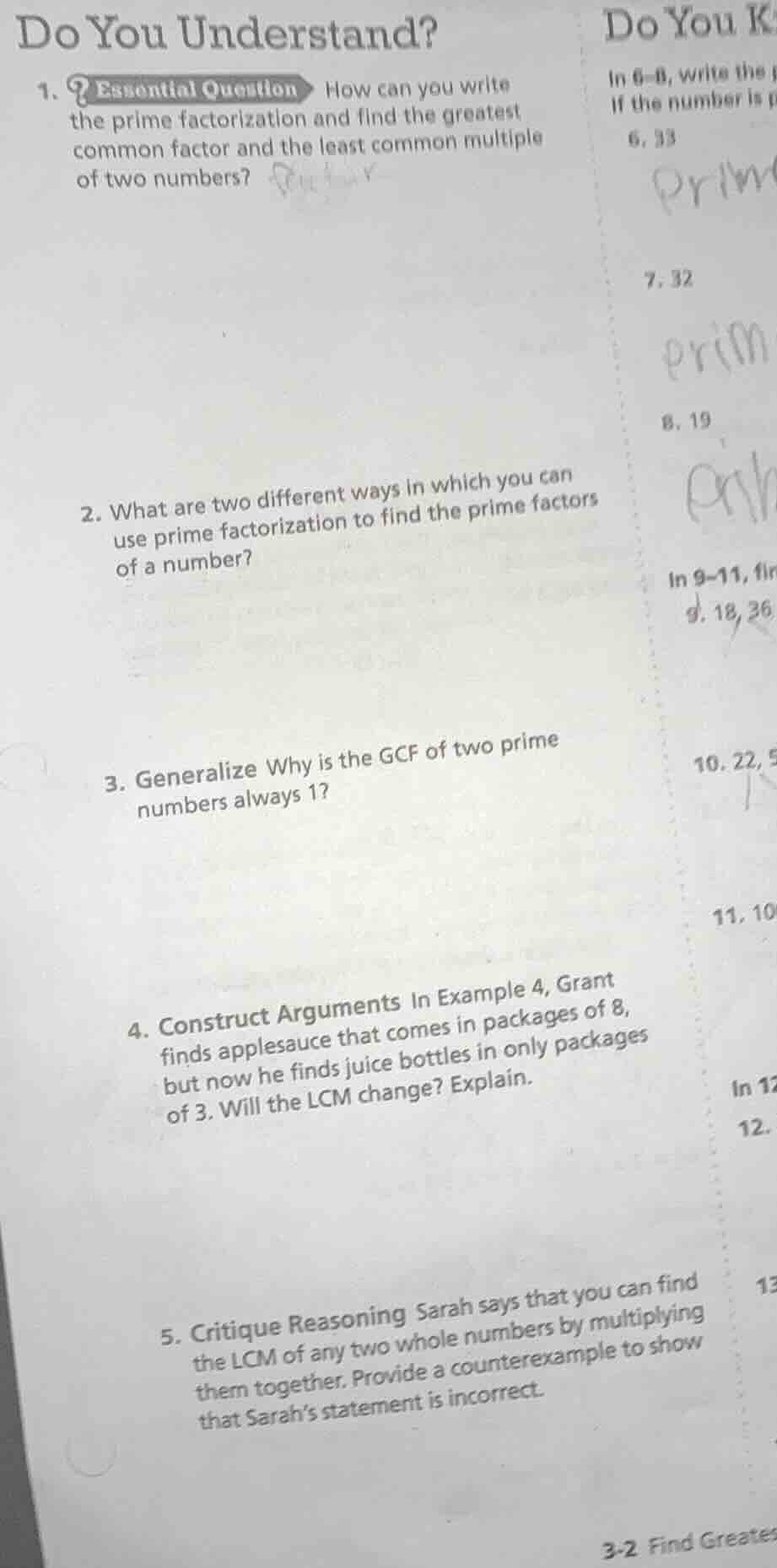
do you understand?
- essential question how can you write the prime factorization and find the greatest common factor and the least common multiple of two numbers?
- what are two different ways in which you can use prime factorization to find the prime factors of a number?
- generalize why is the gcf of two prime numbers always 1?
- construct arguments in example 4, grant finds applesauce that comes in packages of 8, but now he finds juice bottles in only packages of 3. will the lcm change? explain.
- critique reasoning sarah says that you can find the lcm of any two whole numbers by multiplying them together. provide a counterexample to show that sarah’s statement is incorrect.
do you k
in 6–8, write the
if the number is p
- 33
- 32
- 19
in 9–11, fin
- 18, 36
- 22, 5
- 10
in 12
12.
13
3 - 2 find greates
Question 3: Generalize Why is the GCF of two prime numbers always 1?
A prime number is defined as a number greater than 1 that has exactly two distinct positive divisors: 1 and itself. For example, take two prime numbers, say 5 and 7. The factors of 5 are 1 and 5, and the factors of 7 are 1 and 7. The only common factor between them is 1. In general, for any two different prime numbers, their only common divisor is 1 because they have no other factors besides 1 and themselves, and they are different (so their "themselves" factors are different). If the two prime numbers were the same (e.g., 3 and 3), the GCF would be the prime number itself, but the question implies two prime numbers (usually distinct in such contexts, or if they are the same, the question might be phrased differently). Assuming two distinct prime numbers, their greatest common factor is 1 because they share no other common factors.

Snap & solve any problem in the app
Get step-by-step solutions on Sovi AI
Photo-based solutions with guided steps
Explore more problems and detailed explanations
The GCF of two prime numbers is always 1 because a prime number has only 1 and itself as factors. For two distinct prime numbers, the only common factor is 1 (since their other factor, themselves, are different and not shared). For example, for primes \( p \) and \( q \) (\( p
eq q \)), factors of \( p \) are \( 1, p \) and factors of \( q \) are \( 1, q \), so the greatest common factor is 1.