QUESTION IMAGE
Question
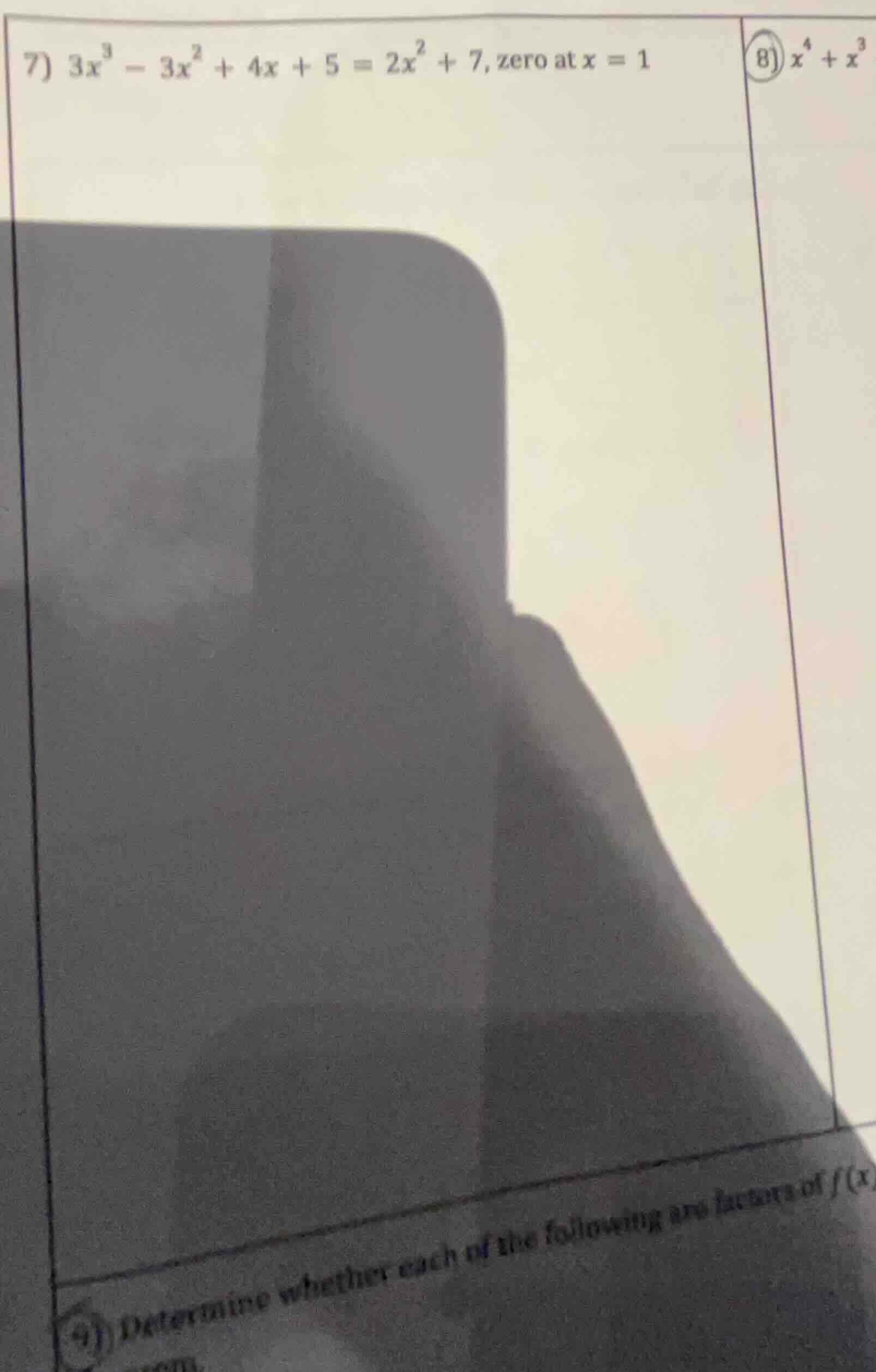
- $3x^3 - 3x^2 + 4x + 5 = 2x^2 + 7$, zero at $x = 1$
- $x^4 + x^3$
- determine whether each of the following are factors of $f(x)$
Step1: Rearrange equation to standard form
Subtract $2x^2 + 7$ from both sides.
$3x^3 - 3x^2 + 4x + 5 - 2x^2 - 7 = 0$
$3x^3 - 5x^2 + 4x - 2 = 0$
Step2: Factor using known zero $x=1$
Since $x=1$ is a zero, $(x-1)$ is a factor. Use polynomial division or synthetic division to divide $3x^3 - 5x^2 + 4x - 2$ by $(x-1)$.
Using synthetic division:
Result: $3x^2 - 2x + 2$
Step3: Solve quadratic factor
Use quadratic formula $x = \frac{-b \pm \sqrt{b^2 - 4ac}}{2a}$ for $3x^2 - 2x + 2=0$, where $a=3$, $b=-2$, $c=2$.
$x = \frac{2 \pm \sqrt{(-2)^2 - 4(3)(2)}}{2(3)}$
$x = \frac{2 \pm \sqrt{4 - 24}}{6}$
$x = \frac{2 \pm \sqrt{-20}}{6}$
$x = \frac{2 \pm 2i\sqrt{5}}{6} = \frac{1 \pm i\sqrt{5}}{3}$

Snap & solve any problem in the app
Get step-by-step solutions on Sovi AI
Photo-based solutions with guided steps
Explore more problems and detailed explanations
$x=1$, $x=\frac{1+i\sqrt{5}}{3}$, $x=\frac{1-i\sqrt{5}}{3}$