QUESTION IMAGE
Question
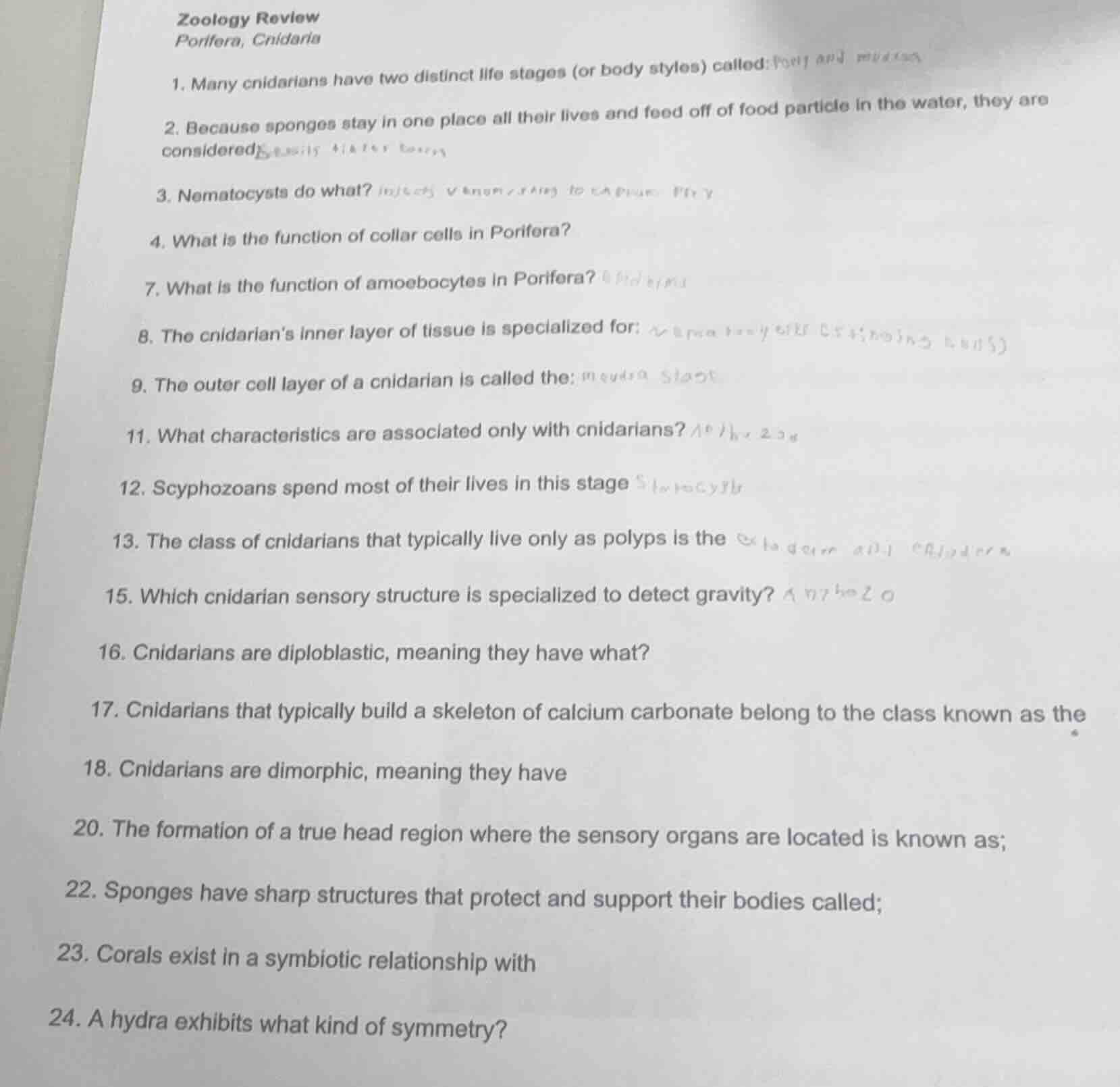
zoology reviewporifera, cnidaria1. many cnidarians have two distinct life stages (or body styles) called:2. because sponges stay in one place all their lives and feed off of food particle in the water, they are considered3. nematocysts do what?4. what is the function of collar cells in porifera?7. what is the function of amoebocytes in porifera?8. the cnidarians inner layer of tissue is specialized for:9. the outer cell layer of a cnidarian is called the:11. what characteristics are associated only with cnidarians?12. scyphozoans spend most of their lives in this stage13. the class of cnidarians that typically live only as polyps is the15. which cnidarian sensory structure is specialized to detect gravity?16. cnidarians are diploblastic, meaning they have what?17. cnidarians that typically build a skeleton of calcium carbonate belong to the class known as the18. cnidarians are dimorphic, meaning they have20. the formation of a true head region where the sensory organs are located is known as;22. sponges have sharp structures that protect and support their bodies called;23. corals exist in a symbiotic relationship with24. a hydra exhibits what kind of symmetry?
- Cnidarians have two dominant body forms in their life cycle.
- Organisms that stay fixed in one location are defined this way.
- Nematocysts are stinging organelles unique to cnidarians.
- Collar cells in sponges generate water flow and capture food.
- Amoebocytes in sponges perform multiple nutrient and structural roles.
- The inner tissue layer of cnidarians handles digestion.
- The outer cell layer of cnidarians is the first embryonic tissue layer.
- Cnidarians have a unique stinging cell structure.
- Scyphozoans (jellyfish) are most prominent in their free-swimming stage.
- This cnidarian class includes corals and anemones, which are almost exclusively polyps.
- This structure helps cnidarians orient themselves in water.
- "Diploblastic" refers to the number of embryonic tissue layers.
- This cnidarian class builds calcium carbonate skeletons that form reefs.
- "Dimorphic" refers to the two distinct body forms of cnidarians.
- This term describes the evolutionary development of a head region.
- These sharp, structural elements are unique to sponges.
- Corals have a mutualistic relationship with photosynthetic protists.
- Hydras have symmetry where body parts radiate from a central axis.

Snap & solve any problem in the app
Get step-by-step solutions on Sovi AI
Photo-based solutions with guided steps
Explore more problems and detailed explanations
- Polyp and medusa
- Sessile filter feeders
- Inject venom to capture prey/defend
- Create water flow and trap food particles
- Transport nutrients, make spicules, and repair tissue
- Digesting and absorbing nutrients
- Epidermis
- Nematocysts (stinging cells)
- Medusa stage
- Anthozoa
- Statocyst
- Two embryonic germ layers (ectoderm and endoderm)
- Anthozoa
- Two distinct body forms (polyp and medusa)
- Cephalization
- Spicules
- Zooxanthellae (dinoflagellates)
- Radial symmetry