QUESTION IMAGE
Question
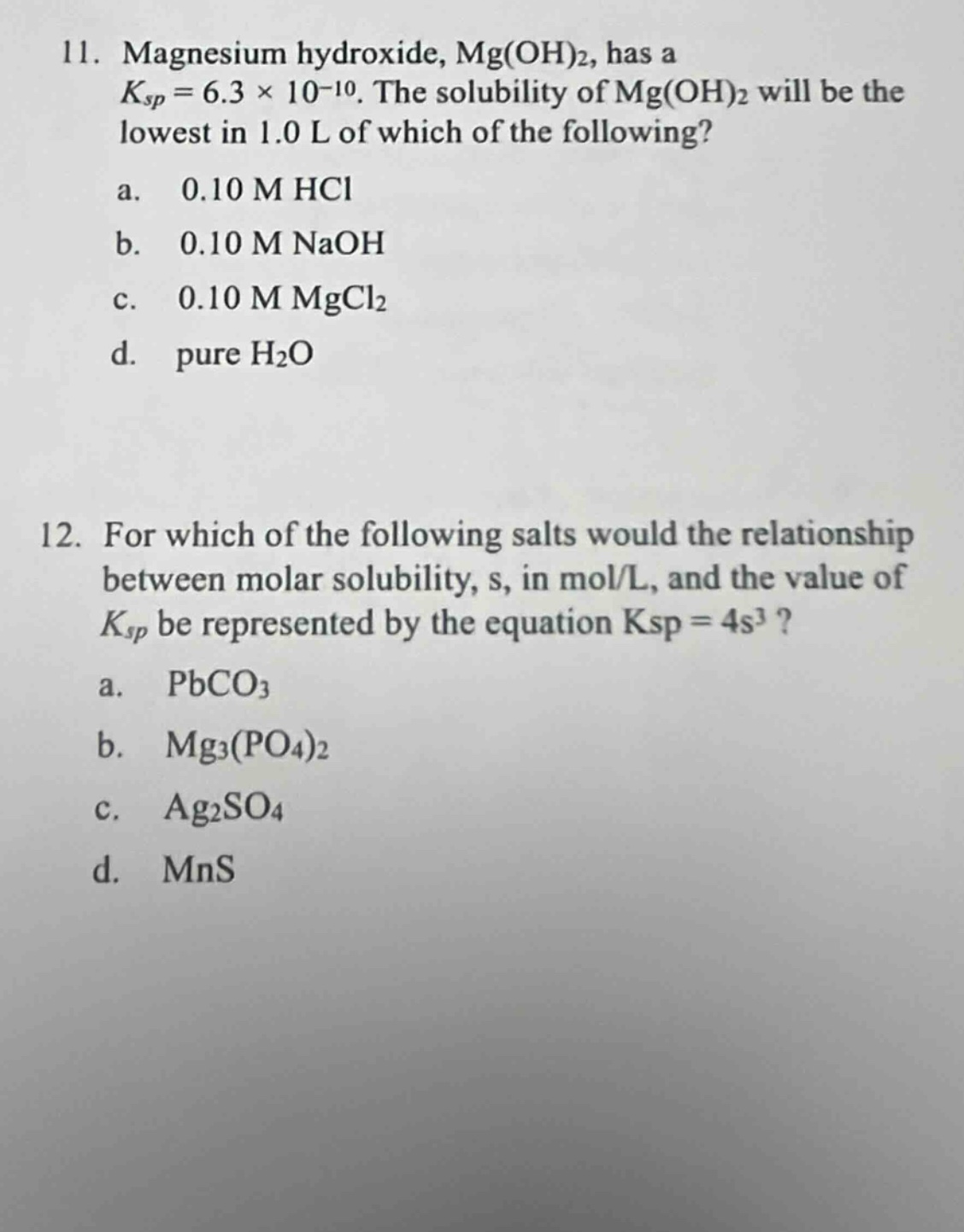
- magnesium hydroxide, mg(oh)₂, has a ( k_{sp} = 6.3 \times 10^{-10} ). the solubility of mg(oh)₂ will be the lowest in 1.0 l of which of the following?
a. 0.10 m hcl
b. 0.10 m naoh
c. 0.10 m mgcl₂
d. pure h₂o
- for which of the following salts would the relationship between molar solubility, s, in mol/l, and the value of ( k_{sp} ) be represented by the equation ( k_{sp} = 4s^3 )?
a. pbco₃
b. mg₃(po₄)₂
c. ag₂so₄
d. mns
Question 11
Step1: Recall Le Chatelier's Principle for solubility equilibrium. The dissolution of $\ce{Mg(OH)2}$ is $\ce{Mg(OH)2(s) <=> Mg^{2+}(aq) + 2OH^{-}(aq)}$. The solubility is affected by the common ion effect or reaction with ions.
Step2: Analyze each option:
- Option a (0.10 M HCl): $\ce{H+}$ reacts with $\ce{OH-}$ (from $\ce{Mg(OH)2}$ dissolution), shifting equilibrium right, increasing solubility.
- Option b (0.10 M NaOH): Provides $\ce{OH-}$ (common ion). Let solubility be $s$. Then $[\ce{Mg^{2+}}] = s$, $[\ce{OH-}] = 0.10 + 2s \approx 0.10$ (since $s$ is small). $K_{sp} = s(0.10)^2 = 6.3\times10^{-10} \implies s = \frac{6.3\times10^{-10}}{0.01} = 6.3\times10^{-8}$.
- Option c (0.10 M $\ce{MgCl2}$): Provides $\ce{Mg^{2+}}$ (common ion). Let solubility be $s$. Then $[\ce{Mg^{2+}}] = 0.10 + s \approx 0.10$, $[\ce{OH-}] = 2s$. $K_{sp} = 0.10\times(2s)^2 = 6.3\times10^{-10} \implies 0.10\times4s^2 = 6.3\times10^{-10} \implies s^2 = \frac{6.3\times10^{-10}}{0.4} = 1.575\times10^{-9} \implies s \approx 3.97\times10^{-5}$.
- Option d (pure $\ce{H2O}$): Let solubility be $s$. $[\ce{Mg^{2+}}] = s$, $[\ce{OH-}] = 2s$. $K_{sp} = s(2s)^2 = 4s^3 = 6.3\times10^{-10} \implies s^3 = \frac{6.3\times10^{-10}}{4} = 1.575\times10^{-10} \implies s \approx \sqrt[3]{1.575\times10^{-10}} \approx 5.4\times10^{-4}$.
Comparing $s$ values: Option b has $s = 6.3\times10^{-8}$, Option c has $\approx 3.97\times10^{-5}$, Option d has $\approx 5.4\times10^{-4}$. So lowest solubility in 0.10 M NaOH? Wait, wait, no—wait, in Option b, $[\ce{OH-}]$ is 0.10 M (from NaOH) plus 2s. Wait, maybe I miscalculated. Wait, no: when we have a common ion, the common ion is in excess. Wait, let's re - calculate Option b:
Dissolution: $\ce{Mg(OH)2 <=> Mg^{2+} + 2OH-}$. Let $s$ be solubility (mol/L). Then $[\ce{Mg^{2+}}] = s$, $[\ce{OH-}] = 0.10 + 2s$. But since $K_{sp}$ is small, $2s \ll 0.10$, so $[\ce{OH-}] \approx 0.10$. Then $K_{sp} = s\times(0.10)^2 = 6.3\times10^{-10} \implies s = \frac{6.3\times10^{-10}}{0.01} = 6.3\times10^{-8}$.
Option c: $\ce{MgCl2}$ provides $\ce{Mg^{2+}} = 0.10$ M. So $[\ce{Mg^{2+}}] = 0.10 + s \approx 0.10$, $[\ce{OH-}] = 2s$. Then $K_{sp} = 0.10\times(2s)^2 = 0.10\times4s^2 = 0.4s^2 = 6.3\times10^{-10} \implies s^2 = \frac{6.3\times10^{-10}}{0.4} = 1.575\times10^{-9} \implies s = \sqrt{1.575\times10^{-9}} \approx 3.97\times10^{-5}$.
Option d: Pure water, $K_{sp} = 4s^3 = 6.3\times10^{-10} \implies s^3 = \frac{6.3\times10^{-10}}{4} = 1.575\times10^{-10} \implies s = \sqrt[3]{1.575\times10^{-10}} \approx 5.4\times10^{-4}$.
Option a: HCl reacts with $\ce{OH-}$, so equilibrium shifts right, solubility is higher than in pure water.
Now, comparing the solubilities: Option b ($6.3\times10^{-8}$) < Option c ($3.97\times10^{-5}$) < Option d ($5.4\times10^{-4}$) < Option a (higher than d). Wait, but wait—maybe I made a mistake. Wait, NaOH provides more $\ce{OH-}$ than $\ce{MgCl2}$ provides $\ce{Mg^{2+}}$? Wait, the concentration of common ion: in NaOH, $[\ce{OH-}] = 0.10$; in $\ce{MgCl2}$, $[\ce{Mg^{2+}}] = 0.10$. The stoichiometry: for $\ce{OH-}$, the exponent is 2, for $\ce{Mg^{2+}}$, exponent is 1. So let's recast the $K_{sp}$ expression.
For $\ce{Mg(OH)2}$, $K_{sp} = [\ce{Mg^{2+}}][\ce{OH-}]^2$.
In Option b: $[\ce{OH-}] = 0.10$, so $[\ce{Mg^{2+}}] = \frac{K_{sp}}{[\ce{OH-}]^2} = \frac{6.3\times10^{-10}}{(0.10)^2} = 6.3\times10^{-8}$ (this is the solubility, since 1 mol of $\ce{Mg(OH)2}$ gives 1 mol of $\ce{Mg^{2+}}$).
In Option c: $[\ce{Mg^{2+}}] = 0.10$, so $[\ce{OH-}] = \sqrt{\frac{K_{sp}}{[\ce{Mg^{2+}}]}} = \sqrt{\frac{6.3\ti…
Step1: Recall the relationship between molar solubility ($s$) and $K_{sp}$ for a salt with formula $\ce{A_xB_y}$. The dissolution is $\ce{A_xB_y(s) <=> xA^{y+}(aq) + yB^{x-}(aq)}$. Then $K_{sp} = [\ce{A^{y+}}]^x [\ce{B^{x-}}]^y = (xs)^x (ys)^y = x^x y^y s^{x + y}$.
Step2: Analyze each option:
- Option a ($\ce{PbCO3}$): Formula $\ce{AB}$ (x = 1, y = 1). Dissolution: $\ce{PbCO3 <=> Pb^{2+} + CO3^{2-}}$. $K_{sp} = (s)(s) = s^2$.
- Option b ($\ce{Mg3(PO4)2}$): Formula $\ce{A3B2}$ (x = 3, y = 2). Dissolution: $\ce{Mg3(PO4)2 <=> 3Mg^{2+} + 2PO4^{3-}}$. $[\ce{Mg^{2+}}] = 3s$, $[\ce{PO4^{3-}}] = 2s$. $K_{sp} = (3s)^3 (2s)^2 = 27s^3 \times 4s^2 = 108s^5$.
- Option c ($\ce{Ag2SO4}$): Formula $\ce{A2B}$ (x = 2, y = 1). Dissolution: $\ce{Ag2SO4 <=> 2Ag+ + SO4^{2-}}$. $[\ce{Ag+}] = 2s$, $[\ce{SO4^{2-}}] = s$. $K_{sp} = (2s)^2 (s) = 4s^2 \times s = 4s^3$.
- Option d ($\ce{MnS}$): Formula $\ce{AB}$ (x = 1, y = 1). Dissolution: $\ce{MnS <=> Mn^{2+} + S^{2-}}$. $K_{sp} = (s)(s) = s^2$.

Snap & solve any problem in the app
Get step-by-step solutions on Sovi AI
Photo-based solutions with guided steps
Explore more problems and detailed explanations
b. 0.10 M NaOH