QUESTION IMAGE
Question
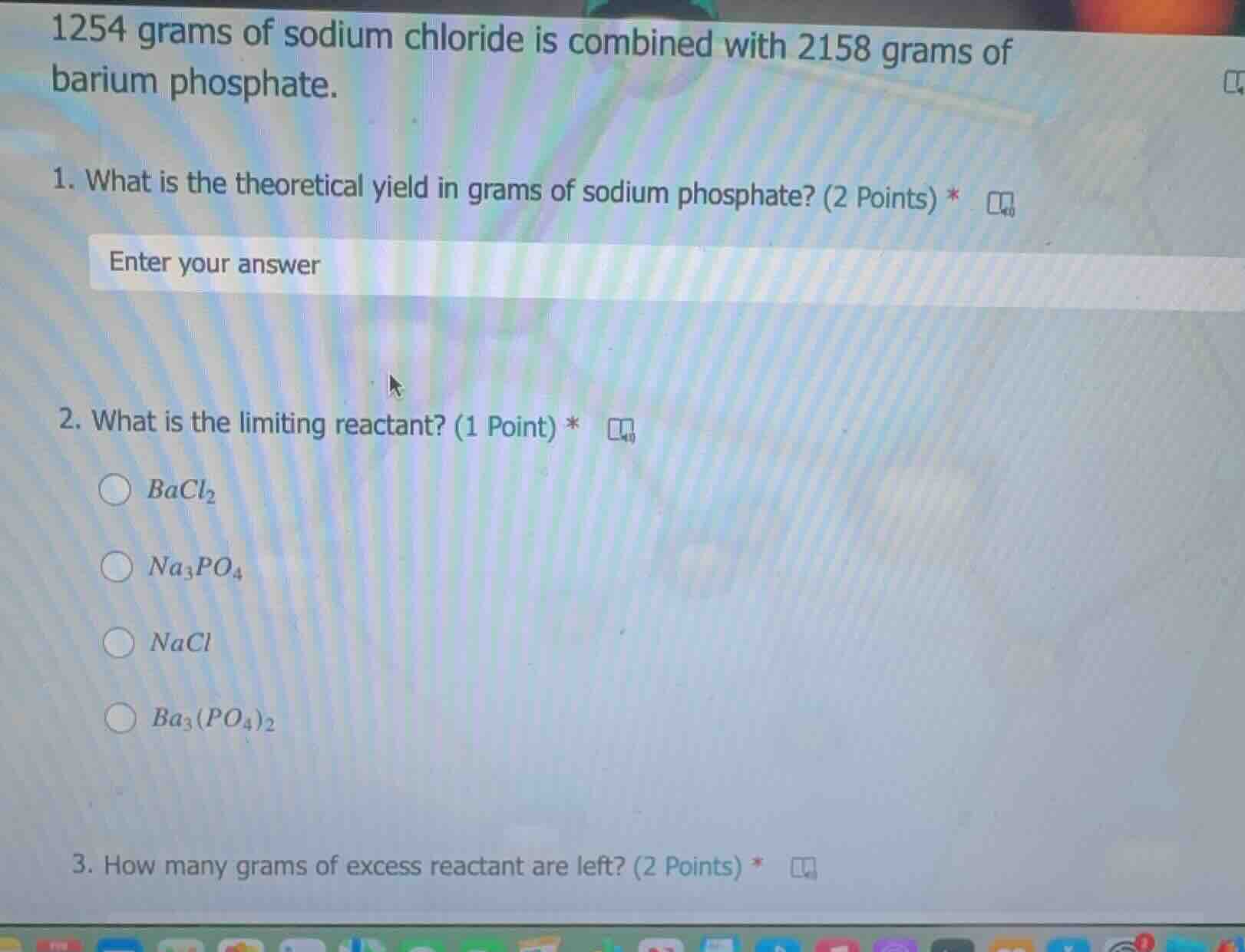
1254 grams of sodium chloride is combined with 2158 grams of barium phosphate.
- what is the theoretical yield in grams of sodium phosphate? (2 points) *
enter your answer
- what is the limiting reactant? (1 point) *
\\( bacl_2 \\)
\\( na_3po_4 \\)
\\( nacl \\)
\\( ba_3(po_4)_2 \\)
- how many grams of excess reactant are left? (2 points) *
1. Theoretical Yield of Sodium Phosphate
First, we need the balanced chemical equation for the reaction between sodium chloride (NaCl) and barium phosphate ($\ce{Ba3(PO4)2}$). The reaction is a double - displacement reaction:
(Wait, no, the correct balanced equation for the reaction between $\ce{Ba3(PO4)2}$ and $\ce{NaCl}$ is: $\ce{Ba3(PO4)2 + 6NaCl=2Na3PO4 + 3BaCl2}$)
Step 1: Calculate moles of reactants
Molar mass of $\ce{NaCl}$: $M_{NaCl}=22.99 + 35.45=58.44\space g/mol$
Moles of $\ce{NaCl}$, $n_{NaCl}=\frac{1254\space g}{58.44\space g/mol}\approx21.46\space mol$
Molar mass of $\ce{Ba3(PO4)2}$: $M_{\ce{Ba3(PO4)2}} = 3\times137.33+2\times(30.97 + 4\times16.00)=3\times137.33+2\times(30.97 + 64.00)=411.99+2\times94.97 = 411.99 + 189.94=601.93\space g/mol$
Moles of $\ce{Ba3(PO4)2}$, $n_{\ce{Ba3(PO4)2}}=\frac{2158\space g}{601.93\space g/mol}\approx3.585\space mol$
Step 2: Determine the limiting reactant (pre - step for theoretical yield)
From the balanced equation $\ce{Ba3(PO4)2 + 6NaCl=2Na3PO4 + 3BaCl2}$, the mole ratio of $\ce{Ba3(PO4)2}: \ce{NaCl}$ is $1:6$.
For $\ce{Ba3(PO4)2}$: If we use all $3.585\space mol$ of $\ce{Ba3(PO4)2}$, the moles of $\ce{NaCl}$ required would be $n_{NaCl\space required}=6\times3.585 = 21.51\space mol$
We have $21.46\space mol$ of $\ce{NaCl}$, which is slightly less than $21.51\space mol$. So $\ce{NaCl}$ is the limiting reactant.
Step 3: Calculate moles of $\ce{Na3PO4}$ produced
From the balanced equation, the mole ratio of $\ce{NaCl}:\ce{Na3PO4}$ is $6:2 = 3:1$.
Moles of $\ce{Na3PO4}$ produced, $n_{\ce{Na3PO4}}=\frac{2}{6}\times n_{NaCl}=\frac{1}{3}\times21.46\space mol\approx7.153\space mol$
Step 4: Calculate mass of $\ce{Na3PO4}$
Molar mass of $\ce{Na3PO4}$: $M_{\ce{Na3PO4}}=3\times22.99+30.97 + 4\times16.00=68.97+30.97 + 64.00 = 163.94\space g/mol$
Mass of $\ce{Na3PO4}$, $m_{\ce{Na3PO4}}=n_{\ce{Na3PO4}}\times M_{\ce{Na3PO4}}=7.153\space mol\times163.94\space g/mol\approx1172\space g$ (approximate value, more precise calculation: $7.153\times163.94 = 7.153\times(160 + 3.94)=7.153\times160+7.153\times3.94 = 1144.48+28.18 = 1172.66\space g\approx1173\space g$)
To find the limiting reactant, we compare the moles of reactants with the mole ratio from the balanced equation. The balanced equation is $\ce{Ba3(PO4)2 + 6NaCl=2Na3PO4 + 3BaCl2}$. We calculated the moles of each reactant. For the given moles of $\ce{Ba3(PO4)2}$, the required moles of $\ce{NaCl}$ is slightly more than the available moles of $\ce{NaCl}$. So $\ce{NaCl}$ is the limiting reactant.
Step 1: Calculate moles of $\ce{Ba3(PO4)2}$ used
From the mole ratio of $\ce{NaCl}:\ce{Ba3(PO4)2}=6:1$, moles of $\ce{Ba3(PO4)2}$ used, $n_{\ce{Ba3(PO4)2}\space used}=\frac{1}{6}\times n_{NaCl}=\frac{1}{6}\times21.46\space mol\approx3.577\space mol$
Step 2: Calculate moles of $\ce{Ba3(PO4)2}$ left
Moles of $\ce{Ba3(PO4)2}$ initially = $3.585\space mol$
Moles of $\ce{Ba3(PO4)2}$ left, $n_{\ce{Ba3(PO4)2}\space left}=3.585 - 3.577 = 0.008\space mol$
Step 3: Calculate mass of $\ce{Ba3(PO4)2}$ left
Mass of $\ce{Ba3(PO4)2}$ left, $m = n\times M=0.008\space mol\times601.93\space g/mol\approx4.815\space g$ (approximate, more precise: $0.008\times601.93 = 4.81544\space g\approx4.82\space g$)

Snap & solve any problem in the app
Get step-by-step solutions on Sovi AI
Photo-based solutions with guided steps
Explore more problems and detailed explanations
Approximately $\boldsymbol{1173\space g}$ (or more precise value around 1172 - 1173 g)