QUESTION IMAGE
Question
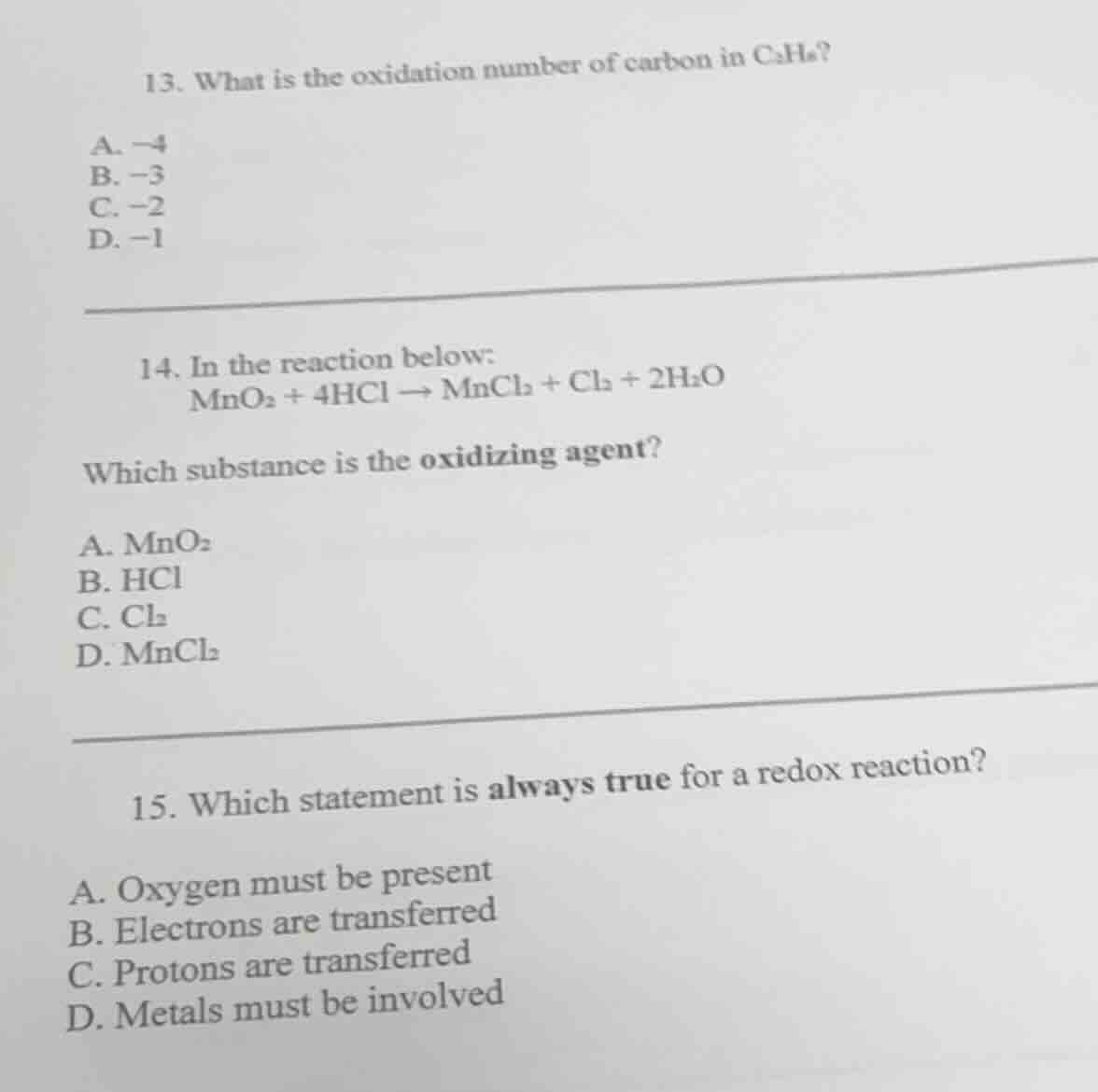
- what is the oxidation number of carbon in c₂h₆?
a. -4
b. -3
c. -2
d. -1
- in the reaction below:
mno₂ + 4hcl → mncl₂ + cl₂ + 2h₂o
which substance is the oxidizing agent?
a. mno₂
b. hcl
c. cl₂
d. mncl₂
- which statement is always true for a redox reaction?
a. oxygen must be present
b. electrons are transferred
c. protons are transferred
d. metals must be involved
Question 13
Step1: Recall oxidation number rules
Hydrogen has an oxidation number of +1 in most compounds. Let the oxidation number of carbon be \( x \). In \( \ce{C2H6} \), the sum of oxidation numbers is 0 (neutral compound).
Step2: Set up equation
For \( \ce{C2H6} \), we have \( 2x + 6(+1) = 0 \). Solving: \( 2x + 6 = 0 \) → \( 2x = -6 \) → \( x = -3 \).
Step1: Recall oxidizing agent definition
An oxidizing agent is reduced (gains electrons, oxidation number decreases).
Step2: Find oxidation numbers
- In \( \ce{MnO2} \), Mn has oxidation number +4; in \( \ce{MnCl2} \), Mn has +2 (decrease, so Mn is reduced).
- In \( \ce{HCl} \), Cl has -1; in \( \ce{Cl2} \), Cl has 0 (increase, oxidized). So \( \ce{MnO2} \) is the oxidizing agent.
Step1: Recall redox reaction definition
Redox reactions involve electron transfer (oxidation: loss of electrons, reduction: gain of electrons).
Step2: Analyze options
- A: Redox can occur without O (e.g., \( \ce{Zn + CuSO4} \)).
- B: Electrons are transferred (defining feature of redox).
- C: Protons (H⁺) transfer is acid - base, not redox.
- D: Redox can occur without metals (e.g., \( \ce{H2 + Cl2 -> 2HCl} \)).

Snap & solve any problem in the app
Get step-by-step solutions on Sovi AI
Photo-based solutions with guided steps
Explore more problems and detailed explanations
B. -3