QUESTION IMAGE
Question
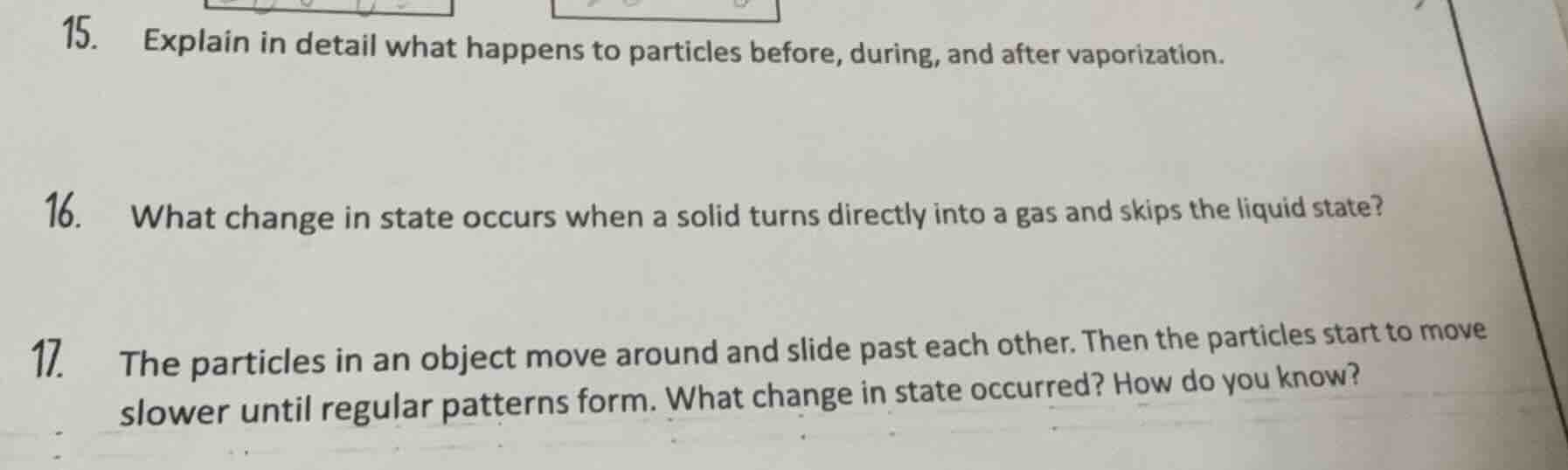
- explain in detail what happens to particles before, during, and after vaporization.
- what change in state occurs when a solid turns directly into a gas and skips the liquid state?
- the particles in an object move around and slide past each other. then the particles start to move slower until regular patterns form. what change in state occurred? how do you know?
Response
Question 15
Brief Explanations
- Before Vaporization: The substance is typically in a liquid state (for liquid - to - gas vaporization) or solid state (for solid - to - gas sublimation, a type of vaporization). In a liquid, particles are close together, have some kinetic energy, and move past one another. In a solid, particles are in a fixed, ordered arrangement and vibrate in place. They have relatively low kinetic energy compared to the gaseous state.
- During Vaporization: Energy (usually heat) is added. This energy increases the kinetic energy of the particles. In the case of liquid - to - gas vaporization, the particles gain enough energy to overcome the intermolecular forces holding them in the liquid state. They start to move more freely and rapidly, and some particles at the surface (in evaporation) or throughout the liquid (in boiling) break away from the liquid phase. For sublimation (solid - to - gas vaporization), solid particles gain enough energy to break free from their fixed positions and enter the gaseous state directly.
- After Vaporization: The particles are in the gaseous state. They have high kinetic energy, move randomly and rapidly in all directions, and are far apart from one another. The intermolecular forces between gas particles are very weak (compared to liquids and solids) because the particles have enough energy to overcome most of these forces.
Brief Explanations
The change of state where a solid turns directly into a gas without passing through the liquid state is called sublimation. For example, dry ice (solid carbon dioxide) sublimes at standard atmospheric pressure, turning directly into carbon dioxide gas. In this process, the solid particles gain enough energy to break free from their fixed, ordered structure and enter the gaseous state, bypassing the liquid - phase arrangement of particles.
Brief Explanations
- First, analyze the initial state: When particles move around and slide past each other, this is characteristic of the liquid state. In a liquid, particles are close together but are not in a fixed position, allowing them to slide past one another.
- Then, analyze the final state: When particles start to move slower and form regular patterns, this is characteristic of the solid state. In a solid, particles have low kinetic energy, move (vibrate) slowly, and are in a fixed, ordered arrangement.
- So the change in state is from liquid to solid, which is called freezing (or solidification). We know this because the initial particle motion (sliding past) is liquid - like, and the final motion (slow, regular pattern) is solid - like, indicating a phase change from liquid to solid.

Snap & solve any problem in the app
Get step-by-step solutions on Sovi AI
Photo-based solutions with guided steps
Explore more problems and detailed explanations
- Before: Particles in liquid (or solid) have moderate (or low) KE, close (or fixed) arrangement.
- During: Energy added, KE increases, particles overcome intermolecular forces.
- After: Particles in gas, high KE, far apart, move freely.