QUESTION IMAGE
Question
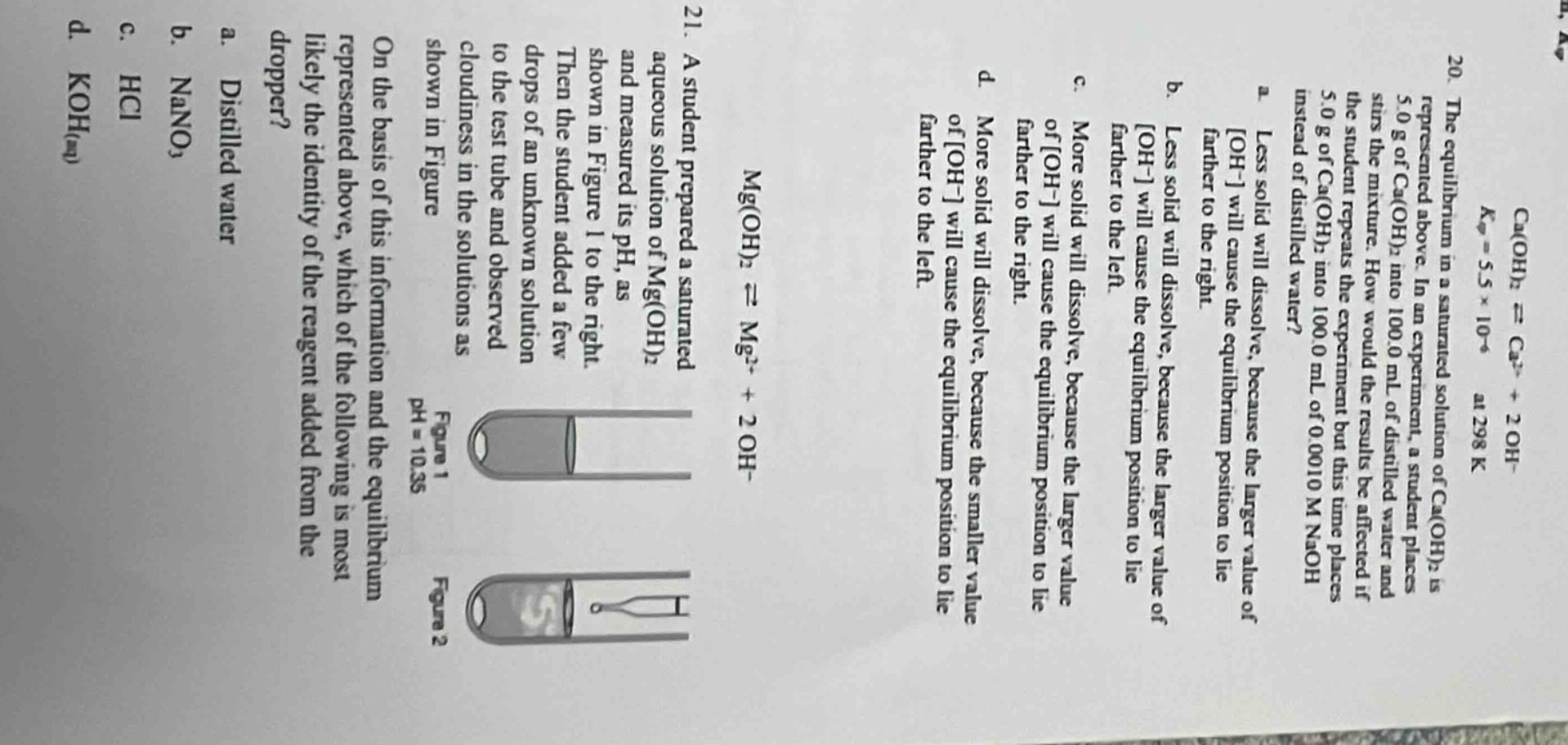
- $k_{sp}=5.5\times10^{-6}$
$\ce{ca(oh)_{2}}\
ightleftharpoons\ce{ca^{2+}} + 2\ce{oh^{-}}$
the equilibrium in a saturated solution of $\ce{ca(oh)_{2}}$ is represented above. in an experiment, a student places 5.0 g of $\ce{ca(oh)_{2}}$ into 100.0 ml of distilled water and stirs the mixture. how would the results be affected if the student repeats the experiment but this time places 5.0 g of $\ce{ca(oh)_{2}}$ into 100.0 ml of 0.0010 m $\ce{naoh}$ instead of distilled water?
a. less solid will dissolve, because the larger value of $\ce{oh^{-}}$ will cause the equilibrium position to lie farther to the right.
b. less solid will dissolve, because the larger value of $\ce{oh^{-}}$ will cause the equilibrium position to lie farther to the left.
c. more solid will dissolve, because the larger value of $\ce{oh^{-}}$ will cause the equilibrium position to lie farther to the right.
d. more solid will dissolve, because the smaller value of $\ce{oh^{-}}$ will cause the equilibrium position to lie farther to the left.
- $\ce{mg(oh)_{2}}\
ightleftharpoons\ce{mg^{2+}} + 2\ce{oh^{-}}$
a student prepared a saturated aqueous solution of $\ce{mg(oh)_{2}}$ and measured its ph, as shown in figure 1 to the right. then the student added a few drops of an unknown solution to the test tube and observed cloudiness in the solutions as shown in figure
on the basis of this information and the equilibrium represented above, which of the following is most likely the identity of the reagent added from the dropper?
a. distilled water
b. $\ce{nano_{3}}$
c. $\ce{hcl}$
d. $\ce{koh(aq)}$
Question 20
Step 1: Analyze the equilibrium
The equilibrium for $\ce{Ca(OH)2}$ is $\ce{Ca(OH)2
ightleftharpoons Ca^{2+} + 2OH^-}$. The solubility product $K_{sp} = [\ce{Ca^{2+}}][\ce{OH^-}]^2 = 5.5\times 10^{-6}$ at 298 K.
Step 2: Effect of adding different substances
- Option a: Distilled water: Adding distilled water dilutes the solution, but for a saturated solution, diluting will not change the equilibrium position (Le Chatelier's principle - the system will adjust to re - establish saturation, but the amount of solid dissolved per unit volume remains the same in terms of equilibrium shift? Wait, no. Wait, when we add water to a saturated solution of $\ce{Ca(OH)2}$, the equilibrium $\ce{Ca(OH)2(s)
ightleftharpoons Ca^{2+}(aq) + 2OH^-(aq)}$ will shift to the right to dissolve more solid to re - establish the $K_{sp}$ (since the ion concentrations are below the saturation level after dilution). But the question is about replacing distilled water with 0.0010 M $\ce{NaOH}$.
- Option b: $\ce{NaOH}$ is a strong base, so it provides $\ce{OH^-}$ ions. The concentration of $\ce{OH^-}$ from 0.0010 M $\ce{NaOH}$ is 0.0010 M. In distilled water, the $\ce{OH^-}$ concentration from $\ce{Ca(OH)2}$ in a saturated solution: Let $[\ce{Ca^{2+}}]=x$, then $[\ce{OH^-}]=2x$. $K_{sp}=x\times(2x)^2 = 4x^3=5.5\times 10^{-6}$, $x^3=\frac{5.5\times 10^{-6}}{4}=1.375\times 10^{-6}$, $x=\sqrt[3]{1.375\times 10^{-6}}\approx1.11\times 10^{-2}$ M, so $[\ce{OH^-}]=2x\approx2.22\times 10^{-2}$ M. Wait, no, that can't be right. Wait, maybe I miscalculated. Wait, $K_{sp} = 5.5\times 10^{-6}=[\ce{Ca^{2+}}][\ce{OH^-}]^2$. Let $s$ be the solubility of $\ce{Ca(OH)2}$ in mol/L. Then $[\ce{Ca^{2+}}]=s$, $[\ce{OH^-}]=2s$. So $K_{sp}=s\times(2s)^2 = 4s^3$. So $s^3=\frac{K_{sp}}{4}=\frac{5.5\times 10^{-6}}{4}=1.375\times 10^{-6}$, $s=\sqrt[3]{1.375\times 10^{-6}}\approx1.11\times 10^{-2}$ M, $[\ce{OH^-}]=2s\approx2.22\times 10^{-2}$ M. The $\ce{OH^-}$ concentration from 0.0010 M $\ce{NaOH}$ is 0.0010 M, which is less than the $\ce{OH^-}$ concentration from $\ce{Ca(OH)2}$ in distilled water? Wait, no, that can't be. Wait, maybe I made a mistake in the $K_{sp}$ interpretation. Wait, no, the $K_{sp}$ of $\ce{Ca(OH)2}$ is actually around $5.5\times 10^{-6}$, but let's re - calculate. If $K_{sp}=5.5\times 10^{-6}=[\ce{Ca^{2+}}][\ce{OH^-}]^2$. Let's assume that the contribution of $\ce{OH^-}$ from water is negligible. Let $[\ce{Ca^{2+}}]=s$, $[\ce{OH^-}]=2s$. Then $4s^3 = 5.5\times 10^{-6}$, $s=\sqrt[3]{\frac{5.5\times 10^{-6}}{4}}\approx1.11\times 10^{-2}$ M, so $[\ce{OH^-}]=2.22\times 10^{-2}$ M. The $\ce{NaOH}$ solution has $[\ce{OH^-}]=0.0010$ M $=1\times 10^{-3}$ M, which is less than $2.22\times 10^{-2}$ M. Wait, but the question is about adding $\ce{NaOH}$ instead of water. Wait, no, the student is adding 5.0 g of $\ce{Ca(OH)2}$ into 100.0 mL of 0.0010 M $\ce{NaOH}$ instead of distilled water. So the initial $[\ce{OH^-}]$ is higher than in distilled water (wait, no, 0.0010 M $\ce{NaOH}$ has $[\ce{OH^-}]=0.001$ M, and in distilled water, the initial $[\ce{OH^-}]$ from water is $1\times 10^{-7}$ M, which is much lower. Wait, I think I messed up earlier. The $\ce{Ca(OH)2}$ is a base, but when we add $\ce{NaOH}$, we are increasing the $[\ce{OH^-}]$ compared to distilled water. According to Le Chatelier's principle, for the equilibrium $\ce{Ca(OH)2(s)
ightleftharpoons Ca^{2+}(aq) + 2OH^-(aq)}$, an increase in $[\ce{OH^-}]$ (from $\ce{NaOH}$) will shift the equilibrium to the left, decreasing the solubility of $\ce{Ca(OH)2}$. But the question is about the amount of solid diss…
Step 1: Analyze the equilibrium and the change
The equilibrium is $\ce{Mg(OH)2(s)
ightleftharpoons Mg^{2+}(aq) + 2OH^-(aq)}$. The initial solution is a saturated solution of $\ce{Mg(OH)2}$ with $\text{pH} = 10.35$. So $[\ce{H^+}]=10^{-10.35}$ M, and $[\ce{OH^-}]=\frac{1\times 10^{-14}}{10^{-10.35}}=10^{-3.65}\approx2.24\times 10^{-4}$ M.
When a reagent is added, the cloudiness (amount of $\ce{Mg(OH)2}$ solid) increases, which means the equilibrium shifts to the left (more $\ce{Mg(OH)2}$ is formed). So we need to find a reagent that will increase the concentration of either $\ce{Mg^{2+}}$ or $\ce{OH^-}$ (to shift the equilibrium left) or react in a way that causes more $\ce{Mg(OH)2}$ to precipitate.
- Option a: Distilled water
Adding distilled water will dilute the solution. According to Le Chatelier's principle, the equilibrium $\ce{Mg(OH)2(s)
ightleftharpoons Mg^{2+}(aq) + 2OH^-(aq)}$ will shift to the right to dissolve more solid to re - establish the $K_{sp}$ (since the ion concentrations are below the saturation level after dilution). So the cloudiness should decrease, not increase.
- Option b: $\ce{NaNO3}$
$\ce{NaNO3}$ is a neutral salt. It will dissociate into $\ce{Na^+}$ and $\ce{NO3^-}$ ions. These ions do not react with $\ce{Mg^{2+}}$ or $\ce{OH^-}$ ions. So the equilibrium position of $\ce{Mg(OH)2}$ dissolution will not be affected (or the effect of ionic strength is negligible for this question's purpose), and the cloudiness should not increase significantly.
- Option c: $\ce{HCl}$
$\ce{HCl}$ is a strong acid. It will react with $\ce{OH^-}$ ions: $\ce{H^+ + OH^-
ightarrow H2O}$. This will decrease the concentration of $\ce{OH^-}$ ions. According to Le Chatelier's principle, the equilibrium $\ce{Mg(OH)2(s)
ightleftharpoons Mg^{2+}(aq) + 2OH^-(aq)}$ will shift to the right to produce more $\ce{OH^-}$ ions, which means more $\ce{Mg(OH)2}$ will dissolve, and the cloudiness will decrease.
- Option d: $\ce{KOH(aq)}$
$\ce{KOH}$ is a strong base. It will dissociate into $\ce{K^+}$ and $\ce{OH^-}$ ions, increasing the concentration of $\ce{OH^-}$ ions in the solution. According to Le Chatelier's principle, for the equilibrium $\ce{Mg(OH)2(s)
ightleftharpoons Mg^{2+}(aq) + 2OH^-(aq)}$, an increase in the concentration of the product $\ce{OH^-}$ will shift the equilibrium to the left. This will cause more $\ce{Mg(OH)2}$ solid to form, increasing the cloudiness of the solution, which matches the observation in Figure 2 (more cloudiness).

Snap & solve any problem in the app
Get step-by-step solutions on Sovi AI
Photo-based solutions with guided steps
Explore more problems and detailed explanations
b. Less solid will dissolve, because the larger value of $[\ce{OH^-}]$ will cause the equilibrium position to lie farther to the left.