QUESTION IMAGE
Question
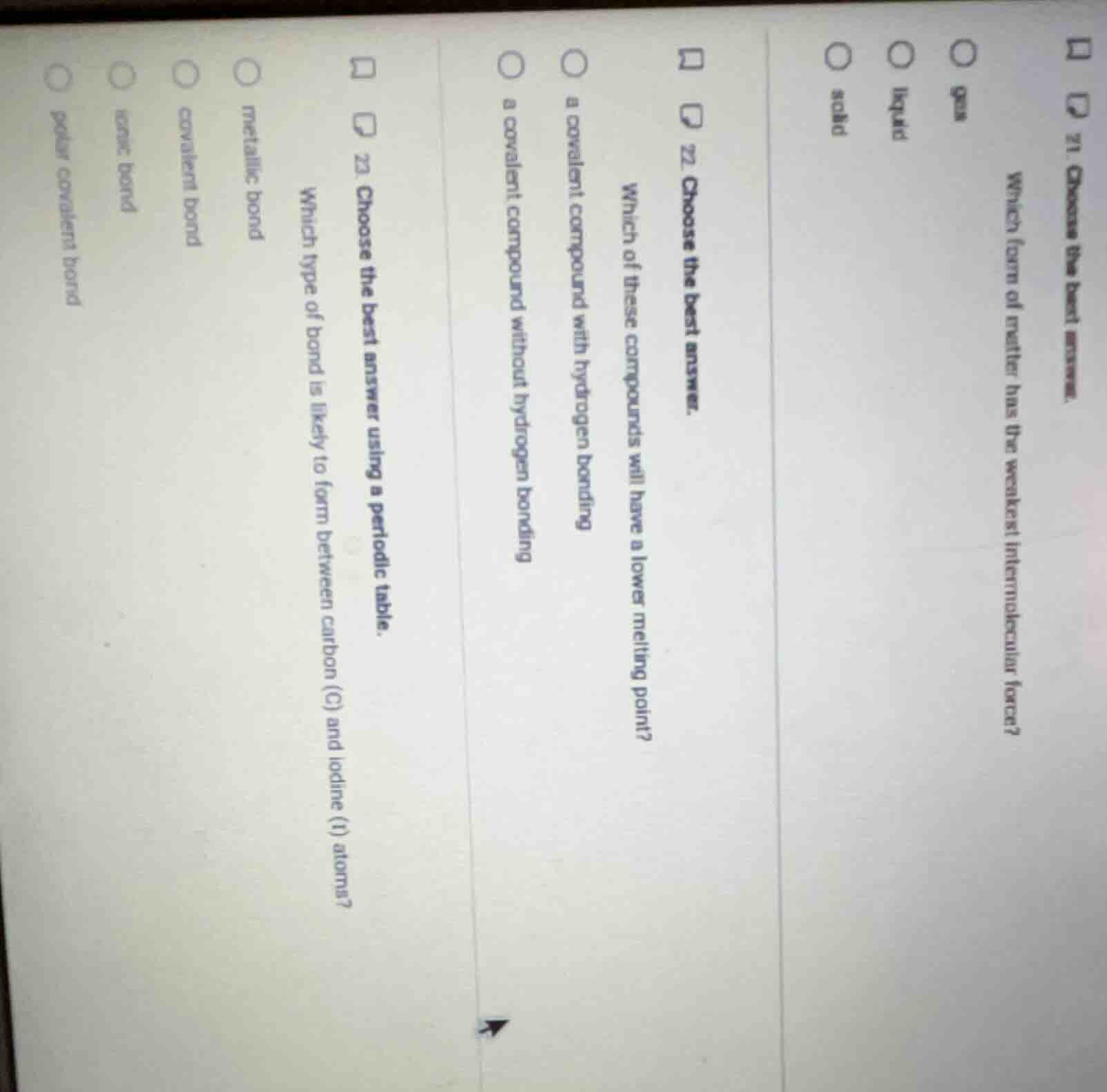
- choose the best answer. which form of matter has the weakest intermolecular force? gas liquid solid 22. choose the best answer. which of these compounds will have a lower melting point? a covalent compound with hydrogen bonding a covalent compound without hydrogen bonding 23. choose the best answer using a periodic table. which type of bond is likely to form between carbon (c) and iodine (i) atoms? metallic bond covalent bond ionic bond polar covalent bond
Brief Explanations
- Gases have particles that are far apart with minimal attraction between them, resulting in the weakest intermolecular forces compared to liquids and solids.
- Hydrogen bonding is a strong intermolecular force; compounds without it have weaker intermolecular attractions, requiring less energy to melt, so they have lower melting points.
- Carbon (C) and iodine (I) are both nonmetals. Nonmetals form covalent bonds by sharing electrons, and their electronegativity difference is small enough to form a polar covalent bond (since iodine is less electronegative than carbon, creating a slight dipole).

Snap & solve any problem in the app
Get step-by-step solutions on Sovi AI
Photo-based solutions with guided steps
Explore more problems and detailed explanations
- gas
- a covalent compound without hydrogen bonding
- polar covalent bond