QUESTION IMAGE
Question
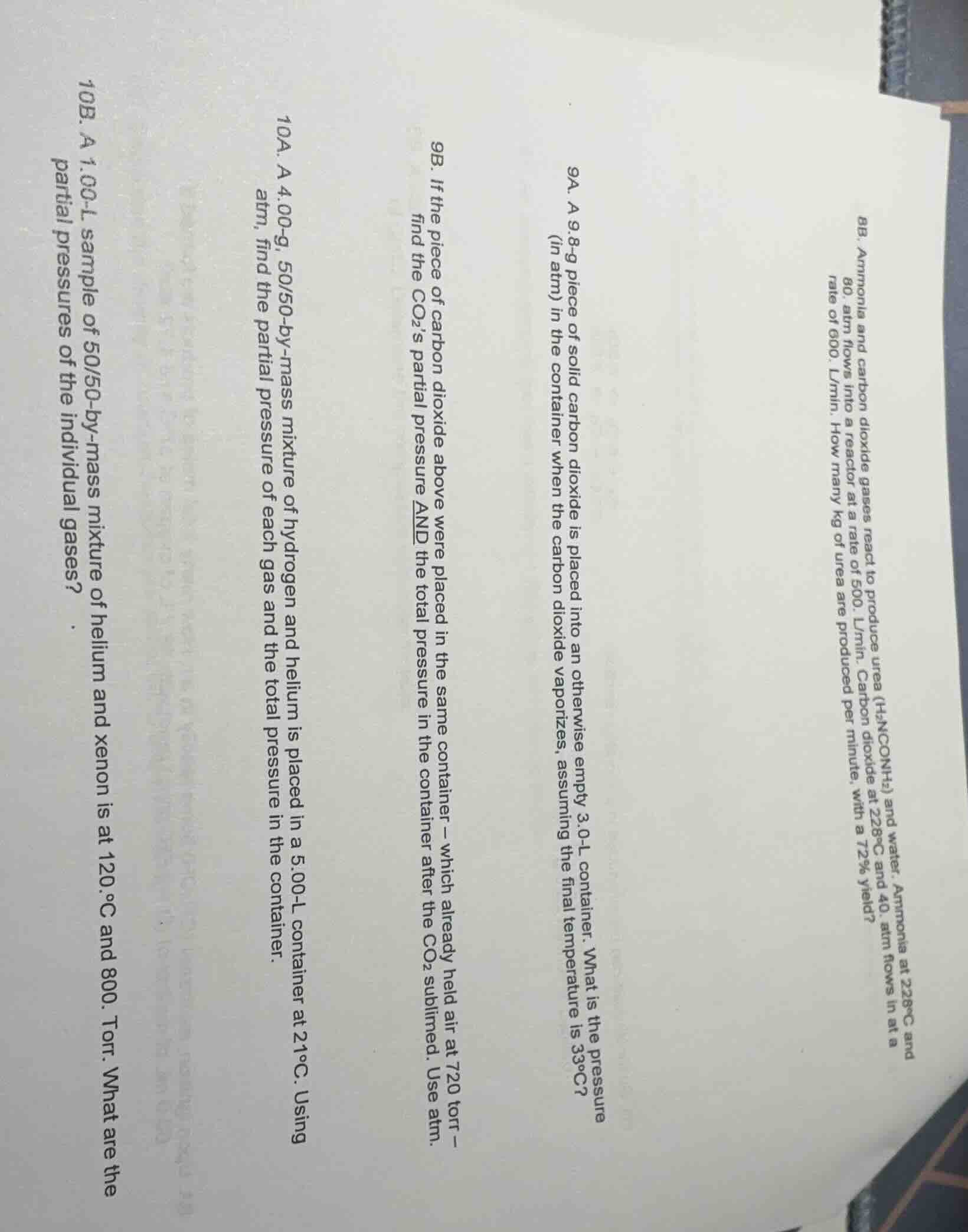
8b. ammonia and carbon dioxide gases react to produce urea (h₂nconh₂) and water. ammonia at 228°c and 80. atm flows into a reactor at a rate of 500. l/min. carbon dioxide at 228°c and 40. atm flows in at a rate of 600. l/min. how many kg of urea are produced per minute, with a 72% yield?
9a. a 9.8 - g piece of solid carbon dioxide is placed into an otherwise empty 3.0 - l container. what is the pressure (in atm) in the container when the carbon dioxide vaporizes, assuming the final temperature is 33°c?
9b. if the piece of carbon dioxide above were placed in the same container — which already held air at 720 torr — find the co₂s partial pressure and the total pressure in the container after the co₂ sublimed. use atm.
10a. a 4.00 - g, 50/50 - by - mass mixture of hydrogen and helium is placed in a 5.00 - l container at 21°c. using atm, find the partial pressure of each gas and the total pressure in the container.
10b. a 1.00 - l sample of 50/50 - by - mass mixture of helium and xenon is at 120.°c and 800. torr. what are the partial pressures of the individual gases?
Let's solve problem 10A first.
Problem 10A:
A 4.00 - g, 50/50 - by - mass mixture of hydrogen and helium is placed in a 5.00 - L container at 21°C. Find the partial pressure of each gas and the total pressure in the container.
Step 1: Calculate the moles of each gas
The mixture is 50/50 by mass. So the mass of \(H_2\) and \(He\) is each \(\frac{4.00\ g}{2}=2.00\ g\)
For \(H_2\) (molar mass \(M_{H_2}=2.016\ g/mol\)):
\(n_{H_2}=\frac{m_{H_2}}{M_{H_2}}=\frac{2.00\ g}{2.016\ g/mol}\approx0.992\ mol\)
For \(He\) (molar mass \(M_{He} = 4.003\ g/mol\)):
\(n_{He}=\frac{m_{He}}{M_{He}}=\frac{2.00\ g}{4.003\ g/mol}\approx0.4996\ mol\)
Step 2: Convert temperature to Kelvin
\(T = 21^{\circ}C+273.15 = 294.15\ K\)
Step 3: Use the ideal gas law \(PV=nRT\) to find partial pressures
The ideal gas law is \(P=\frac{nRT}{V}\), where \(R = 0.0821\ L\cdot atm/(mol\cdot K)\), \(V = 5.00\ L\)
For \(H_2\):
\(P_{H_2}=\frac{n_{H_2}RT}{V}=\frac{0.992\ mol\times0.0821\ L\cdot atm/(mol\cdot K)\times294.15\ K}{5.00\ L}\)
\(P_{H_2}=\frac{0.992\times0.0821\times294.15}{5.00}\ atm\)
\(0.992\times0.0821\times294.15\approx0.992\times24.15\approx23.96\)
\(P_{H_2}=\frac{23.96}{5.00}\approx4.79\ atm\)
For \(He\):
\(P_{He}=\frac{n_{He}RT}{V}=\frac{0.4996\ mol\times0.0821\ L\cdot atm/(mol\cdot K)\times294.15\ K}{5.00\ L}\)
\(0.4996\times0.0821\times294.15\approx0.4996\times24.15\approx12.07\)
\(P_{He}=\frac{12.07}{5.00}\approx2.41\ atm\)
Step 4: Calculate total pressure
By Dalton's law of partial pressures, \(P_{total}=P_{H_2}+P_{He}\)
\(P_{total}=4.79\ atm + 2.41\ atm=7.20\ atm\)
Problem 10B:
A 1.00 - L sample of 50/50 - by - mass mixture of helium and xenon is at 120.°C and 800. Torr. What are the partial pressures of the individual gases?
Step 1: Let the mass of \(He\) and \(Xe\) be \(m\) (since 50/50 by mass, total mass \(= 2m\))
Molar mass of \(He = 4.003\ g/mol\), molar mass of \(Xe=131.29\ g/mol\)
Moles of \(He\): \(n_{He}=\frac{m}{4.003}\)
Moles of \(Xe\): \(n_{Xe}=\frac{m}{131.29}\)
Mole fraction of \(He\): \(X_{He}=\frac{n_{He}}{n_{He}+n_{Xe}}=\frac{\frac{m}{4.003}}{\frac{m}{4.003}+\frac{m}{131.29}}=\frac{\frac{1}{4.003}}{\frac{1}{4.003}+\frac{1}{131.29}}\)
\(\frac{1}{4.003}+\frac{1}{131.29}=\frac{131.29 + 4.003}{4.003\times131.29}=\frac{135.293}{525.5}\)
\(X_{He}=\frac{\frac{1}{4.003}}{\frac{135.293}{525.5}}=\frac{525.5}{4.003\times135.293}\approx\frac{525.5}{541.6}\approx0.970\)
Mole fraction of \(Xe\): \(X_{Xe}=1 - X_{He}=1 - 0.970 = 0.030\)
Step 2: Convert total pressure to atm (or use Torr, since Dalton's law works with any pressure units as long as consistent)
\(800\ Torr=\frac{800}{760}\ atm\approx1.0526\ atm\) (or we can work in Torr)
Using Dalton's law: \(P_i = X_i\times P_{total}\)
Partial pressure of \(He\): \(P_{He}=X_{He}\times P_{total}\)
\(P_{He}=0.970\times800\ Torr\approx776\ Torr\)
Partial pressure of \(Xe\): \(P_{Xe}=X_{Xe}\times P_{total}\)
\(P_{Xe}=0.030\times800\ Torr = 24\ Torr\) (approximate, more precise calculation:
\(X_{He}=\frac{\frac{m}{4.003}}{\frac{m}{4.003}+\frac{m}{131.29}}=\frac{131.29}{131.29 + 4.003}=\frac{131.29}{135.293}\approx0.9704\)
\(P_{He}=0.9704\times800\ Torr\approx776.3\ Torr\)
\(P_{Xe}=(1 - 0.9704)\times800\ Torr=0.0296\times800\ Torr\approx23.7\ Torr\))

Snap & solve any problem in the app
Get step-by-step solutions on Sovi AI
Photo-based solutions with guided steps
Explore more problems and detailed explanations
s:
10A:
- Partial pressure of \(H_2\): \(\approx4.79\ atm\)
- Partial pressure of \(He\): \(\approx2.41\ atm\)
- Total pressure: \(7.20\ atm\)
10B:
- Partial pressure of \(He\): \(\approx776\ Torr\) (or \(1.02\ atm\))
- Partial pressure of \(Xe\): \(\approx24\ Torr\) (or \(0.0316\ atm\)) (using \(800\ Torr=\frac{800}{760}\ atm\approx1.0526\ atm\), \(P_{He}=0.9704\times1.0526\ atm\approx1.02\ atm\), \(P_{Xe}=0.0296\times1.0526\ atm\approx0.0312\ atm\))