QUESTION IMAGE
Question
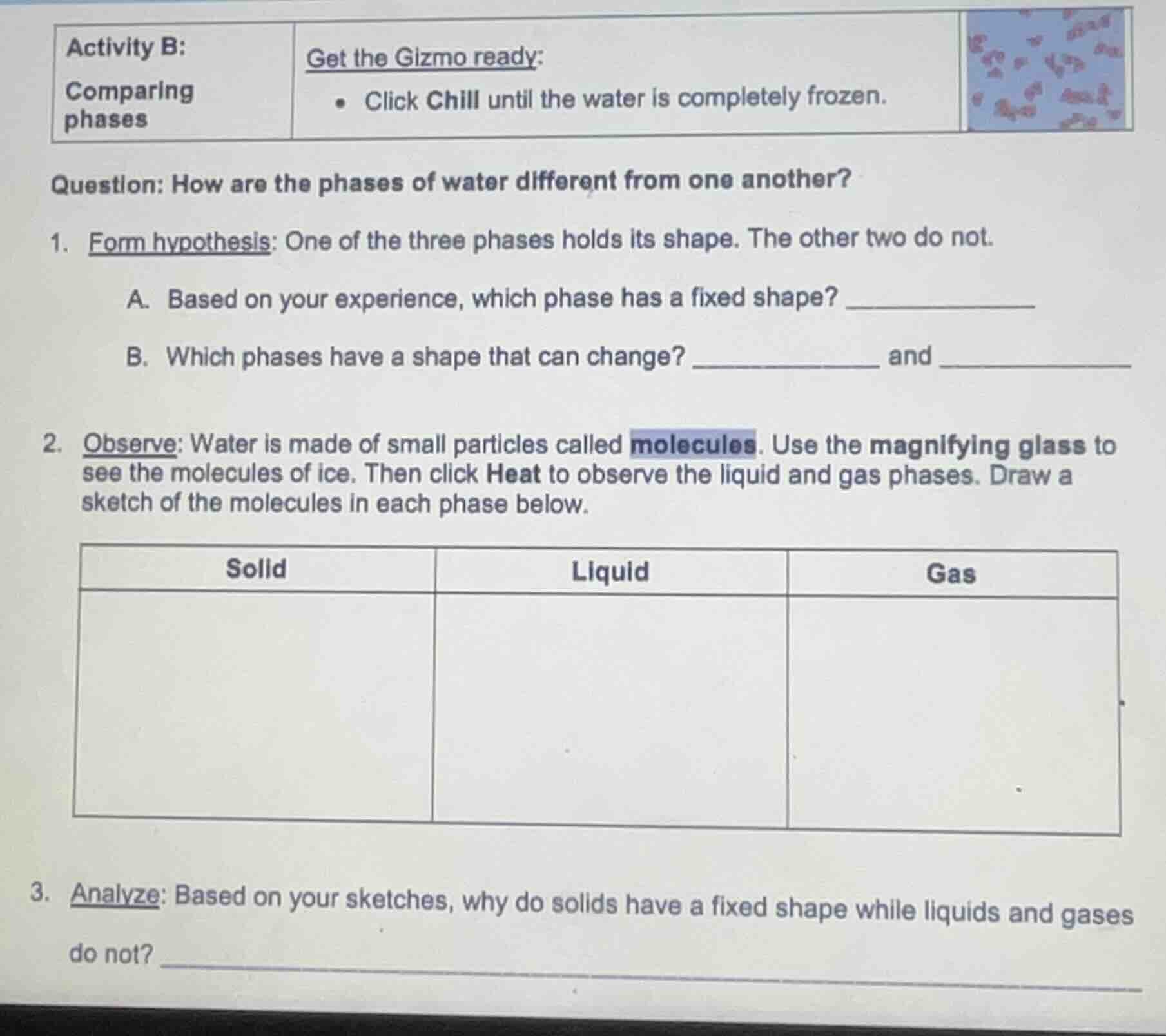
activity b: comparing phases get the gizmo ready: - click chill until the water is completely frozen. question: how are the phases of water different from one another? 1. form hypothesis: one of the three phases holds its shape. the other two do not. a. based on your experience, which phase has a fixed shape? __________ b. which phases have a shape that can change? ________ and ________ 2. observe: water is made of small particles called molecules. use the magnifying glass to see the molecules of ice. then click heat to observe the liquid and gas phases. draw a sketch of the molecules in each phase below. | solid | liquid | gas | |-------|--------|-----| | | | | 3. analyze: based on your sketches, why do solids have a fixed shape while liquids and gases do not? __________
- For the hypothesis, real-world experience shows solids maintain their shape, while liquids and gases take the shape of their container.
- For molecular sketches: Solid (ice) molecules are tightly packed in a rigid, ordered lattice; liquid water molecules are close together but can slide past one another; gas (water vapor) molecules are spread far apart with lots of empty space between them.
- The fixed shape of solids comes from their tightly bonded, immobile molecules that stay in a fixed arrangement, while liquid and gas molecules can move freely, allowing them to change shape.

Snap & solve any problem in the app
Get step-by-step solutions on Sovi AI
Photo-based solutions with guided steps
Explore more problems and detailed explanations
- A. Solid (ice)
B. Liquid (water) and Gas (water vapor)
2.
| Solid | Liquid | Gas |
|---|
- Solids have a fixed shape because their molecules are tightly held in a rigid, fixed arrangement and cannot move freely. Liquids and gases do not have fixed shapes because their molecules can move past each other (liquids) or spread out freely (gases), allowing them to conform to the shape of their container.