QUESTION IMAGE
Question
advanced practice - homework
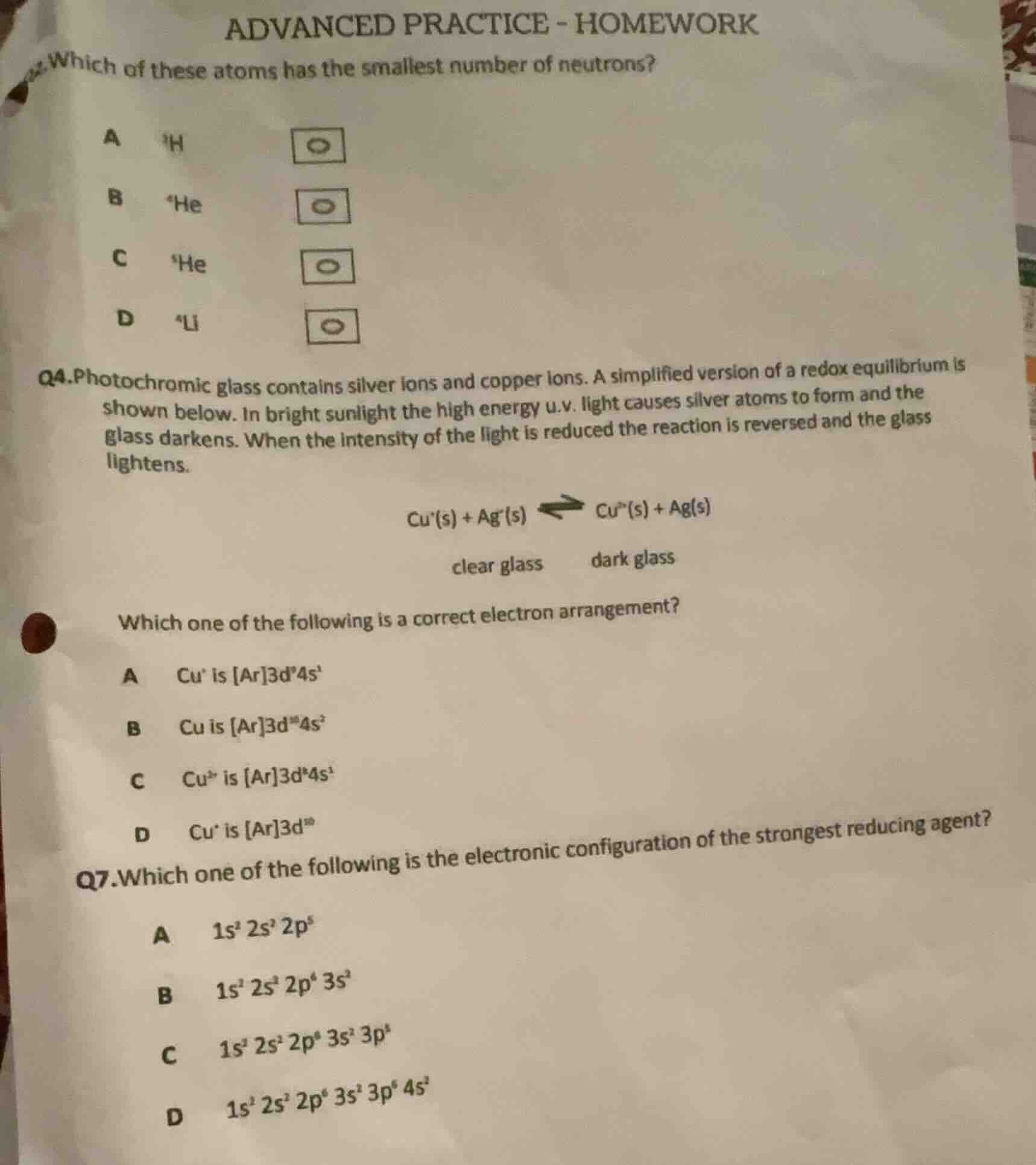
which of these atoms has the smallest number of neutrons?
a ¹h
b ⁴he
c ³he
d ⁴li
q4. photochromic glass contains silver ions and copper ions. a simplified version of a redox equilibrium is shown below. in bright sunlight the high energy u.v. light causes silver atoms to form and the glass darkens. when the intensity of the light is reduced the reaction is reversed and the glass lightens.
cu⁺(s) + ag⁺(s) ⇌ cu²⁺(s) + ag(s)
clear glass dark glass
which one of the following is a correct electron arrangement?
a cu⁺ is ar3d⁹4s¹
b cu is ar3d⁹4s²
c cu²⁺ is ar3d⁹4s¹
d cu⁺ is ar3d¹⁰
q7. which one of the following is the electronic configuration of the strongest reducing agent?
a 1s²2s²2p⁵
b 1s²2s²2p⁶3s²
c 1s²2s²2p⁶3s²3p⁵
d 1s²2s²2p⁶3s²3p⁶4s²
Q3 (Which of these atoms has the smallest number of neutrons?)
Step1: Recall neutron calculation formula
The number of neutrons in an atom is calculated by \( \text{Number of neutrons} = \text{Mass number} - \text{Atomic number} \). The atomic number (proton number) for H is 1, for He is 2, for Li is 3.
Step2: Calculate neutrons for each option
- Option A (\(^1\text{H}\)): Mass number = 1, Atomic number = 1. Neutrons = \( 1 - 1 = 0 \).
- Option B (\(^4\text{He}\)): Mass number = 4, Atomic number = 2. Neutrons = \( 4 - 2 = 2 \).
- Option C (\(^3\text{He}\)): Mass number = 3, Atomic number = 2. Neutrons = \( 3 - 2 = 1 \).
- Option D (\(^4\text{Li}\)): Mass number = 4, Atomic number = 3. Neutrons = \( 4 - 3 = 1 \).
- Option A: The electron configuration of \( \text{Cu} \) is \([\text{Ar}]3d^{10}4s^1\). When \( \text{Cu} \) loses one electron to form \( \text{Cu}^+ \), it loses the \( 4s^1 \) electron, so \( \text{Cu}^+ \) should be \([\text{Ar}]3d^{10}\), not \([\text{Ar}]3d^94s^1\). So A is incorrect.
- Option B: The correct electron configuration of \( \text{Cu} \) is \([\text{Ar}]3d^{10}4s^1\) (due to the stability of a full d - orbital), not \([\text{Ar}]3d^94s^2\). So B is incorrect.
- Option C: For \( \text{Cu}^{2+} \), \( \text{Cu} \) loses two electrons. It first loses the \( 4s^1 \) electron and then one \( 3d \) electron. So \( \text{Cu}^{2+} \) is \([\text{Ar}]3d^9\), not \([\text{Ar}]3d^94s^1\) (the \( 4s \) orbital is empty after losing electrons). Wait, maybe there is a typo, but among the given options, let's re - evaluate. Wait, actually, when forming \( \text{Cu}^+ \), it loses the \( 4s \) electron, so \( \text{Cu}^+ \) is \([\text{Ar}]3d^{10}\) (Option D: \( \text{Cu}^+ \) is \([\text{Ar}]3d^{10}\))? Wait, no, the option D says \( \text{Cu}^+ \) is \([\text{Ar}]3d^{10}\)? Wait, the original option D: "Cu⁺ is [Ar]3d¹⁰". Let's re - check:
The electron configuration of Cu (atomic number 29) is \( 1s^22s^22p^63s^23p^63d^{10}4s^1 \) or \([\text{Ar}]3d^{10}4s^1\). When Cu loses one electron to form \( \text{Cu}^+ \), it loses the \( 4s^1 \) electron, so \( \text{Cu}^+ \) has the configuration \([\text{Ar}]3d^{10}\). So Option D is correct. Wait, maybe I misread the options. Let's re - list the options:
A. \( \text{Cu}^+ \) is \([\text{Ar}]3d^94s^1\)
B. \( \text{Cu} \) is \([\text{Ar}]3d^94s^2\)
C. \( \text{Cu}^{2+} \) is \([\text{Ar}]3d^94s^1\)
D. \( \text{Cu}^+ \) is \([\text{Ar}]3d^{10}\)
So, the correct one is D. Because:
- \( \text{Cu} \): \([\text{Ar}]3d^{10}4s^1\)
- \( \text{Cu}^+ \): loses \( 4s^1 \) electron, so \([\text{Ar}]3d^{10}\)
- \( \text{Cu}^{2+} \): loses \( 4s^1 \) and one \( 3d \) electron, so \([\text{Ar}]3d^9\)
A reducing agent is a substance that loses electrons easily (is oxidized). Elements with lower ionization energy (more electropositive) are stronger reducing agents.
- Option A: \( 1s^22s^22p^5 \) is the electron configuration of F (fluorine). Fluorine is a strong oxidizing agent (it gains electrons easily), not a reducing agent.
- Option B: \( 1s^22s^22p^63s^2 \) is the electron configuration of Mg (magnesium). Mg has two valence electrons in the \( 3s \) orbital.
- Option C: \( 1s^22s^22p^63s^23p^5 \) is the electron configuration of Cl (chlorine). Chlorine is an oxidizing agent (gains electrons).
- Option D: \( 1s^22s^22p^63s^23p^64s^2 \) is the electron configuration of Ca (calcium).
Among Mg and Ca, Ca is more electropositive (lower ionization energy) because it has more electron shells, so the valence electrons are further from the nucleus and are easier to lose. So Ca (with electron configuration \( 1s^22s^22p^63s^23p^64s^2 \)) is a stronger reducing agent than Mg.

Snap & solve any problem in the app
Get step-by-step solutions on Sovi AI
Photo-based solutions with guided steps
Explore more problems and detailed explanations
A. \(^1\text{H}\)