QUESTION IMAGE
Question
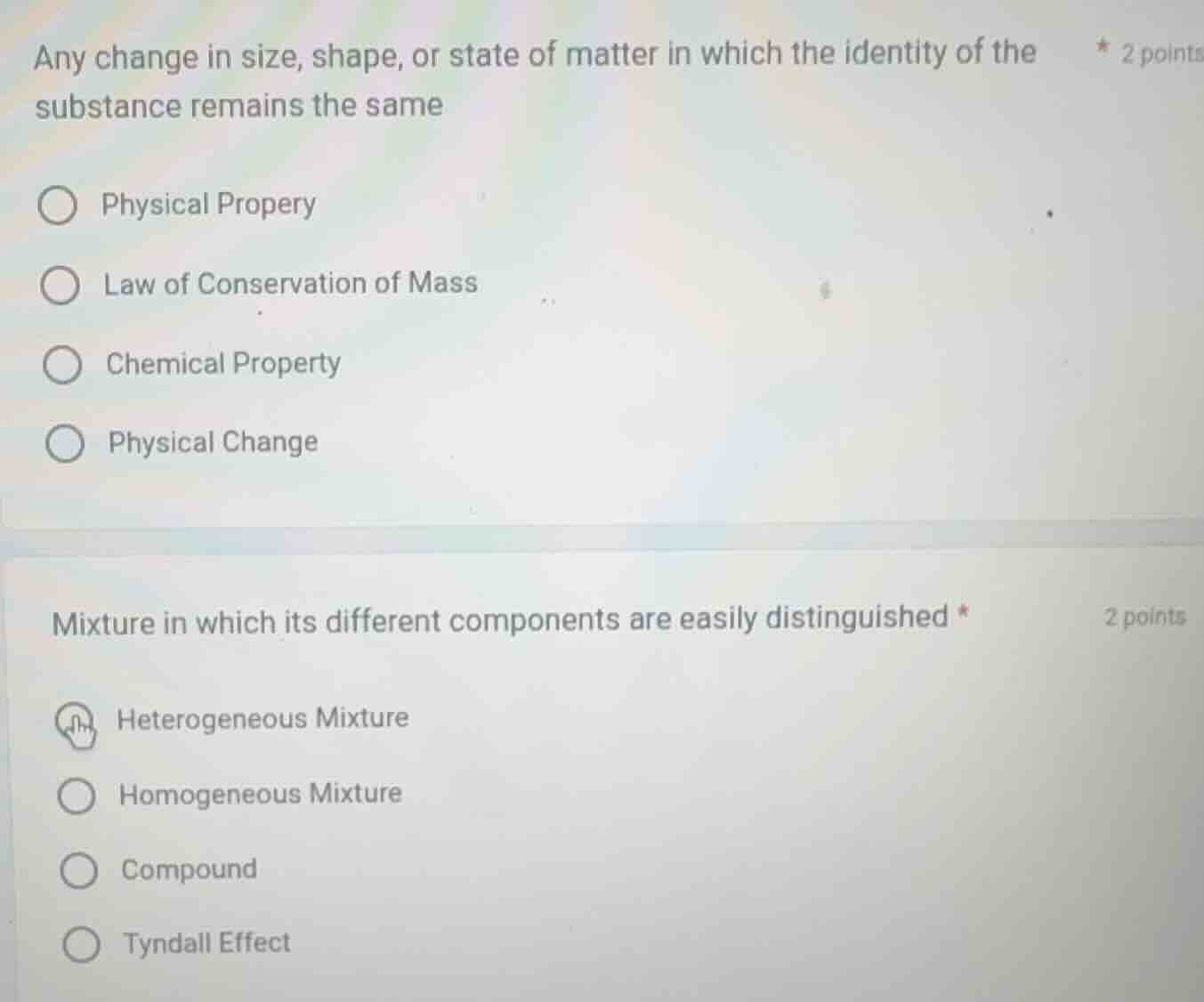
any change in size, shape, or state of matter in which the identity of the substance remains the same
physical propery
law of conservation of mass
chemical property
physical change
mixture in which its different components are easily distinguished
heterogeneous mixture
homogeneous mixture
compound
tyndall effect
Response
First Question:
Brief Explanations
- "Physical Property" refers to characteristics of a substance (like color, density) without changing its identity, not a change. Eliminate.
- "Law of Conservation of Mass" states mass is conserved in reactions, not related to the described change. Eliminate.
- "Chemical Property" describes a substance's ability to undergo chemical changes (like reactivity), not a change itself. Eliminate.
- "Physical Change" is a change in size, shape, or state (e.g., melting ice) where the substance's identity remains the same, matching the description.
Brief Explanations
- "Heterogeneous Mixture" is a mixture where components are not uniformly distributed and are easily distinguishable (e.g., salad). This matches the description.
- "Homogeneous Mixture" has uniform composition (e.g., salt water), components not easily distinguished. Eliminate.
- "Compound" is a substance with fixed composition (e.g., water), not a mixture. Eliminate.
- "Tyndall Effect" is the scattering of light by colloids, not related to mixture component distinction. Eliminate.

Snap & solve any problem in the app
Get step-by-step solutions on Sovi AI
Photo-based solutions with guided steps
Explore more problems and detailed explanations
D. Physical Change