QUESTION IMAGE
Question
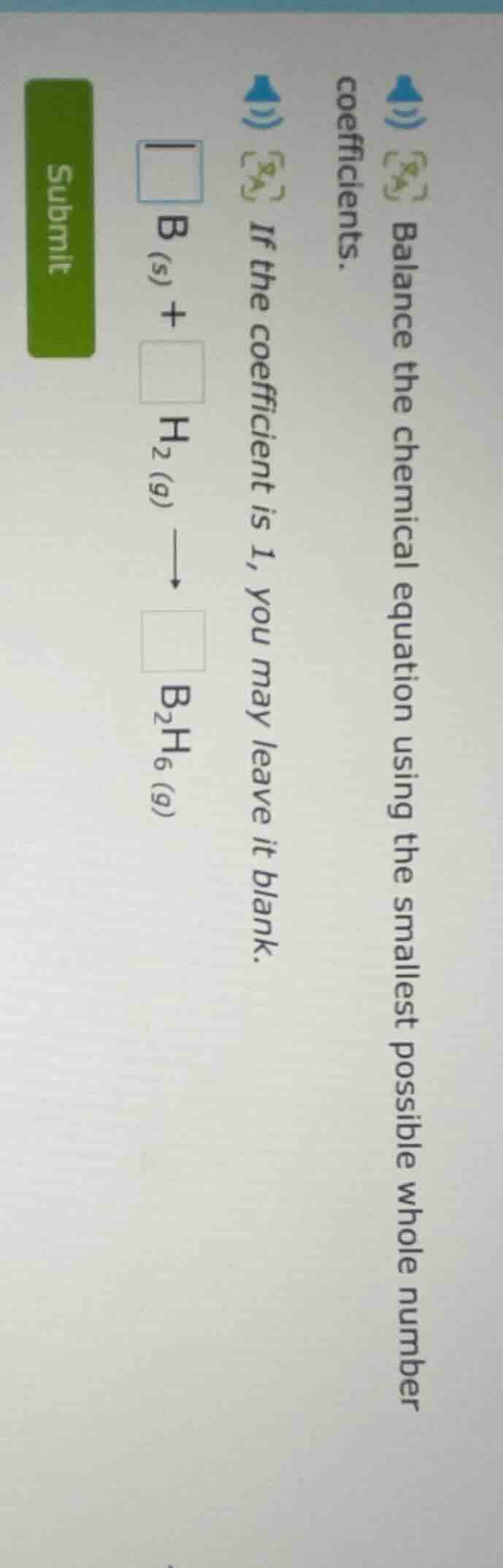
balance the chemical equation using the smallest possible whole number coefficients.
if the coefficient is 1, you may leave it blank.
\square b_{(s)} + \square h_2_{(g)} \
ightarrow \square b_2h_6_{(g)}
Step1: Balance boron atoms
On the product side, there are 2 B atoms in $\text{B}_2\text{H}_6$. So we need 2 B atoms on the reactant side:
$\boldsymbol{2}\ \text{B}_{(s)} + \square\ \text{H}_{2(g)}
ightarrow \square\ \text{B}_2\text{H}_{6(g)}$
Step2: Balance hydrogen atoms
On the product side, there are 6 H atoms in $\text{B}_2\text{H}_6$. Each $\text{H}_2$ has 2 H atoms, so we need $\frac{6}{2}=3$ $\text{H}_2$ molecules. The product has 1 $\text{B}_2\text{H}_6$ molecule to keep the smallest whole numbers:
$2\ \text{B}_{(s)} + \boldsymbol{3}\ \text{H}_{2(g)}
ightarrow \boldsymbol{1}\ \text{B}_2\text{H}_{6(g)}$
(Note: The coefficient 1 can be left blank as instructed.)

Snap & solve any problem in the app
Get step-by-step solutions on Sovi AI
Photo-based solutions with guided steps
Explore more problems and detailed explanations
First blank (B): 2
Second blank (H₂): 3
Third blank (B₂H₆): (blank, or 1)
Balanced equation: $\boldsymbol{2\ \text{B}_{(s)} + 3\ \text{H}_{2(g)}
ightarrow \text{B}_2\text{H}_{6(g)}}$