QUESTION IMAGE
Question
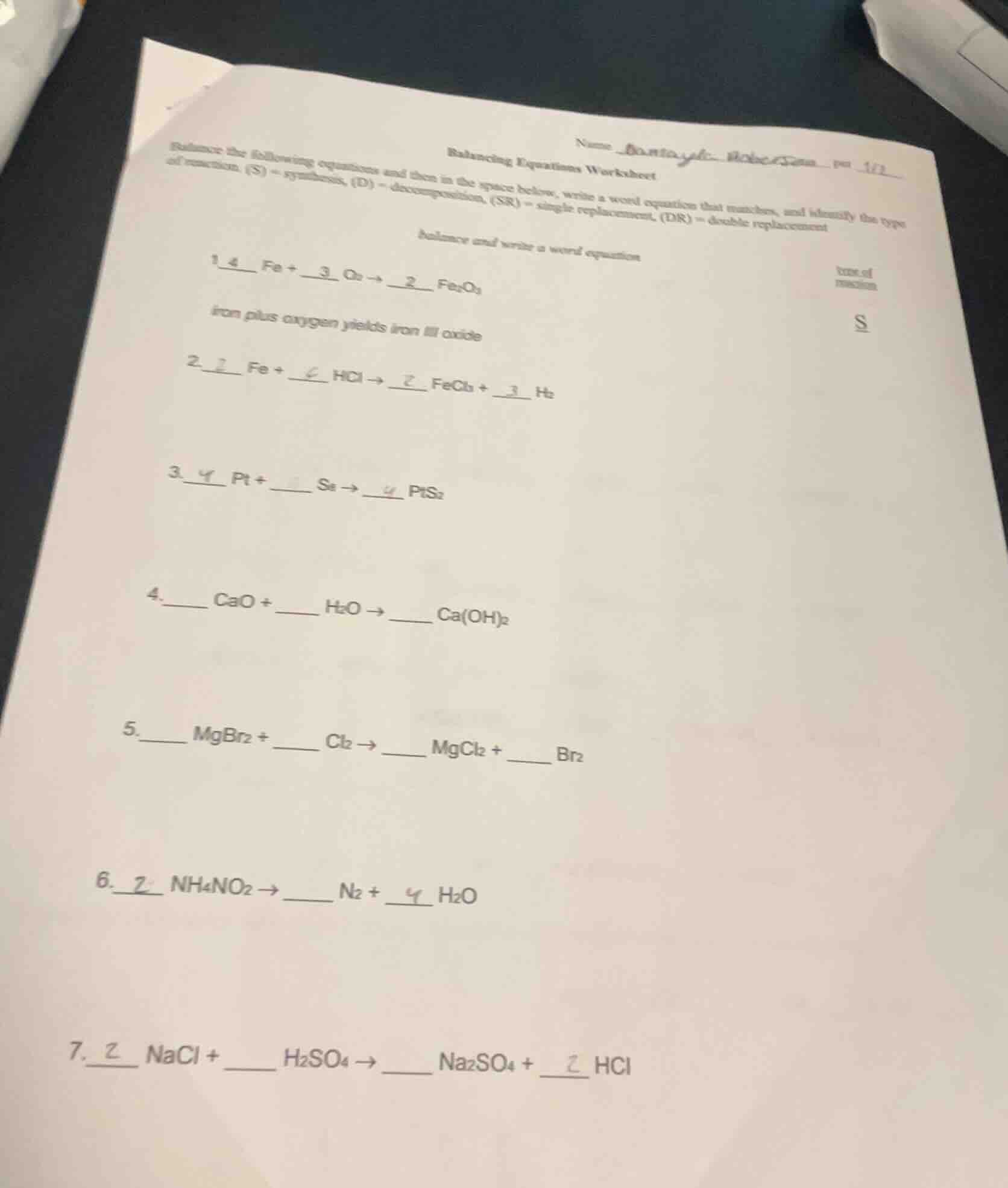
balancing equations worksheet
name
balance the following equations and then in the space below, write a word equation that matches, and identify the type of reaction. (s) = synthesis, (d) = decomposition, (sr) = single replacement, (dr) = double replacement
balance and write a word equation type of
reaction
- 4 fe + 3 o₂ → 2 fe₂o₃
iron plus oxygen yields iron iii oxide
s
- fe + hcl → fecl₃ + h₂
- pt + s₈ → pts₂
- cao + h₂o → ca(oh)₂
- mgbr₂ + cl₂ → mgcl₂ + br₂
- 2 nh₄no₂ → n₂ + 4 h₂o
- 2 nacl + h₂so₄ → na₂so₄ + 2 hcl
Problem 2: Balancing \( \boldsymbol{\text{Fe} + \text{HCl}
ightarrow \text{FeCl}_3 + \text{H}_2} \)
Step 1: Balance Fe atoms
On the left, we have 1 Fe atom. On the right, in \( \text{FeCl}_3 \), we have 1 Fe atom. Wait, no—wait, let's check again. Wait, the product is \( \text{FeCl}_3 \), so Fe on right is 1 per \( \text{FeCl}_3 \). Left: 1 Fe. So Fe is balanced? Wait, no, wait the user's initial has some numbers, but let's do it properly. Let's start over.
The unbalanced equation is \( \text{Fe} + \text{HCl}
ightarrow \text{FeCl}_3 + \text{H}_2 \).
First, balance Cl: On the right, \( \text{FeCl}_3 \) has 3 Cl. So we need 3 HCl on the left. So put 3 in front of HCl: \( \text{Fe} + 3\text{HCl}
ightarrow \text{FeCl}_3 + \text{H}_2 \).
Now balance H: On the left, 3 H (from 3 HCl). On the right, \( \text{H}_2 \) has 2 H. So we need to find a common multiple of 3 and 2, which is 6. So multiply HCl by 2: \( \text{Fe} + 2\text{HCl} \)? No, wait, let's do it step by step.
Wait, let's list the atoms:
- Fe: 1 (left) vs 1 (right, in \( \text{FeCl}_3 \)) → balanced for now.
- Cl: 1 (left, HCl) vs 3 (right, \( \text{FeCl}_3 \)) → need 3 HCl. So put 3 in front of HCl: \( \text{Fe} + 3\text{HCl}
ightarrow \text{FeCl}_3 + \text{H}_2 \).
- H: 3 (left, 3 HCl) vs 2 (right, \( \text{H}_2 \)) → to balance H, we need 6 H on both sides. So multiply HCl by 2: no, wait, 3 HCl gives 3 H, \( \text{H}_2 \) has 2 H. So the least common multiple of 3 and 2 is 6. So we need 6 H on left and right. So:
Left H: 3x (where x is coefficient of HCl) → 3x = 6 → x=2? No, wait, 3 HCl has 3 H, 2 HCl has 2 H. Wait, I'm confused. Let's use the method of balancing by changing coefficients.
Let’s denote the coefficients as \( a\text{Fe} + b\text{HCl}
ightarrow c\text{FeCl}_3 + d\text{H}_2 \).
- Fe: \( a = c \)
- Cl: \( b = 3c \)
- H: \( b = 2d \)
Let’s set \( c = 1 \) (so Fe is balanced: \( a = 1 \)). Then \( b = 3(1) = 3 \). Then H: \( b = 2d \) → 3 = 2d → d = 3/2. But we can't have fractions, so multiply all coefficients by 2 to eliminate fractions.
So \( a = 2 \), \( b = 6 \), \( c = 2 \), \( d = 3 \). Wait, no: if \( c = 2 \), then \( a = 2 \), \( b = 3(2) = 6 \), \( d = b/2 = 6/2 = 3 \). So the balanced equation is \( 2\text{Fe} + 6\text{HCl}
ightarrow 2\text{FeCl}_3 + 3\text{H}_2 \).
Wait, let's check:
- Fe: 2 (left) vs 2 (right) → balanced.
- Cl: 6 (left, 6 HCl) vs 6 (right, 2 FeCl₃ × 3 Cl) → balanced.
- H: 6 (left, 6 HCl) vs 6 (right, 3 H₂ × 2 H) → balanced.
So the balanced equation is \( 2\text{Fe} + 6\text{HCl}
ightarrow 2\text{FeCl}_3 + 3\text{H}_2 \).
Now, the word equation: Iron plus hydrochloric acid yields iron(III) chloride plus hydrogen.
Type of reaction: Single replacement (SR), because Fe replaces H in HCl.
Step 2: Verify
Check each atom:
- Fe: 2 on left, 2 on right (2 FeCl₃) → good.
- Cl: 6 on left (6 HCl), 6 on right (2×3) → good.
- H: 6 on left (6 HCl), 6 on right (3×2) → good.
Problem 3: Balancing \( \boldsymbol{\text{Pt} + \text{Se}
ightarrow \text{PtSe}_2} \)
Step 1: Balance Se atoms
On the left, Se is 1 (as a single atom). On the right, in \( \text{PtSe}_2 \), we have 2 Se atoms. So we need 2 Se on the left. So put 2 in front of Se: \( \text{Pt} + 2\text{Se}
ightarrow \text{PtSe}_2 \).
Now check Pt: 1 on left, 1 on right → balanced.
So the balanced equation is \( \text{Pt} + 2\text{Se}
ightarrow \text{PtSe}_2 \).
Word equation: Platinum plus selenium yields platinum(II) selenide (or platinum selenide, since Pt is +2 here? Wait, PtSe₂: Pt is +2, Se is -2. So word equation: Platinum plus selenium yields platinum selenide.
Type of reaction: Synthesis (S), because two substances combine to form one.
Step 2: Verify
- Pt: 1 left, 1 right → good.
- Se: 2 left (2 Se), 2 right (PtSe₂) → good.
Problem 4: Balancing \( \boldsymbol{\text{CaO} + \text{H}_2\text{O}
ightarrow \text{Ca(OH)}_2} \)
Step 1: Check each atom
- Ca: 1 (left, CaO) vs 1 (right, Ca(OH)₂) → balanced.
- O: 1 (CaO) + 1 (H₂O) = 2 O. On the right, Ca(OH)₂ has 2 O (from 2 OH⁻) → balanced.
- H: 2 (H₂O) vs 2 (Ca(OH)₂) → balanced.
Wait, so the equation is already balanced? Let's check:
\( \text{CaO} + \text{H}_2\text{O}
ightarrow \text{Ca(OH)}_2 \).
Atoms:
- Ca: 1 left, 1 right → good.
- O: 1 (CaO) + 1 (H₂O) = 2; right: 2 (Ca(OH)₂ has 2 O) → good.
- H: 2 (H₂O) → right: 2 (Ca(OH)₂ has 2 H) → good.
So coefficients are all 1: \( 1\text{CaO} + 1\text{H}_2\text{O}
ightarrow 1\text{Ca(OH)}_2 \).
Word equation: Calcium oxide plus water yields calcium hydroxide.
Type of reaction: Synthesis (S), because two substances combine to form one.
Step 2: Verify
All atoms balanced: Ca (1), O (2), H (2) on both sides.
Problem 5: Balancing \( \boldsymbol{\text{MgBr}_2 + \text{Cl}_2
ightarrow \text{MgCl}_2 + \text{Br}_2} \)

Snap & solve any problem in the app
Get step-by-step solutions on Sovi AI
Photo-based solutions with guided steps
Explore more problems and detailed explanations
Step 1: Balance Na atoms
On the left, 1 Na (in NaCl). On the right, \( \text{Na}_2\text{SO}_4 \) has 2 Na. So put 2 in front of NaCl: \( 2\text{NaCl} + \text{H}_2\text{SO}_4
ightarrow \text{Na}_2\text{SO}_4 + \text{HCl} \).
Step 2: Balance Cl atoms
On the left, 2 Cl (from 2 NaCl). On the right, \( \text{HCl} \) has 1 Cl. So put 2 in front of HCl: \( 2\text{NaCl} + \text{H}_2\text{SO}_4
ightarrow \text{Na}_2\text{SO}_4 + 2\text{HCl} \).
Step 3: Check other atoms
- S: 1 (left, \( \text{H}_2\text{SO}_4 \)) vs 1 (right, \( \text{Na}_2\text{SO}_4 \)) → balanced.
- H: 2 (left, \( \text{H}_2\text{SO}_4 \)) vs 2 (right, 2 HCl) → balanced.
- O: 4 (left, \( \text{H}_2\text{SO}_4 \)) vs 4 (right, \( \text{Na}_2\text{SO}_4 \)) → balanced.
So the balanced equation is \( 2\text{NaCl} + 1\text{H}_2\text{SO}_4
ightarrow 1\text{Na}_2\text{SO}_4 + 2\text{HCl} \).
Word equation: Sodium chloride plus sulfuric acid yields sodium sulfate plus hydrochloric acid.
Type of reaction: Double replacement (DR), because Na and H swap partners (Na from NaCl to Na₂SO₄, H from H₂SO₄ to HCl).
Step 2: Verify
- Na: 2 (left, 2 NaCl) vs 2 (right, Na₂SO₄) → good.
- Cl: 2 (left, 2 NaCl) vs 2 (right, 2 HCl) → good.
- S: 1 (left, H₂SO₄) vs 1 (right, Na₂SO₄) → good.
- H: 2 (left, H₂SO₄) vs 2 (right, 2 HCl) → good.
- O: 4 (left, H₂SO₄) vs 4 (right, Na₂SO₄) → good.
Final Answers (Balanced Equations):
- \( \boldsymbol{2\text{Fe} + 6\text{HCl}
ightarrow 2\text{FeCl}_3 + 3\text{H}_2} \) (Word: Iron + Hydrochloric Acid → Iron(III) Chloride + Hydrogen; Type: SR)
- \( \boldsymbol{\text{Pt} + 2\text{Se}
ightarrow \text{PtSe}_2} \) (Word: Platinum + Selenium → Platinum Selenide; Type: S)
- \( \boldsymbol{\text{CaO} + \text{H}_2\text{O}
ightarrow \text{Ca(OH)}_2} \) (Word: Calcium Oxide + Water → Calcium Hydroxide; Type: S)
- \( \boldsymbol{\text{MgBr}_2 + \text{Cl}_2
ightarrow \text{MgCl}_2 + \text{Br}_2} \) (Word: Magnesium Bromide + Chlorine → Magnesium Chloride + Bromine; Type: SR)
- \( \boldsymbol{\text{NH}_4\text{NO}_2
ightarrow \text{N}_2 + 2\text{H}_2\text{O}} \) (Word: Ammonium Nitrite → Nitrogen + Water; Type: D)
- \( \boldsymbol{2\text{NaCl} + \text{H}_2\text{SO}_4
ightarrow \text{Na}_2\text{SO}_4 + 2\text{HCl}} \) (Word: Sodium Chloride + Sulfuric Acid → Sodium Sulfate + Hydrochloric Acid; Type: DR)