QUESTION IMAGE
Question
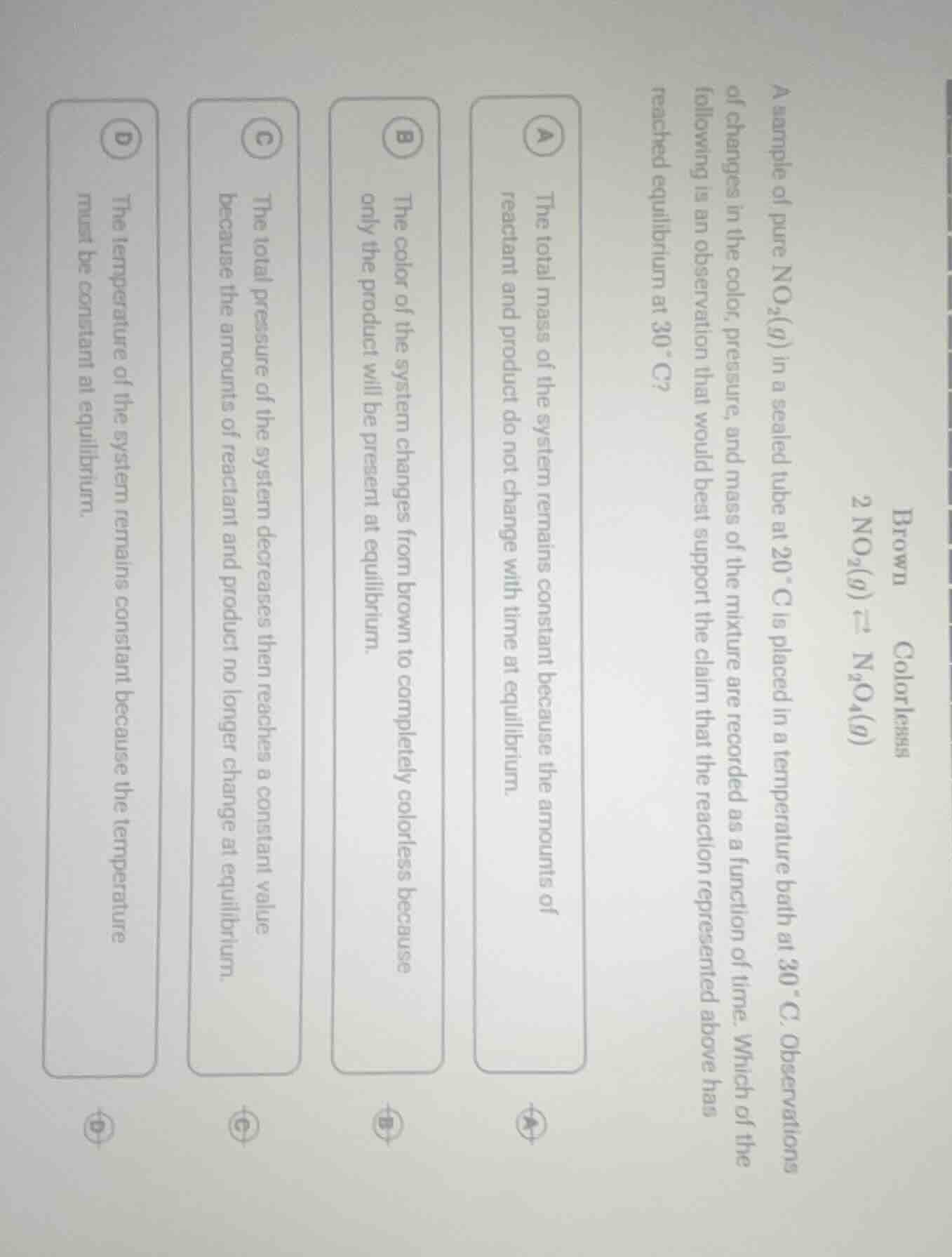
brown colorless \\(\ce{2no_{2}(g) \
ightleftharpoons n_{2}o_{4}(g)}\\) a sample of pure \\(\ce{no_{2}(g)}\\) in a sealed tube at \\(20^{\circ}\text{c}\\) is placed in a temperature bath at \\(30^{\circ}\text{c}\\). observations of changes in the color, pressure, and mass of the mixture are recorded as a function of time. which of the following is an observation that would best support the claim that the reaction represented above has reached equilibrium at \\(30^{\circ}\text{c}\\)? a the total mass of the system remains constant because the amounts of reactant and product do not change with time at equilibrium. b the color of the system changes from brown to completely colorless because only the product will be present at equilibrium. c the total pressure of the system decreases then reaches a constant value because the amounts of reactant and product no longer change at equilibrium. d the temperature of the system remains constant because the temperature must be constant at equilibrium.
To determine the correct option, we analyze each choice based on chemical equilibrium concepts:
- Option A: In a sealed system, mass is conserved (Law of Conservation of Mass). At equilibrium, the rates of forward and reverse reactions are equal, so the amounts of reactant and product stop changing. This matches the definition of equilibrium.
- Option B: The reaction is in equilibrium (not complete), so both reactant ($\ce{NO2}$, brown) and product ($\ce{N2O4}$, colorless) are present. A complete color change to colorless would imply the reaction went to completion, which is not true for equilibrium. Eliminate B.
- Option C: For the reaction $\ce{2NO2(g) <=> N2O4(g)}$, the number of moles of gas decreases (2 moles $\ce{NO2}$ to 1 mole $\ce{N2O4}$). As the reaction proceeds towards equilibrium, pressure (related to moles of gas) decreases until equilibrium is reached (constant pressure). This observation supports equilibrium. Wait, but let's re - evaluate. Wait, the question is which observation supports equilibrium. Wait, no, let's check again. Wait, the reaction is $\ce{2NO2(g) <=> N2O4(g)}$. At equilibrium, the amounts of reactant and product are constant, so pressure (which depends on moles of gas) becomes constant. But let's check Option A again. Option A says total mass is constant (which is always true in a sealed system, not just at equilibrium) and amounts of reactant and product do not change with time (which is true at equilibrium). Wait, maybe I made a mistake. Wait, the key is that at equilibrium, the concentrations (or amounts) of reactants and products remain constant because the forward and reverse rates are equal. The total mass is always constant in a sealed system, so the first part of A is always true, but the second part (amounts of reactant and product do not change with time) is true at equilibrium. Now, Option C: The total pressure decreases then becomes constant. Since the reaction has a change in moles of gas (2 moles $\ce{NO2}$ to 1 mole $\ce{N2O4}$), as the reaction proceeds towards equilibrium (from pure $\ce{NO2}$ initially), the moles of gas decrease, so pressure decreases until equilibrium is reached (constant pressure). This also supports equilibrium. Wait, but the question is which is the best observation. Wait, no, let's re - examine the options. Wait, the reaction starts with pure $\ce{NO2}$ (brown) at 20°C, then is placed at 30°C. Let's think about the equilibrium state. At equilibrium, the macroscopic properties (like color, pressure, concentration) are constant because the rates of forward and reverse reactions are equal.
- Option D: The temperature of the system is constant because the temperature of the bath is constant, not because of equilibrium. The system is in a temperature bath, so the temperature is controlled by the bath, not by the equilibrium (which involves energy changes, but the bath keeps T constant). So D is incorrect.
Now, between A and C:
- For Option A: The total mass is always constant in a sealed system (conservation of mass), so the fact that mass is constant doesn't prove equilibrium. The second part (amounts of reactant and product don't change with time) does prove equilibrium.
- For Option C: The pressure decreases as the reaction proceeds (since moles of gas decrease) until equilibrium is reached (constant pressure). This also proves equilibrium. But wait, the reaction is $\ce{2NO2(g) <=> N2O4(g)}$. When the system reaches equilibrium, the rate of forward reaction ( $\ce{2NO2 -> N2O4}$ ) equals the rate of reverse reaction ( $\ce{N2O4 -> 2NO2}$ ). So the amounts of $\…

Snap & solve any problem in the app
Get step-by-step solutions on Sovi AI
Photo-based solutions with guided steps
Explore more problems and detailed explanations
C. The total pressure of the system decreases then reaches a constant value because the amounts of reactant and product no longer change at equilibrium.