QUESTION IMAGE
Question
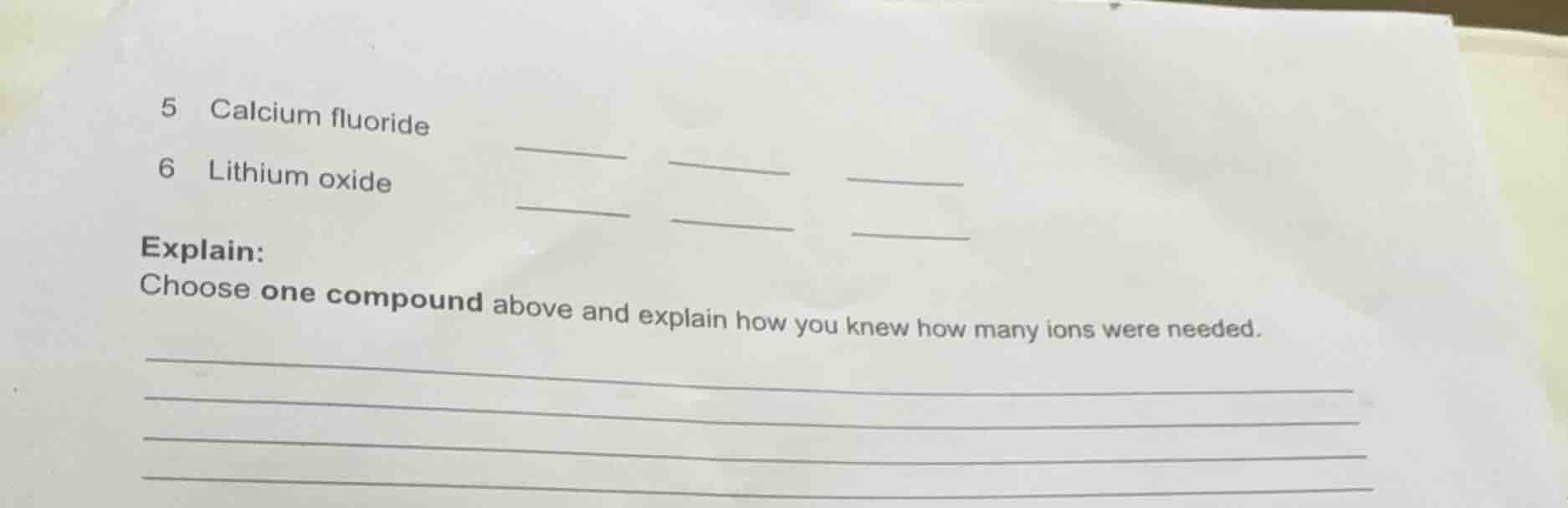
5 calcium fluoride
6 lithium oxide
explain:
choose one compound above and explain how you knew how many ions were needed.
First, we use the principle of charge neutrality: ionic compounds have a net charge of 0. For calcium fluoride, calcium (Ca) is in group 2, so it forms a +2 cation ($\text{Ca}^{2+}$). Fluorine (F) is in group 17, forming a -1 anion ($\text{F}^-$). To balance the +2 charge of Ca, we need 2 F⁻ ions, since $2 + (2 \times -1) = 0$. For lithium oxide, lithium (Li) is group 1, forming +1 cations ($\text{Li}^+$). Oxygen (O) is group 16, forming -2 anions ($\text{O}^{2-}$). To balance the -2 charge of O, we need 2 Li⁺ ions, since $(2 \times +1) + (-2) = 0$. We choose calcium fluoride for the explanation.

Snap & solve any problem in the app
Get step-by-step solutions on Sovi AI
Photo-based solutions with guided steps
Explore more problems and detailed explanations
- Calcium fluoride formula: $\text{CaF}_2$
- Explanation: Calcium forms a +2 cation ($\text{Ca}^{2+}$), fluorine forms a -1 anion ($\text{F}^-$). To achieve a neutral compound (net charge 0), 2 fluoride ions are needed to balance the +2 charge of one calcium ion, as $+2 + (2 \times -1) = 0$.